
🛒 Where to Buy
⚠️ Golden Rule of Retro Handhelds: Throw away the cheap MicroSD card that comes in the box — it will fail. And never use a high-wattage PD “Fast Charger” on these devices; it can damage the battery. Use a standard 5V/1.5A brick.
Device Overview: Retroid Pocket Classic
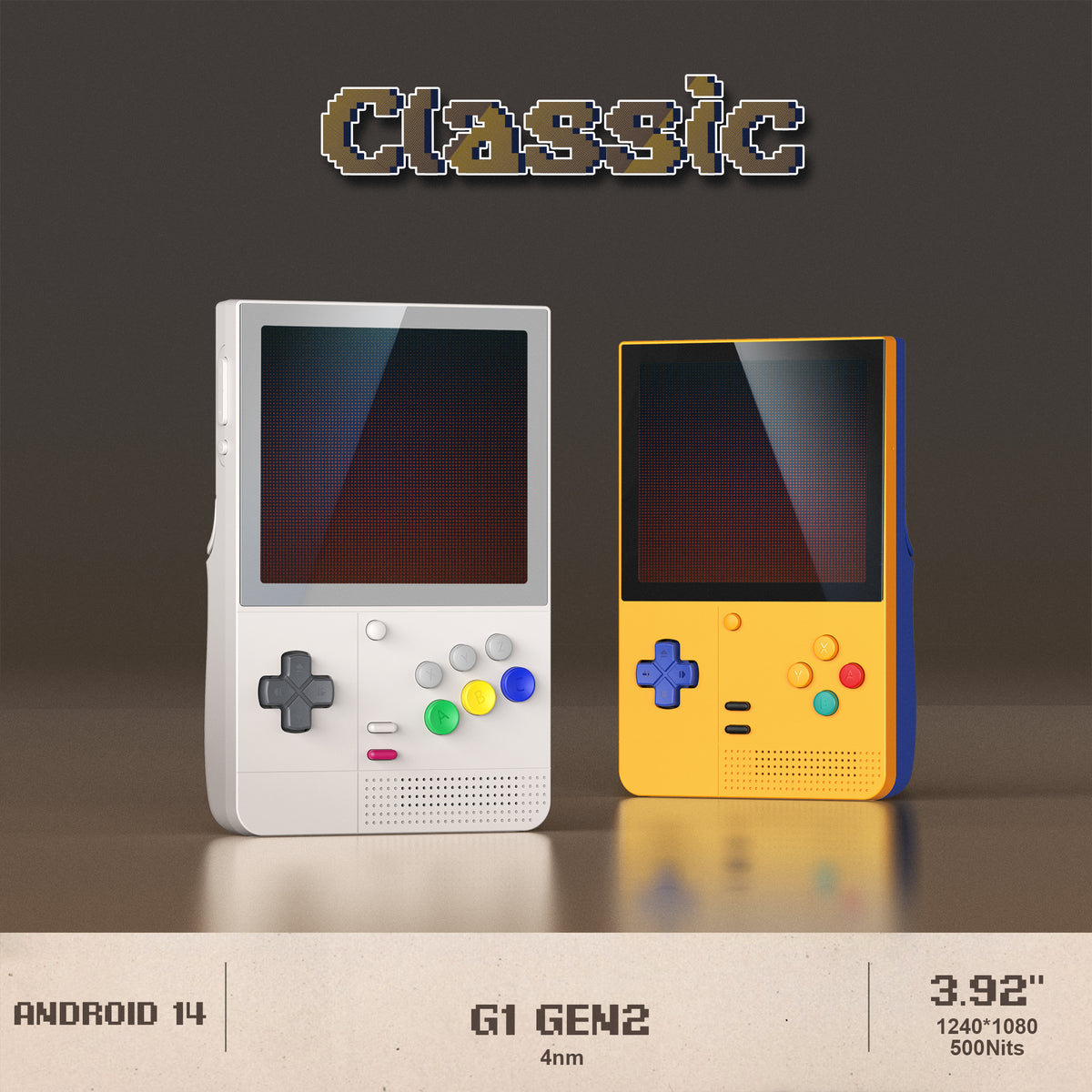
The Retroid Pocket Classic is Retroid’s answer to a specific fantasy: a Game Boy shape wrapped around a modern Qualcomm chip and, more importantly, one of the best small screens ever bolted to a retro handheld. It launched on 17 March 2025 at $119 for the 4GB/64GB model and $129 for 6GB/128GB, and it runs Android 14 rather than a stripped Linux distro. The pitch is narrow and deliberate. This is a vertical, portrait-orientation device with no analog stick anywhere on it, built for people whose backlog is 2D and who would rather carry a pocketable slab than a 3D-capable brick. Retroid has made this same move before with the Mini line, but the Classic pushes the idea further by pairing that portrait shape with a genuinely flagship-grade display.
Emulation performance, generation by generation
The Snapdragon G1 Gen 2 (eight Kryo cores, two performance plus six efficiency, paired with an Adreno A12 GPU) is the same silicon Retroid uses in the Pocket Mini V2 and Flip 2, so its ceiling is well understood. Everything through the 16-bit era is trivial: Game Boy, GBC, GBA, NES, SNES, Genesis, PC Engine, Neo Geo and CPS arcade all run at full speed in RetroArch with headroom for shaders and run-ahead. PlayStation 1 is a solved problem in DuckStation, upscaled and stable. From there it becomes a question of how hard the emulator leans on the CPU. Dreamcast via Flycast or Redream is largely excellent, PSP in PPSSPP handles most of its library at 2x-3x resolution, and Saturn — historically a nightmare — is genuinely playable here through the Beetle and Yaba Sanshiro cores, which is a real selling point given the six-button variant. Nintendo 64 (Mupen64Plus) and Nintendo DS (DraStic, MelonDS) sit in the “mostly good, some fussy titles” band. GameCube and Wii on Dolphin, plus PS2 on AetherSX2/NetherSX2, will boot and some games run well, but two things hold them back: this is a mid-tier mobile chip, not a Snapdragon 8-series, and there is no stick to steer a 3D camera. Treat GameCube and PS2 as a bonus, not the reason you buy, and expect to spend time hunting per-game settings rather than assuming a whole library just works.
Screen, build and controls
The screen is the headline and it earns it. It is a 3.92-inch AMOLED at 1240×1080, roughly a 31:27 near-square panel at about 419 PPI — the same display used in the far pricier AYANEO Pocket DMG. On OLED, GB and GBC sprites get true blacks and punchy colour, and the tall aspect ratio suits portrait systems and vertical arcade shooters better than any 16:9 handheld can. The body is plastic, weighs 223 grams and measures roughly 90 x 138 x 26 mm, with an active cooling fan inside to keep the chip from throttling. Controls are a Vita-style top-mounted D-pad, face buttons, and an in-line L1/L2/R1/R2 arrangement with short travel; there is a gyro and a touchscreen but, again, no analog stick and no Hall-effect anything. Retroid sells two versions: a standard four-button layout and a six-button “Classic 6” with an A/B/C, X/Y/Z arrangement aimed squarely at Sega Genesis and Saturn fighters. The D-pad is clean with no false diagonals, which matters more here than on most devices.
Software and setup
Because this is an Android 14 device, the Linux custom-firmware scene most retro handhelds live in — muOS, Knulli, ArkOS, ROCKNIX, OnionOS — simply does not apply. You are not flashing an SD card image here. Instead you get Retroid’s own launcher and the full Android emulator stack: RetroArch for everything 2D and PS1, standalone DuckStation, Flycast, PPSSPP, DraStic, Dolphin and NetherSX2 for the heavier systems, and a proper frontend such as ES-DE or Daijisho to tie your library together with box art. Setup is closer to configuring a phone than flashing firmware, which is friendlier for newcomers but still means the usual per-emulator tuning of controls, aspect ratio and shaders. The upside of Android is a real browser, streaming apps and the Play Store; the downside is the occasional update prompt and Google-account nagging on what is otherwise a dedicated retro toy.
Price, value and who it is for
At its $119-$129 launch pricing the Classic undercuts the AYANEO Pocket DMG dramatically while using the same panel, and it comfortably outclasses Linux minis like the Miyoo Mini Plus in both screen and horsepower. (Note the official store has since listed configurations as high as $149, so check the exact SKU before buying.) The people who should buy it know who they are: anyone whose ideal session is Game Boy, GBC, GBA, SNES, Genesis, PS1, Saturn or vertical arcade in a shirt-pocket form factor, with Dreamcast and PSP as generous extras. If your library is N64, GameCube and PS2 3D platformers, the missing stick is a dealbreaker and a horizontal device like the Retroid Pocket 5 makes far more sense. Bought for what it actually is — the best 2D vertical handheld screen at a mid-range price — it is very hard to argue with.
📐 Size & Pocketability
⚖️ Weight vs Other Handhelds
🔋 Real-World Battery Estimator
⭐ Emulation Performance
📊 View How This Score is Calculated
The Hardware Power Score is an absolute metric. Perfect emulation of difficult, modern consoles awards significantly more points than standard retro consoles.
- 15× Multiplier: Modern PC
- 12× Multiplier: Switch, PS3, Xbox 360
- 10× Multiplier: Wii U
- 8× Multiplier: PS2, GameCube, Wii, Xbox
- 5× Multiplier: Saturn, Dreamcast, PSP
- 3× Multiplier: N64, PS1
- 1× Multiplier: SNES, GBA
Gen 8 & PC
Generation 7
Generation 6
Generation 5
Handhelds & Retro
📋 Full Specifications
📺 Display
⚙️ Platform
💾 Memory
🕹️ Controls
📏 Body
🔋 Battery
⚖️ Verdict
✅ The Good
- Best-in-class 3.92-inch 1240×1080 AMOLED, the same panel as the AYANEO Pocket DMG, at a fraction of the price
- Snapdragon G1 Gen 2 clears every 2D system plus PS1 with ease, and reaches into Dreamcast, PSP and Saturn
- Tall near-square screen and a false-diagonal-free D-pad are ideal for portrait systems, arcade and 2D fighters
- Optional six-button "Classic 6" layout is genuinely useful for Sega Genesis and Saturn titles
❌ The Bad
- No analog stick at all makes N64, GameCube, PS2 and Dreamcast 3D games awkward to unplayable
- Android 14 means per-emulator setup and account/update friction rather than plug-and-play custom firmware
- Plastic build and a short "chin" below the screen can feel cramped in larger hands
📰 Latest News & Guides
The Ultimate Guide to ARMSX3: Android’s New PS3 Emulator, Competitor Comparisons, and Setup Tutorial
18/08/2026Pokémon Gold, Silver, and Crystal (Gen 2) Recomp Lands on Android
17/08/2026How to Play the Pokémon Red, Blue, or Yellow Recomp on Your Android, Windows, and Linux Devices
16/08/2026🔍 Similar Handhelds
Other handhelds that emulate up to PS2.