
🛒 Where to Buy
⚠️ Golden Rule of Retro Handhelds: Throw away the cheap MicroSD card that comes in the box — it will fail. And never use a high-wattage PD “Fast Charger” on these devices; it can damage the battery. Use a standard 5V/1.5A brick.
Device Overview: KinHank K56
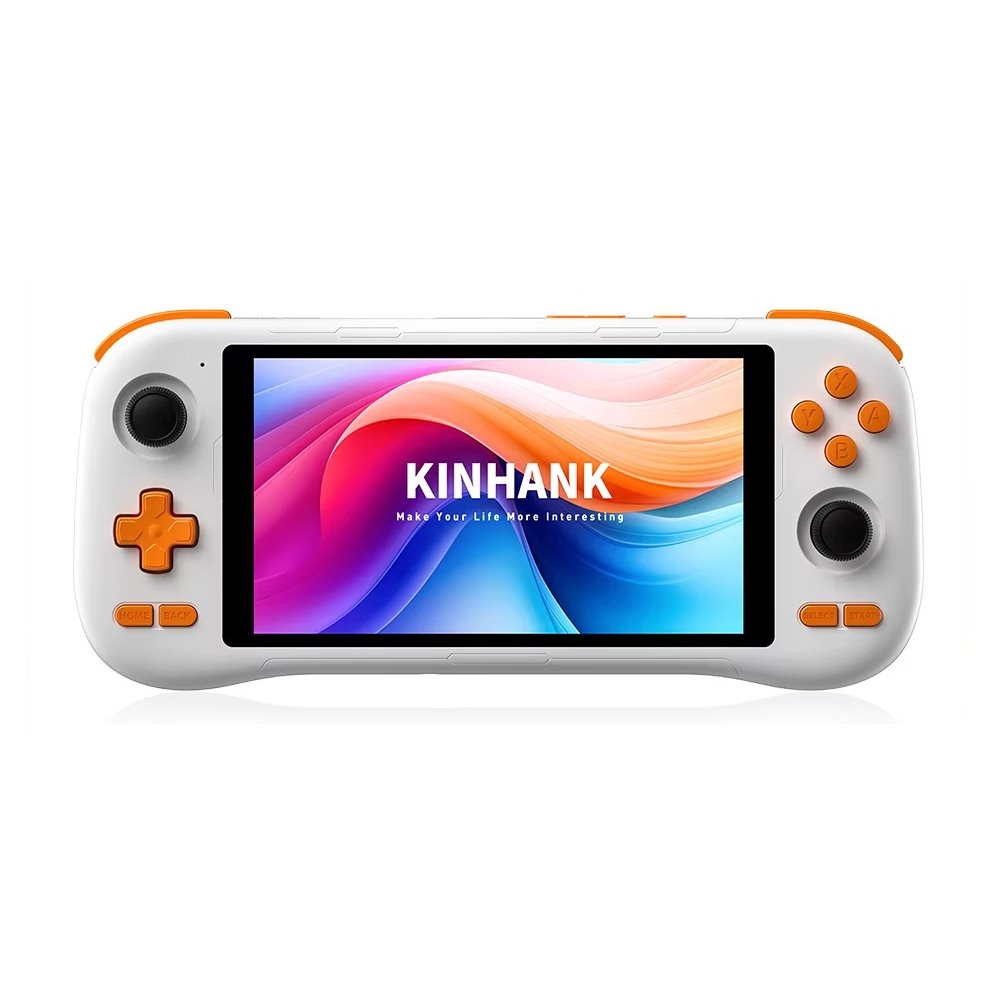
The KinHank K56 is a horizontal Android handheld that arrived in April 2025 at roughly $130 to $150, built around the Unisoc Tiger T620 rather than the Snapdragon or Dimensity silicon that powers the handhelds enthusiasts actually chase. That single choice defines it. The T620 is a budget tablet chip, and no amount of competent industrial design changes what it can and cannot emulate. KinHank sells this as a grab-and-play device loaded with thousands of games, and for a first-time buyer who never wants to open a settings menu, that pitch mostly holds. For anyone who has owned a Retroid Pocket, it reads as a device priced a tier above its hardware.
Emulation performance, generation by generation
The T620 pairs two Cortex-A75 cores with six Cortex-A55 cores and a single-core Mali-G57 GPU clocked at 850 MHz. In plain terms: everything through the fifth generation is effortless. NES, SNES, Genesis, Game Boy Advance, PS1 and the full DS library run at full speed in RetroArch or standalone cores with headroom to spare. Nintendo 64 is solid on the well-behaved titles through Mupen, PSP is comfortable at 2x or 3x internal resolution in PPSSPP, and Dreamcast via Flycast is the highest system the K56 handles without asterisks. GameCube is where the honesty starts. Dolphin boots many games and runs the lighter ones at playable speeds, but heavier first-party titles stutter and you will tune per game rather than just play. PlayStation 2 through AetherSX2 or the NetherSX2 fork is genuinely hit or miss, fine for 2D and simpler 3D games and a slideshow for the demanding ones. Saturn is playable within Beetle’s limits. Do not buy this for Switch or Wii; the T620 is not that class of chip, and any listing implying otherwise is marketing.
Screen, build and controls
The 5.5-inch IPS panel is the K56’s strongest single component: a genuine 1920×1080 at 60 Hz, roughly 400 PPI, with colour and contrast that outclass the 720p screens on cheaper rivals. The catch is the 16:9 shape, which suits PSP and widescreen Android games but pillarboxes the 4:3 retro libraries this device otherwise targets. The shell is plastic and weighs about 307 grams across a 212 x 90 x 17 mm body; reviewers have flagged a loose battery that rattles and menu buttons loud enough to notice, the sort of finish you forgive at $80 and question at $150. Controls are a mixed bag done mostly right: Hall-effect analog sticks (drift-immune but sized like the small Switch 1 sticks), a soft-click d-pad in the Retroid/AYN mould, and face buttons with decent tension. The triggers are the weak point, digital rather than analog and described as simultaneously mushy and clicky, which matters for racing games and PSP titles that expect pressure sensitivity.
Software and setup
This is an Android 14 device, and that distinction governs everything about living with it. It ships with a KinHank ES-DE build and the Pegasus front-end over a microSD stuffed with ROMs, drawing on 6 GB of LPDDR4X and 128 GB of UFS 2.0 storage. The preloaded ES-DE is stripped of theme support, so you get a monochrome text menu instead of the boxart-driven interface the format is known for, an odd corner to cut on a device sold on presets. Because the K56 runs Android on Unisoc silicon, the Linux custom-firmware ecosystem does not apply: there is no muOS, Knulli, ROCKNIX or ArkOS for this chip, and anyone expecting that scene should look at Rockchip or Allwinner Linux handhelds instead. The real path to improvement here is Android-native: install Daijisho or Beacon as a nicer front-end, pull standalone emulators (PPSSPP, Dolphin, DuckStation, AetherSX2/NetherSX2, Flycast) from their own builds, and lean on RetroArch for the older systems. Full Google Play access means Android games and streaming apps work too.
Price, value and who it is for
At $130 to $150 the K56 sits in an awkward spot. A Retroid Pocket in the same bracket ships with a stronger Snapdragon or Dimensity chip and cleaner GameCube and PS2 performance, which is exactly the ceiling buyers at this price tend to care about. What the K56 offers instead is a very good 1080p screen, drift-proof Hall sticks, and a genuinely no-setup out-of-box experience for someone who wants to press power and see Mario. That is a real audience: the relative or gift-buyer who wants retro games through PSP and Dreamcast without watching a firmware tutorial. Tinkerers and value hunters are better served elsewhere. Buy the K56 for the panel and the plug-and-play convenience, go in knowing its practical ceiling is Dreamcast and PSP with GameCube as a stretch, and treat the on-box game counts as the marketing they are.
📐 Size & Pocketability
⚖️ Weight vs Other Handhelds
🔋 Real-World Battery Estimator
⭐ Emulation Performance
📊 View How This Score is Calculated
The Hardware Power Score is an absolute metric. Perfect emulation of difficult, modern consoles awards significantly more points than standard retro consoles.
- 15× Multiplier: Modern PC
- 12× Multiplier: Switch, PS3, Xbox 360
- 10× Multiplier: Wii U
- 8× Multiplier: PS2, GameCube, Wii, Xbox
- 5× Multiplier: Saturn, Dreamcast, PSP
- 3× Multiplier: N64, PS1
- 1× Multiplier: SNES, GBA
Generation 7
Generation 6
Generation 5
Handhelds & Retro
📋 Full Specifications
📺 Display
⚙️ Platform
💾 Memory
🕹️ Controls
📏 Body
🔋 Battery
⚖️ Verdict
✅ The Good
- Excellent 5.5-inch 1080p 60 Hz IPS panel, sharper and more vivid than the 720p screens on similarly priced rivals
- Hall-effect analog sticks that will not develop drift, paired with a well-judged soft-click d-pad
- True plug-and-play: Android 14 with Pegasus/ES-DE and a ROM-loaded card mean it works out of the box, plus full Google Play access
- Runs everything through Dreamcast, N64 and PSP at full speed with headroom to spare
❌ The Bad
- Unisoc T620 is a budget chip: GameCube is inconsistent and PS2 is genuinely hit or miss, short of price-matched Retroid Pockets
- Build quality (rattling battery, loud buttons, plastic shell) feels like an $80 device at a $130-150 price
- Digital, mushy triggers, and being Android-on-Unisoc it is locked out of the muOS/Knulli/ROCKNIX custom-firmware scene
📰 Latest News & Guides
The Ultimate Guide to ARMSX3: Android’s New PS3 Emulator, Competitor Comparisons, and Setup Tutorial
18/08/2026Pokémon Gold, Silver, and Crystal (Gen 2) Recomp Lands on Android
17/08/2026How to Play the Pokémon Red, Blue, or Yellow Recomp on Your Android, Windows, and Linux Devices
16/08/2026🔍 Similar Handhelds
Other handhelds that emulate up to Saturn.