
🛒 Where to Buy
⚠️ Golden Rule of Retro Handhelds: Throw away the cheap MicroSD card that comes in the box — it will fail. And never use a high-wattage PD “Fast Charger” on these devices; it can damage the battery. Use a standard 5V/1.5A brick.
Device Overview: Retroid Pocket 6
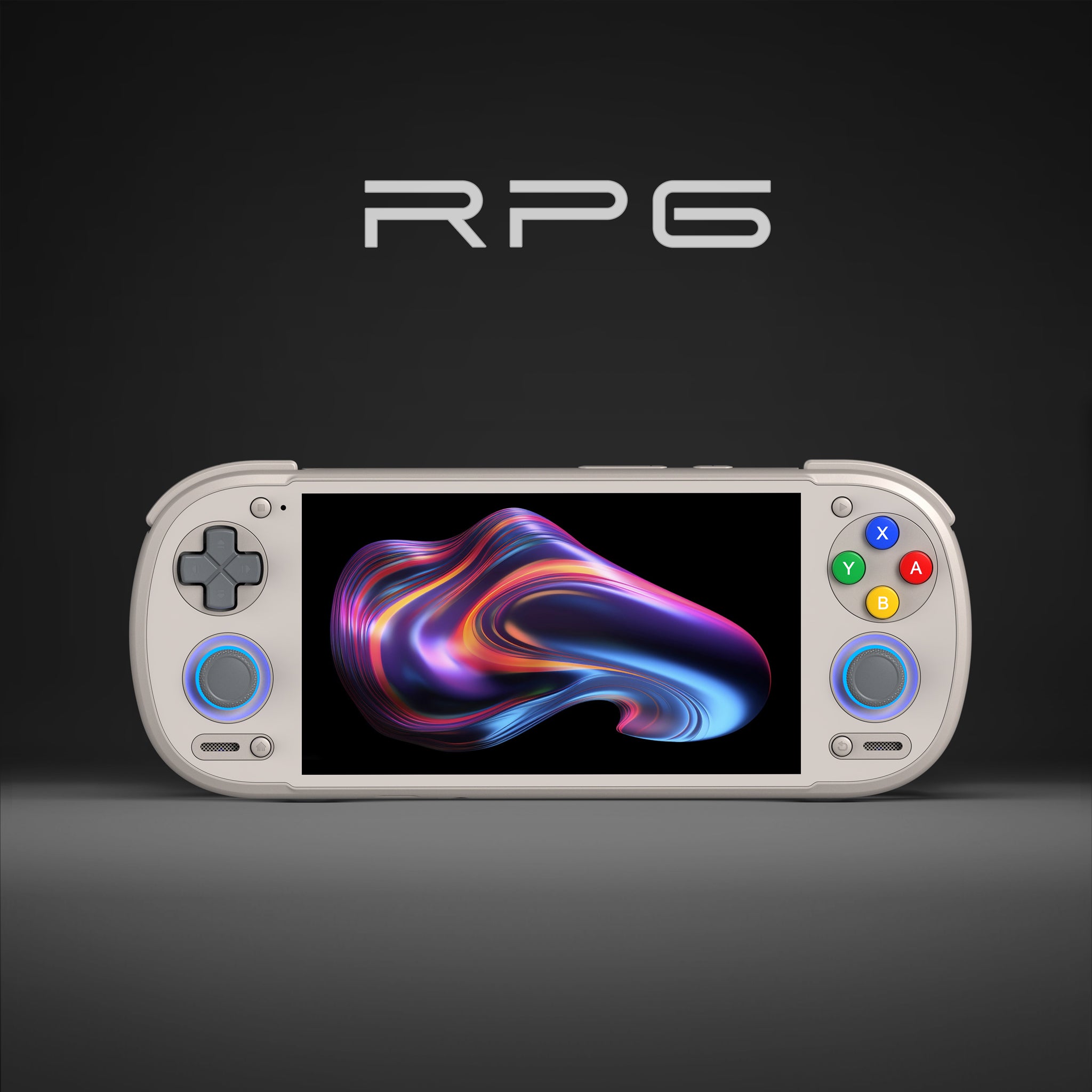
The Retroid Pocket 6 is the first single-screen Retroid handheld to move up to a proper flagship Qualcomm chip, and it is a deliberate departure from the company’s usual budget-first playbook. It pairs a Snapdragon 8 Gen 2 with a 5.5-inch 1080p AMOLED running at 120Hz, wraps it in a 304-320g candybar shell, and starts at $229 for the 8GB/128GB model (the 12GB/256GB version sits around $279, and RAM-price swings pushed the base model to roughly $244-$249 in early 2026). This is not a cheap all-rounder in the mould of the Pocket 4 or the RP Flip. It is Retroid aiming squarely at the Odin 2 and the AYN Odin family, using a smaller footprint and a nicer screen as the differentiators rather than raw price.
Emulation performance, generation by generation
The Snapdragon 8 Gen 2 (one Cortex-X3 at 3.2GHz, four performance cores, three efficiency cores, Adreno 740 GPU) is a genuine former-flagship SoC, so this is one of the more capable Android handhelds you can buy short of the Snapdragon 8 Gen 3 in the Odin 2. Everything through the PS1, N64, Dreamcast, PSP and Saturn era is trivial: DuckStation, Mupen64Plus-Next, Flycast and PPSSPP all run these at 4x internal resolution with headroom to spare. GameCube and Wii via Dolphin are the sweet spot here, with most of the library holding full speed at 3x native (1080p-class) output. PS2 through AetherSX2/NetherSX2 is where you start managing expectations honestly: the bulk of the catalogue runs well at 1.5x to 2x native with the performance governor engaged, but the notoriously heavy titles still need per-game tuning and will not always hold 60fps. Switch emulation exists on this hardware via forks in the Yuzu/Ryujinx lineage, and it is playable for lighter first-party games, but it is inconsistent, legally fraught, and not the reason to buy this over an Odin 2. Treat Wii U (Cemu), PS3 (RPCS3 is x86-only anyway) and 3DS (Citra forks) above modest settings as beyond this chip’s comfortable ceiling. The practical rule is simple: anything from the sixth console generation and earlier is a solved problem here, and the seventh generation is a case-by-case negotiation with settings menus.
Screen, build and controls
The panel is the headline. A 5.5-inch 1080p AMOLED at 120Hz means true blacks, saturated colour and smooth menu scrolling that IPS handhelds in this class cannot match, and the higher refresh rate genuinely helps in fast native Android titles. The trade-off is the usual AMOLED one: some users are sensitive to PWM dimming at low brightness. The body is a plain, symmetrical slab measuring 20.5 x 8.0 x 1.7cm; reviewers have fairly noted it is competent but anonymous, the kind of shape you could rebadge with any competitor’s logo. Controls are the strong part: 3D Hall effect analog sticks that will not develop drift, analog L2/R2 triggers with real travel, and a small, sensitive, Vita-style d-pad. You also get stereo speakers, a 3.5mm headphone jack, USB-C with 4K60 DisplayPort output, Wi-Fi 7 and Bluetooth 5.3. The 6000mAh battery is realistic rather than marketing: expect 6-8 hours on 8/16-bit systems, around 4.5 hours in mixed use, and 2.5-3 hours when you pin the chip at full performance for PS2 or GameCube.
Software and setup
Out of the box it runs Android 13 with Retroid’s own launcher over the top, which is the pragmatic choice for a device that doubles as a streaming and native-Android machine (Moonlight, GeForce Now, and Play Store games all work). Unlike the SoC-locked Rockchip Linux handhelds, custom firmware here is not muOS or Knulli or ROCKNIX; on a Snapdragon device the “custom” path is a cleaner Android setup. In practice that means flashing or configuring a front-end such as ES-DE or Daijisho, installing standalone emulators (RetroArch plus the standalone cores above), and optionally a debloated Android image if the community produces one. There is no one-tap Batocera-style card to swap in as you would on an Anbernic RG35XX. Expect to spend an evening organising ROM folders, BIOS files and per-system control profiles, which is the standard Android-handheld tax.
Price, value and who it is for
At $229-$249 the Pocket 6 is not an impulse buy, and it is not trying to be. Its competition is the Odin 2 (more raw power, larger, LCD in the base model) and the Pocket 6’s own bigger sibling the Pocket 5. The pitch is specific: you want near-top-tier emulation performance in the smallest 5.5-inch body that still has a 1080p AMOLED and Hall sticks. If your library stops at PSP, Dreamcast and GameCube, a cheaper handheld does that job for less money and you are paying for headroom you will not use. If you want to push PS2 and dabble in Switch while keeping the thing genuinely pocketable, this is one of the best-configured Android handhelds of its size in 2026. It is a hobbyist’s device that rewards setup effort, not a plug-and-play retro toy.
📐 Size & Pocketability
⚖️ Weight vs Other Handhelds
🔋 Real-World Battery Estimator
⭐ Emulation Performance
📊 View How This Score is Calculated
The Hardware Power Score is an absolute metric. Perfect emulation of difficult, modern consoles awards significantly more points than standard retro consoles.
- 15× Multiplier: Modern PC
- 12× Multiplier: Switch, PS3, Xbox 360
- 10× Multiplier: Wii U
- 8× Multiplier: PS2, GameCube, Wii, Xbox
- 5× Multiplier: Saturn, Dreamcast, PSP
- 3× Multiplier: N64, PS1
- 1× Multiplier: SNES, GBA
Gen 8 & PC
Generation 7
Generation 6
Generation 5
Handhelds & Retro
⚡ Performance Benchmarks
Where Retroid Pocket 6 Adreno 740 lands against the handhelds everyone knows. Every bar shares one scale, so longer genuinely means faster — add up to two rivals to compare.
CPU = Geekbench 6 multi-core · GPU = 3DMark Wild Life. Median real-world scores; every bar shares one scale — add up to two rivals to compare.
📋 Full Specifications
📺 Display
⚙️ Platform
💾 Memory
🕹️ Controls
📏 Body
🔋 Battery
⚖️ Verdict
✅ The Good
- Snapdragon 8 Gen 2 delivers strong Dolphin (GameCube/Wii at 3x) and workable PS2 emulation in a genuinely pocketable 5.5-inch body
- Excellent 5.5-inch 1080p AMOLED at 120Hz with deep blacks and smooth scrolling, a clear step up from IPS rivals
- Drift-proof 3D Hall effect sticks plus analog L2/R2 triggers and a large 6000mAh battery
- Full connectivity kit: 3.5mm jack, stereo speakers, Wi-Fi 7, Bluetooth 5.3, and USB-C 4K60 DisplayPort output for docked play
❌ The Bad
- Plain, anonymous design that reviewers note is hard to tell apart from other handhelds, and no fingerprint reader at this price
- Android-only means no drop-in Linux CFW (no muOS/Knulli/ROCKNIX); setup requires manual emulator, ROM and BIOS configuration
- At $229-$249 it is priced against the more powerful Odin 2, and the ceiling on Switch, Wii U, PS3 and 3DS is limited and inconsistent
📰 Latest News & Guides
The Ultimate Guide to ARMSX3: Android’s New PS3 Emulator, Competitor Comparisons, and Setup Tutorial
18/08/2026Pokémon Gold, Silver, and Crystal (Gen 2) Recomp Lands on Android
17/08/2026How to Play the Pokémon Red, Blue, or Yellow Recomp on Your Android, Windows, and Linux Devices
16/08/2026🔍 Similar Handhelds
Other handhelds that emulate up to CURRENTGEN.