
🛒 Where to Buy
⚠️ Golden Rule of Retro Handhelds: Throw away the cheap MicroSD card that comes in the box — it will fail. And never use a high-wattage PD “Fast Charger” on these devices; it can damage the battery. Use a standard 5V/1.5A brick.
Device Overview: MINILOONG Pocket 1
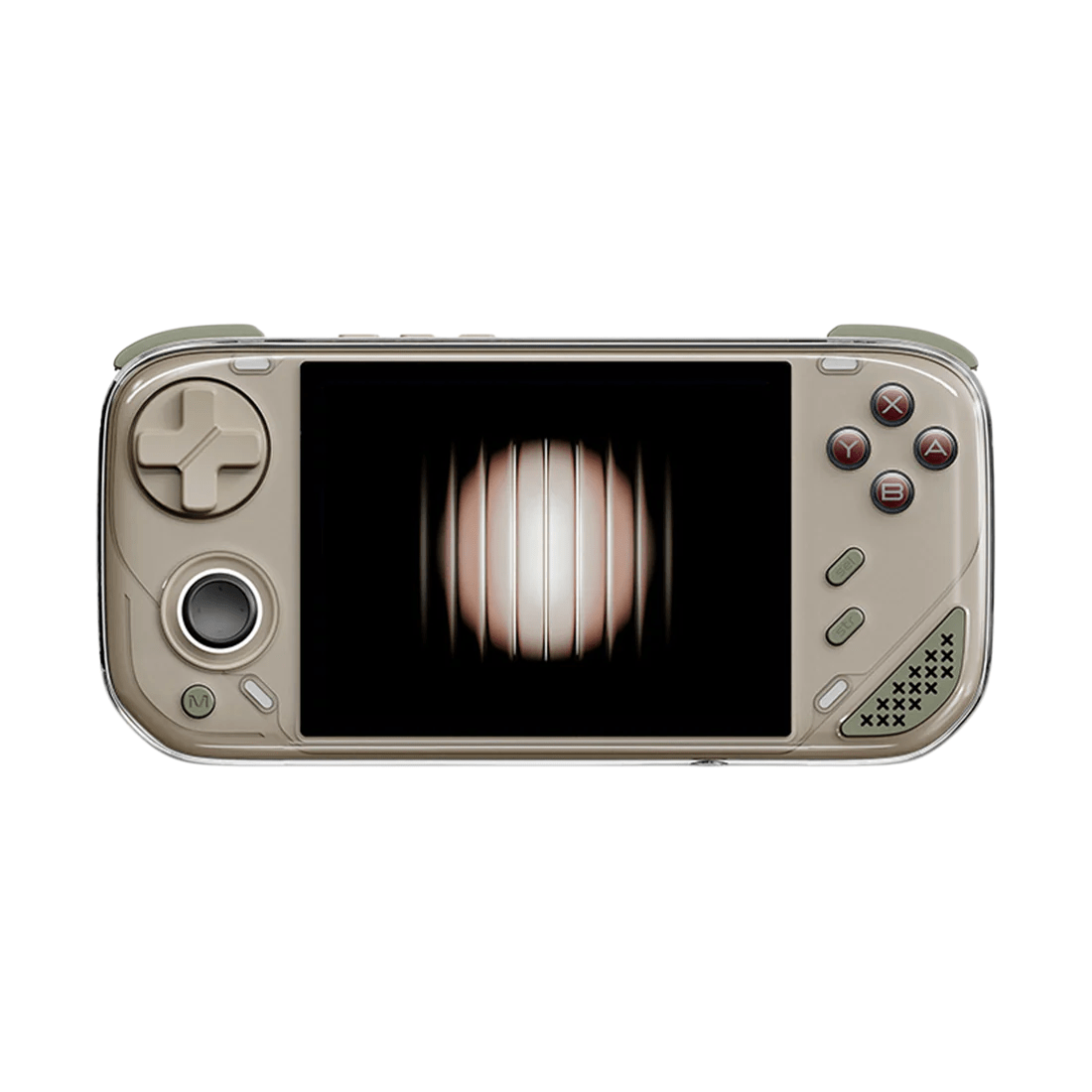
The MINILOONG Pocket 1 is a sub-$90 Linux emulation handheld built around the aging but familiar Rockchip RK3566, and it wears its retro intentions on its sleeve: a 4.0-inch 4:3 screen, a fat pocketable body, magnetic swappable faceplates and two interchangeable d-pad styles. Launched in China on 29 January 2026 for roughly $83, it lands in the crowded RK3566 bracket alongside the Anbernic RG353 series and Powkiddy’s RGB30, and it competes almost entirely on feel and price rather than raw horsepower. If you want a cheap vertical-ish 4:3 device for 8- and 16-bit libraries with a bit of PS1 on the side, it is a genuinely nice object. If you came for PSP or Dreamcast, look elsewhere.
Emulation performance, generation by generation
The RK3566 is a quad-core Cortex-A55 SoC paired with a single-core Mali-G52 2EE GPU clocked around 800 MHz, and by 2026 it is squarely a budget chip. That is not an insult; it just sets a hard ceiling. NES, Game Boy/Color/Advance, Master System, Genesis/Mega Drive, PC Engine and SNES all run at full speed through RetroArch cores such as Snes9x, mGBA and Genesis Plus GX, and the 960×720 panel gives clean integer scaling for most of them. PlayStation 1 is the comfortable top tier here: DuckStation and swanstation handle the bulk of the library well, with the occasional heavy 3D title needing frameskip. Above that, results get honest and messy. Nintendo 64 via Mupen64Plus is a per-game lottery, Nintendo DS through DraStic or melonDS is playable in 2D-heavy titles but strains on 3D, and PSP through PPSSPP only manages lighter 2D and simpler 3D games at reduced resolution. Dreamcast is effectively a non-starter; several reviewers report Flycast either crawling or refusing to boot. Saturn is out. Treat this as a machine that peaks at PS1 and dabbles above it, not a portable that “does PSP.”
Screen, build and controls
The 4.0-inch IPS panel is the standout. It runs 960×720 at a 4:3 ratio with roughly 450 nits of peak brightness, which is bright enough for indoor and shaded outdoor use, and the 4:3 shape flatters the retro consoles most people buy this for. It is a standard 60 Hz IPS, not a high-refresh or OLED panel. Build quality punches above the price: reviewers compare the plastics favourably to devices costing considerably more, and the textured back adds real grip. Controls are a mixed but likeable bag. There is a single analog stick, a dish-style d-pad with decent pivot, crystal-topped ABXY buttons and stacked shoulder buttons that keep L1/L2 and R1/R2 within easy reach. MINILOONG has not published Hall-effect sensor claims for the stick, so assume conventional potentiometers and the drift risk that comes with them until proven otherwise. The headline gimmick, magnetic faceplates and swappable d-pad plates, is real but hampered by supply: at review time no store was actually shipping the replacement plates, so the modularity is more promise than practice.
Software and setup
Out of the box it runs LOONGOS, MINILOONG’s own Linux-based front end built on what the company calls its HELO stack, complete with a built-in OTA updater. It is easy enough to navigate but rough around the edges: menus can feel laggy, some emulated systems do not appear until you configure them manually, and reviewers note that RetroArch tweaks and core swaps do not always stick, which hurts finicky systems like MAME and FinalBurn Neo. This is where the RK3566’s biggest asset comes in. The chip is one of the best-supported platforms in the custom-firmware scene, so ArkOS, ROCKNIX and Batocera all run well on RK3566 hardware in general and are the standard escape hatch when a device’s stock OS disappoints. The caveat for this specific model: as a January 2026 release it may not yet have a dedicated, officially blessed CFW image, so check current community threads before assuming a clean ArkOS or ROCKNIX build exists for the Pocket 1 rather than a close cousin. Note that muOS and Knulli target Allwinner H700 hardware, not this chip, so they are not options here. Setup otherwise follows the usual routine: ROMs and BIOS files onto a microSD, and the second microSD slot is handy for keeping a firmware card separate from your games.
Price, value and who it is for
At around $83, typically $65 to $100 depending on finish and sale, the Pocket 1 is a well-built 4:3 retro handheld with a very good screen and an underwhelming chip. It is worth buying if you specifically want that 4:3 form factor and a nicer-feeling body than most budget devices offer, and if your library stops at PS1. It is the wrong buy if you want PSP, N64 or Dreamcast to run reliably; for that money an Android-based RK3566 or newer alternative will serve you better, and even Anbernic’s own RK3566 units have more mature software. Think of it as a nostalgia box with a great panel and a chip that knows its limits.
📐 Size & Pocketability
⚖️ Weight vs Other Handhelds
🔋 Real-World Battery Estimator
⭐ Emulation Performance
📊 View How This Score is Calculated
The Hardware Power Score is an absolute metric. Perfect emulation of difficult, modern consoles awards significantly more points than standard retro consoles.
- 15× Multiplier: Modern PC
- 12× Multiplier: Switch, PS3, Xbox 360
- 10× Multiplier: Wii U
- 8× Multiplier: PS2, GameCube, Wii, Xbox
- 5× Multiplier: Saturn, Dreamcast, PSP
- 3× Multiplier: N64, PS1
- 1× Multiplier: SNES, GBA
Generation 6
Generation 5
Handhelds & Retro
⚡ Performance Benchmarks
Where MINILOONG Pocket 1 ARM Mali-G52 MP2 (2EE) lands against the handhelds everyone knows. Every bar shares one scale, so longer genuinely means faster — add up to two rivals to compare.
CPU = Geekbench 6 multi-core · GPU = 3DMark Wild Life. Median real-world scores; every bar shares one scale — add up to two rivals to compare.
📋 Full Specifications
📺 Display
⚙️ Platform
💾 Memory
🕹️ Controls
📏 Body
🔋 Battery
⚖️ Verdict
✅ The Good
- Bright, sharp 4:3 4.0-inch 960×720 IPS panel that gives clean integer scaling for retro systems
- Build quality and in-hand feel well above the sub-$90 price, with a grippy textured back
- Handles everything up to and including PS1 smoothly, plus dual microSD slots and mini HDMI out
- Well-known RK3566 platform means ArkOS, ROCKNIX and Batocera are realistic firmware alternatives
❌ The Bad
- RK3566 is a 2020-era budget chip: N64, DS, PSP are hit-and-miss and Dreamcast basically fails
- Stock LOONGOS is laggy and buggy, with RetroArch settings and core swaps that do not reliably stick
- Advertised swappable faceplates and d-pad plates were not actually shipping, and no Hall-effect stick is claimed
📰 Latest News & Guides
The Ultimate Guide to ARMSX3: Android’s New PS3 Emulator, Competitor Comparisons, and Setup Tutorial
18/08/2026Pokémon Gold, Silver, and Crystal (Gen 2) Recomp Lands on Android
17/08/2026How to Play the Pokémon Red, Blue, or Yellow Recomp on Your Android, Windows, and Linux Devices
16/08/2026🔍 Similar Handhelds
Other handhelds that emulate up to PSP.