
🛒 Where to Buy
⚠️ Golden Rule of Retro Handhelds: Throw away the cheap MicroSD card that comes in the box — it will fail. And never use a high-wattage PD “Fast Charger” on these devices; it can damage the battery. Use a standard 5V/1.5A brick.
Device Overview: Retroid Pocket 4
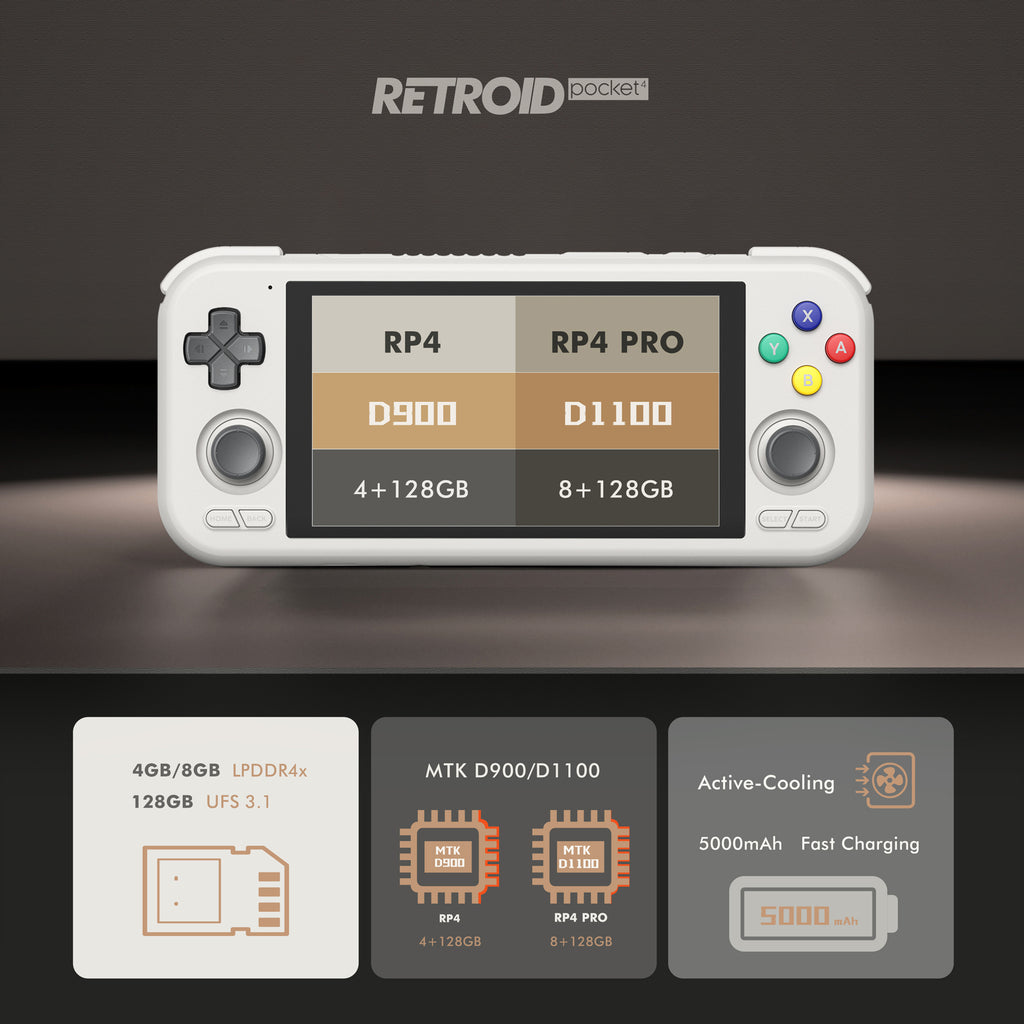
The Retroid Pocket 4 is the cheaper of the two horizontal handhelds Retroid launched in early 2024, sitting one rung below the Retroid Pocket 4 Pro. It runs full Android 11 on a MediaTek Dimensity 900, and at a $149 launch price it was pitched squarely at people who want reliable PSP, Dreamcast, Saturn and GameCube emulation without paying Steam Deck or Odin money. The important thing to get straight up front: this is the standard RP4, not the Pro. The two share an identical shell, the same 4.7-inch screen and the same 5000mAh battery, but the standard model drops to the Dimensity 900, 4GB of RAM and 128GB of UFS 3.1 storage. That gap matters most at the top of the emulation ladder, and I will be honest about where.
Emulation performance, generation by generation
Everything up to and including the sixth console generation runs well. NES, SNES, Genesis, Game Boy Advance, PlayStation 1 and Nintendo DS are effectively free for this chip and run full speed with shaders and run-ahead if you want them. PSP is where the Dimensity 900 shows its worth: the bulk of the library holds 60fps at 2x or 3x resolution in a recent AetherSX2-era build, with only the heaviest 3D titles asking you to drop back to native. Dreamcast and Saturn through Flycast and the Beetle cores are comfortable. GameCube and Wii on Dolphin are where this becomes a case-by-case device rather than a guarantee. Lighter first-party games hold up, but the Cortex-A78 pair (two performance cores, not the Pro’s four) means demanding titles stutter, and you will spend time per-game tuning. PS2 through NetherSX2 is the real dividing line between this and the Pro: many 2D and simpler 3D games are playable at native resolution, but the 4GB of RAM and weaker Mali-G68 MC4 GPU mean the standard RP4 is a “some of the PS2 library” machine, not a “most of it” machine. Expect to lean on frameskip and native-res on the harder PS2 games rather than chasing upscaling. Switch emulation is not a realistic target here; the chip and RAM simply are not built for it. Treat PSP/Dreamcast/GameCube-lite as the honest ceiling, and remember that the sixth-gen “maybes” are exactly what the Pro turns into “yes.”
Screen, build and controls
The 4.7-inch IPS panel runs at 750×1334 in a 16:9 orientation, which is a slightly odd resolution but sharp for its size and bright enough for indoor use. It is a touchscreen, which matters for Android games and DS. The controls are the standout at this price: genuine Hall-effect analog sticks that will not develop drift, plus analog Hall-effect L2/R2 triggers in a stacked shoulder arrangement, so you get real trigger travel for GameCube and PSP rather than a click. The face buttons and d-pad are Retroid’s usual reliable membrane setup. The body measures 184.8 x 82.6 x 15.8mm and weighs 261g, so it is pocketable in a jacket, not jeans. Connectivity covers Wi-Fi 6, Bluetooth 5.2 and a USB-C port at the bottom for charging and video out. It ships in a rotating cast of colorways including Black, Ice Blue, a translucent Crystal and 16-bit retro finishes.
Software and setup
Out of the box you get stock Android 11 with Retroid’s own launcher on top and no emulators preinstalled, which is normal for this class. You supply the cores, and the standard path is RetroArch plus standalone apps (PPSSPP, Dolphin, Flycast, DuckStation, NetherSX2) configured through a front end like Daijisho or ES-DE. Because it is a full Google-services Android device, you can also install Play Store games, cloud-streaming apps and native Android ports directly. There is no Linux custom-firmware ecosystem here the way there is on ARM Linux handhelds; muOS, Knulli, ArkOS and ROCKNIX do not target this device. What exists instead is the healthy Retroid Android community with tuned per-game settings, mapping profiles, boot-to-frontend tweaks and the occasional Android 13 GSI flash for people who want a newer base. Retroid also pushes firmware updates that fix mapping and video-out quirks, so it is worth checking for one on first boot. For most owners, stock Android plus a weekend of core downloads, BIOS files and per-system config is the whole story, and it stays low-maintenance after that.
Price, value and who it is for
At $149 the Retroid Pocket 4 is one of the best value Android handhelds of its generation, but the value case is specific. If your library tops out at PSP, Dreamcast, N64, PS1 and DS, you are overpaying for the Pro and this is the right buy. If you genuinely care about a broad PS2 and GameCube collection or ever want to touch Switch, spend the extra for the 4 Pro’s Dimensity 1100 and 8GB of RAM instead, because the standard model will frustrate you there. Buy this for the excellent Hall sticks, the honest sixth-gen ceiling and the price, not because you expect it to brute-force everything.
📐 Size & Pocketability
⚖️ Weight vs Other Handhelds
🔋 Real-World Battery Estimator
⭐ Emulation Performance
📊 View How This Score is Calculated
The Hardware Power Score is an absolute metric. Perfect emulation of difficult, modern consoles awards significantly more points than standard retro consoles.
- 15× Multiplier: Modern PC
- 12× Multiplier: Switch, PS3, Xbox 360
- 10× Multiplier: Wii U
- 8× Multiplier: PS2, GameCube, Wii, Xbox
- 5× Multiplier: Saturn, Dreamcast, PSP
- 3× Multiplier: N64, PS1
- 1× Multiplier: SNES, GBA
Gen 8 & PC
Generation 7
Generation 6
Generation 5
Handhelds & Retro
⚡ Performance Benchmarks
Where Retroid Pocket 4 Mali-G68 MC4 lands against the handhelds everyone knows. Every bar shares one scale, so longer genuinely means faster — add up to two rivals to compare.
CPU = Geekbench 6 multi-core · GPU = 3DMark Wild Life. Median real-world scores; every bar shares one scale — add up to two rivals to compare.
📋 Full Specifications
📺 Display
⚙️ Platform
💾 Memory
🕹️ Controls
📏 Body
🔋 Battery
⚖️ Verdict
✅ The Good
- Genuine Hall-effect analog sticks and analog Hall triggers at a $149 price point, so no stick drift and real trigger travel
- Full Android 11 with Google services, giving you standalone emulators, Play Store games and cloud streaming, not just RetroArch
- Handles everything up to and including PSP, Dreamcast, Saturn and N64 at full speed with resolution boosts
- 5000mAh battery and a pocketable 261g body with Wi-Fi 6, Bluetooth 5.2 and USB-C video out
❌ The Bad
- Dimensity 900 with only 4GB of RAM makes PS2 and GameCube hit-or-miss and rules out Switch entirely
- No Linux custom-firmware support (no muOS, ArkOS, Knulli or ROCKNIX); you are limited to Android setups
- The Pro model on the identical shell is a large performance jump for a small price premium, which undercuts this version for 3D-heavy libraries
📰 Latest News & Guides
The Ultimate Guide to ARMSX3: Android’s New PS3 Emulator, Competitor Comparisons, and Setup Tutorial
18/08/2026Pokémon Gold, Silver, and Crystal (Gen 2) Recomp Lands on Android
17/08/2026How to Play the Pokémon Red, Blue, or Yellow Recomp on Your Android, Windows, and Linux Devices
16/08/2026🔍 Similar Handhelds
Other handhelds that emulate up to PS2.