
🛒 Where to Buy
⚠️ Golden Rule of Retro Handhelds: Throw away the cheap MicroSD card that comes in the box — it will fail. And never use a high-wattage PD “Fast Charger” on these devices; it can damage the battery. Use a standard 5V/1.5A brick.
Device Overview: One Netbook OneXPlayer 2
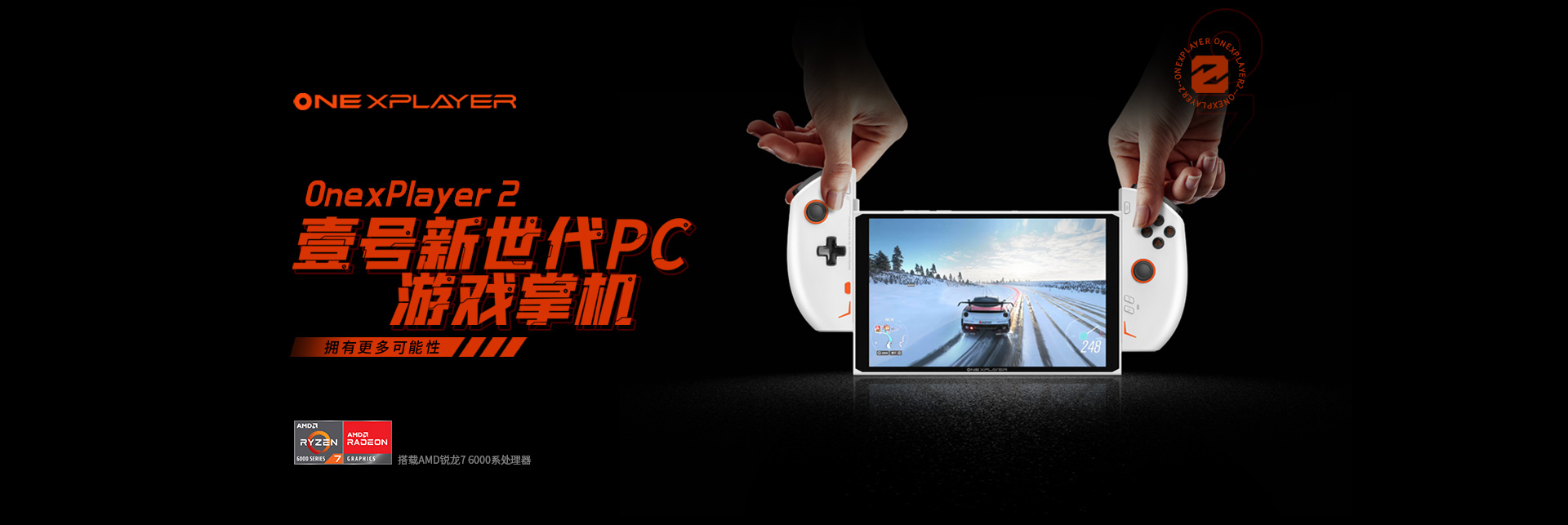
The One Netbook OneXPlayer 2 is a Windows 11 gaming PC dressed as an 8.4-inch tablet, not a cheap ARM emulation box, and that distinction defines everything about it. It shipped in early 2023 off the back of a late-2022 Indiegogo campaign, built around AMD’s Ryzen 7 6800U, and its headline trick is a pair of Switch-style controllers that slide off the sides on pogo pins. At roughly 850 grams and nearly a foot wide with the pads attached, it is closer to a portable workstation than to a Game Boy successor. This is the machine you buy when you want native Windows games and every emulator ever written to run on the same device.
Emulation performance, generation by generation
Because the 6800U is a real x86 chip with Radeon 680M (RDNA 2) graphics, the emulation ceiling here is dramatically higher than on any Rockchip handheld. Everything through the fifth and sixth console generations is trivial: RetroArch cores for the NES, SNES, Genesis, PS1 and arcade run at full speed with shaders and run-ahead to spare. PPSSPP renders PSP games at 3x or 4x internal resolution without breaking a sweat. Dolphin handles the GameCube and Wii comfortably, and most of the PlayStation 2 library in PCSX2 holds 60fps with upscaling, though a handful of the heaviest PS2 titles still stutter. Later systems are where it gets interesting: Citra-derived 3DS emulation is smooth, Cemu runs the bulk of the Wii U catalog well, and RPCS3 makes many PlayStation 3 games playable, “playable” being the operative word, since PS3 emulation is CPU-bound and the 28-watt ceiling caps sustained clocks. Nintendo Switch emulation is technically within reach through the community forks that appeared after yuzu and Ryujinx were taken down, and lighter Switch titles run, but the 680M is not powerful enough to promise the demanding ones at full speed.
Screen, build and controls
The 8.4-inch IPS panel runs at 2560×1600 (2.5K, 16:10) and 60Hz, with touch and pen support. That is a lot of pixels for an integrated GPU, so for native AAA games you will usually drop to 1280×800 and let the sharp panel scale it. It is a bright, colour-accurate screen, but do not expect the contrast or refresh rate of the OLED handhelds that followed. The detachable controllers use Hall effect analog sticks and Hall effect triggers, so stick drift should not be a concern, though several reviewers found the triggers themselves merely adequate rather than premium. The pads carry no internal battery, drawing power from the main unit or the separately sold grip, and the pogo-pin connection is far more rigid than on the original OneXPlayer. A built-in kickstand lets you prop it up and pair a controller for tabletop play. Ports are generous: two USB-C (one full USB4 at 40Gbps), a USB-A 3.0, microSD, a 3.5mm jack, Wi-Fi 6E and Bluetooth 5.2. The 65.5Wh battery is the weak spot, delivering roughly three hours of actual gaming and far less if you push the TDP.
Software and setup
It ships with Windows 11 Home, which is both the strength and the tax. You get Steam, Epic, Game Pass, GOG and every native launcher, but you also inherit Windows’ clumsiness on a touchscreen and its habit of forgetting it is a handheld. The custom-firmware scene that matters for cheap ARM units, muOS, Knulli, ArkOS, ROCKNIX and OnionOS, is simply irrelevant here, because this is an x86 PC and not an Allwinner or Rockchip board. The equivalent tuning work is different: OneXPlayer’s own OneXConsole utility for TDP and fan curves, Handheld Companion for gyro and profile mapping, and a front-end like Playnite or Steam Big Picture to hide the desktop. For emulation specifically, EmuDeck’s Windows installer wires up RetroArch and the standalone emulators in one pass. If you dislike Windows, the device can boot Bazzite, the SteamOS-style Linux distribution, which turns it into something much closer to a Steam Deck in feel.
Price, value and who it is for
The OneXPlayer 2 launched at $899 for the 16GB/512GB Indiegogo tier and climbed to around $1,299 for 32GB/2TB, which was expensive even in 2023 and is why it has since been undercut by the Steam Deck and later Ayaneo models. Today its appeal is as a large-screen, do-everything Windows handheld, and it makes most sense bought used or refurbished, where the price finally matches the hardware. It is not the device for someone who just wants pick-up SNES sessions on the couch; a $70 Anbernic does that with better battery life and less fuss. Buy the One Netbook OneXPlayer 2 if you want one machine that plays your Steam library, runs demanding emulators up to the PS3 era, and doubles as a Windows tablet, and you accept the weight, the mediocre battery and the premium price that combination costs.
📐 Size & Pocketability
⚖️ Weight vs Other Handhelds
🔋 Real-World Battery Estimator
⭐ Emulation Performance
📊 View How This Score is Calculated
The Hardware Power Score is an absolute metric. Perfect emulation of difficult, modern consoles awards significantly more points than standard retro consoles.
- 15× Multiplier: Modern PC
- 12× Multiplier: Switch, PS3, Xbox 360
- 10× Multiplier: Wii U
- 8× Multiplier: PS2, GameCube, Wii, Xbox
- 5× Multiplier: Saturn, Dreamcast, PSP
- 3× Multiplier: N64, PS1
- 1× Multiplier: SNES, GBA
Gen 8 & PC
Generation 7
Generation 6
Generation 5
Handhelds & Retro
⚡ Performance Benchmarks
Where One Netbook OneXPlayer 2 AMD Radeon 680M lands against the handhelds everyone knows. Every bar shares one scale, so longer genuinely means faster — add up to two rivals to compare.
CPU = Geekbench 6 multi-core · GPU = 3DMark Wild Life. Median real-world scores; every bar shares one scale — add up to two rivals to compare.
📋 Full Specifications
📺 Display
⚙️ Platform
💾 Memory
🕹️ Controls
📏 Body
🔋 Battery
⚖️ Verdict
✅ The Good
- Full x86 Windows 11 PC: runs native Steam and Game Pass libraries plus every emulator up to the PS3/Wii U era, not just retro cores
- Large 8.4-inch 2560×1600 IPS touchscreen with pen support, sharper than almost any rival of its day
- Detachable Hall effect controllers (both sticks and triggers) that resist drift, plus a built-in kickstand and a 40Gbps USB4 port
- Ryzen 7 6800U with Radeon 680M is genuinely strong for early 2023, comfortably handling GameCube, Wii, PS2 and much of the Wii U and PS3 libraries
❌ The Bad
- Only about three hours of gaming from the 65.5Wh battery, and heavy at roughly 850g with an almost foot-wide footprint
- Expensive at $899 to $1,299 launch pricing, since undercut by the Steam Deck and newer handhelds
- 60Hz IPS panel and a 28W TDP ceiling mean it is neither an OLED-class screen nor able to guarantee the most demanding Switch and PS3 titles
📰 Latest News & Guides
The Ultimate Guide to ARMSX3: Android’s New PS3 Emulator, Competitor Comparisons, and Setup Tutorial
18/08/2026Pokémon Gold, Silver, and Crystal (Gen 2) Recomp Lands on Android
17/08/2026How to Play the Pokémon Red, Blue, or Yellow Recomp on Your Android, Windows, and Linux Devices
16/08/2026🔍 Similar Handhelds
Other handhelds that emulate up to CURRENTGEN.