
🛒 Where to Buy
⚠️ Golden Rule of Retro Handhelds: Throw away the cheap MicroSD card that comes in the box — it will fail. And never use a high-wattage PD “Fast Charger” on these devices; it can damage the battery. Use a standard 5V/1.5A brick.
Device Overview: Miyoo Mini Plus
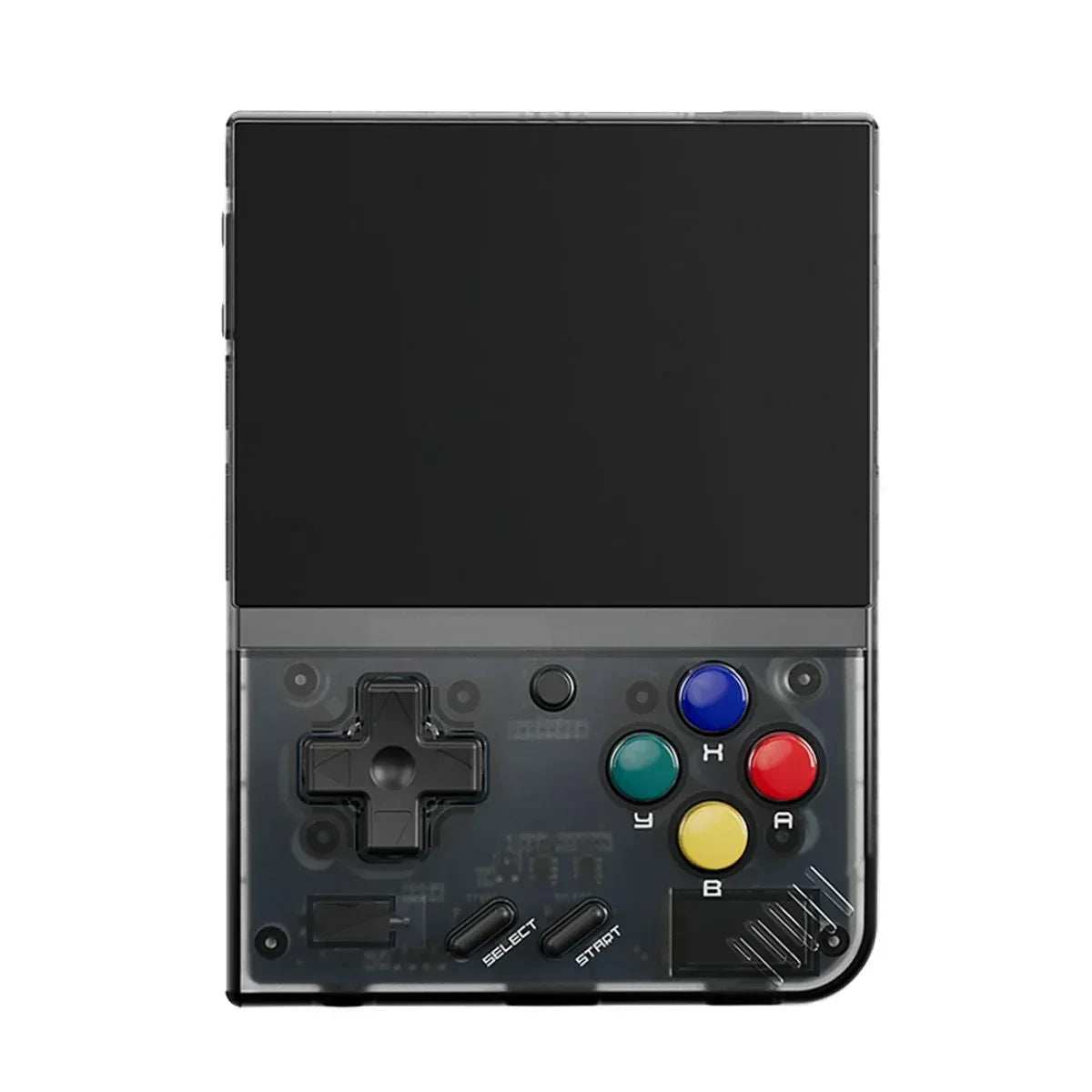
The Miyoo Mini Plus is the handheld that turned a budget vertical into a cult. It is a near-direct sequel to the original Miyoo Mini, keeping the same Game Boy-shaped body and tiny footprint but solving the original’s two real pain points: a fiddly micro-USB port (now USB-C), a 2000mAh cell bumped to 3000mAh, and the addition of WiFi. At roughly $50-65 it competes head-on with Anbernic’s RG35XX, and the comparison is genuinely close: similar SoC class, similar price, similar 2D ambitions. What separates the Mini Plus is not its silicon but its software ecosystem and its shape. It is pocketable in a way the RG35XX is not, and it runs OnionOS, the community firmware that is the actual reason most people buy this thing.
This is a deliberate device. It does not pretend to be a 3D powerhouse, has no analog sticks, no Bluetooth, and a dual-core 1.2GHz Cortex-A7 that was already modest in 2023. If you want a do-everything handheld, look elsewhere. If you want the best small machine for sprite-based games, this is the conversation.
Emulation performance, generation by generation
The SigmaStar SSD202D (2x Cortex-A7 at 1.2GHz, 128MB DDR3) defines a hard ceiling, and the honest picture sits squarely in 2D. Everything 8- and 16-bit runs flawlessly and at full speed: NES, SNES, Genesis/Mega Drive, Master System, PC Engine, Neo Geo, and arcade boards via FBNeo and MAME2003. Game Boy, GBC and Game Boy Advance are perfect, with GBA being a particular highlight on the 4:3 panel. PlayStation 1 is the headline act and the reason this gets called a PS1 machine, but it deserves a caveat: most 2D and lighter 3D titles run at full speed, while heavier 3D games (think Gran Turismo 2, busy Final Fantasy battle backdrops) can show audio crackle or slowdown. It is very good at PS1, not flawless.
Above PS1, set expectations low and selective. N64 via Mupen64Plus-Next is a tweaking exercise: Super Mario 64, Mario Kart 64 and Star Fox 64 are playable with frameskip, while Banjo-Kazooie, Majora’s Mask and Conker run at roughly 70-85% with hitches. Dreamcast is hit-and-miss and not a reason to buy. PSP is not recommended. There is no PS2, no GameCube, and no point pretending otherwise. This is a 2D/PS1 darling, full stop.
Screen, build and controls
The 3.5″ 640×480 IPS panel is the star of the hardware. That 4:3 aspect ratio is exactly right for the era this device targets, so SNES, GBA and PS1 fill the screen without ugly letterboxing or stretching. Color balance is excellent and the panel is genuinely sharp at 228 PPI. The body is plastic, 162g, and small enough (78.5 x 108 x 22.3mm) to disappear into a jacket pocket. The shoulder buttons sit on the back rather than the top edge, which feels strange for an hour and natural forever after. The D-pad is good. There are no analog sticks, which rules out comfortable N64 and PSP control regardless of raw performance, and that is fine given what this device is for. The single speaker distorts at high volume, so use headphones via the 3.5mm jack.
Software and setup
OnionOS is the whole reason. The stock firmware is functional but plain; OnionOS, the community project carried over and expanded from the original Mini, transforms the device. It gives you a clean, fast launcher with box art, per-system emulator and core selection, save states, in-game menus, theming, automatic game-list scraping, and sleep/resume that actually works. Setup is a microSD formatting and file-copy job that takes well under an hour. The WiFi, modest as it is, earns its keep here: NTP clock sync, easier firmware updates, and RetroAchievements (note it needs a 2.4GHz network to authenticate). There is no Bluetooth and no online play to speak of. Buy this device, then immediately put OnionOS on it.
Price, value and who it’s for
At about $50-65 the Mini Plus is one of the easiest recommendations in the hobby, provided you want what it does. Battery life is realistic: 5-6 hours on Game Boy and 8-bit systems, 4-5 on SNES, and 2.5-3 on demanding PS1. This is for the person who wants a tiny, beautifully-screened machine for handheld-era and 2D console games, plus a strong PS1 library, and who does not care about 3D systems or sticks. If you need N64, PSP or analog controls, spend more on something bigger. If your library is sprites and PS1, nothing this small does it better.
📐 Size & Pocketability
⚖️ Weight vs Other Handhelds
🔋 Real-World Battery Estimator
⭐ Emulation Performance
📊 View How This Score is Calculated
The Hardware Power Score is an absolute metric. Perfect emulation of difficult, modern consoles awards significantly more points than standard retro consoles.
- 15× Multiplier: Modern PC
- 12× Multiplier: Switch, PS3, Xbox 360
- 10× Multiplier: Wii U
- 8× Multiplier: PS2, GameCube, Wii, Xbox
- 5× Multiplier: Saturn, Dreamcast, PSP
- 3× Multiplier: N64, PS1
- 1× Multiplier: SNES, GBA
Generation 5
Handhelds & Retro
📋 Full Specifications
📺 Display
⚙️ Platform
💾 Memory
🕹️ Controls
📏 Body
🔋 Battery
⚖️ Verdict
✅ The Good
- Superb 3.5" 640×480 4:3 IPS screen with excellent color and sharpness
- OnionOS community firmware is polished, fast and transforms the experience
- Flawless 8/16-bit and GBA, with strong PlayStation 1 performance
- Genuinely pocketable and well-built for the $50-65 price
❌ The Bad
- No analog sticks, ruling out comfortable N64/PSP control
- Weak above PS1: N64 selective, Dreamcast spotty, PSP not recommended; no PS2/GC
- Single speaker distorts at high volume, and there's no Bluetooth
📰 Latest News & Guides
The Ultimate Guide to ARMSX3: Android’s New PS3 Emulator, Competitor Comparisons, and Setup Tutorial
18/08/2026Pokémon Gold, Silver, and Crystal (Gen 2) Recomp Lands on Android
17/08/2026How to Play the Pokémon Red, Blue, or Yellow Recomp on Your Android, Windows, and Linux Devices
16/08/2026🔍 Similar Handhelds
Other handhelds that emulate up to DS.