
🛒 Where to Buy
⚠️ Golden Rule of Retro Handhelds: Throw away the cheap MicroSD card that comes in the box — it will fail. And never use a high-wattage PD “Fast Charger” on these devices; it can damage the battery. Use a standard 5V/1.5A brick.
Device Overview: Mangmi Pocket Max
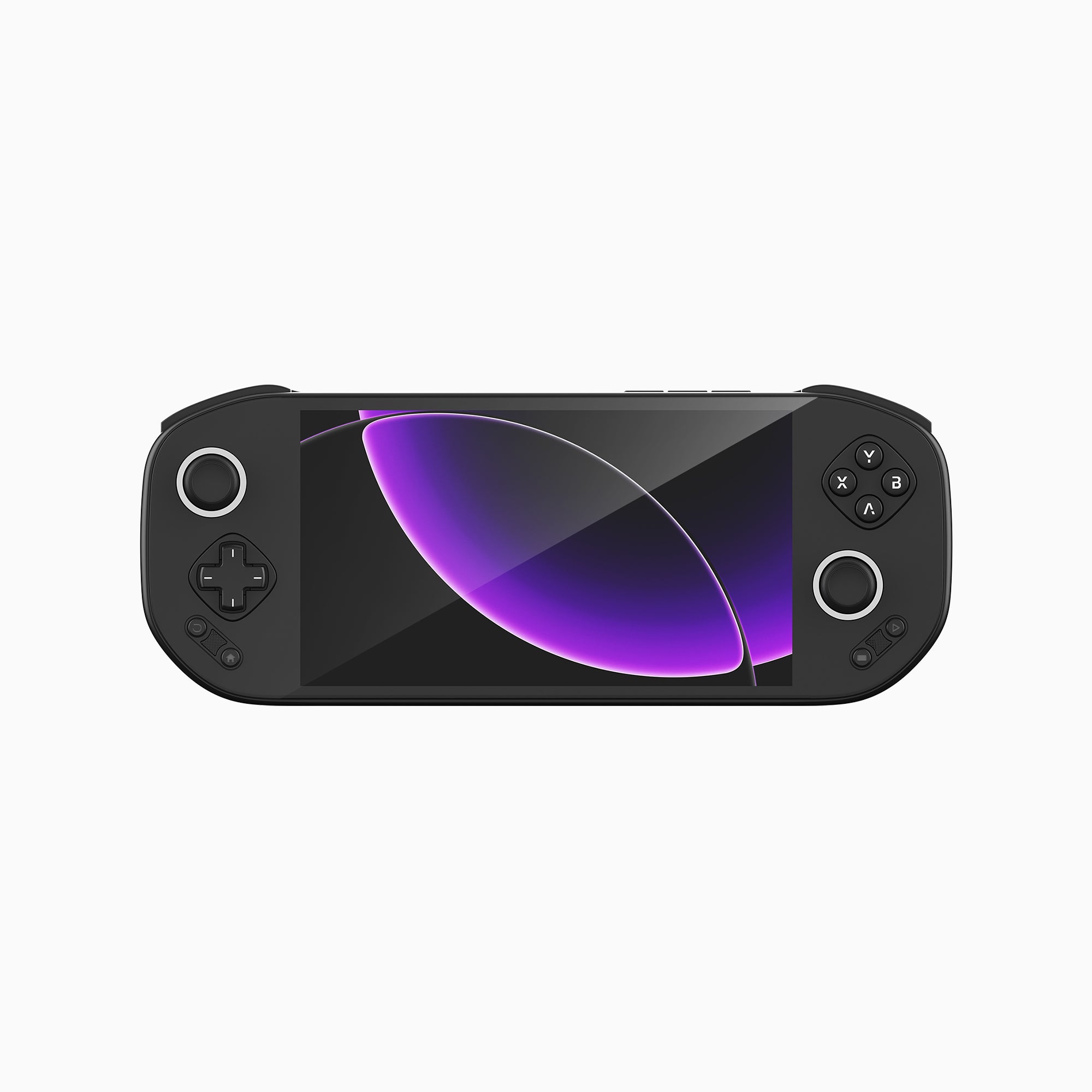
The Mangmi Pocket Max is a 7-inch Android gaming handheld and the second device from Mangmi, following the smaller, low-end Pocket Air. Where the Pocket Air aimed at budget buyers, the Pocket Max swings the other way: a large 1080p AMOLED panel, a glass front, full-sized Hall-effect sticks, and a genuinely novel feature for this category, magnetically swappable D-pad and face-button modules. It launched in early 2026 around a $200 early-bird price, with a list price of $229.99 to $239.99 depending on where and when you buy. That positioning matters, because at full price it lands in one of the most contested brackets in Android handhelds.
Mangmi is an obscure brand with a short track record, so treat this profile as a snapshot of a young product rather than a verdict on a proven one. Core specs are well documented by the manufacturer and corroborated by several independent reviews, but long-term reliability, firmware support, and customer service are unknowns. Buy with that in mind.
Emulation performance and what to expect
The Pocket Max runs a Qualcomm Snapdragon 865 with an Adreno 650 GPU, 8GB of LPDDR4X, and 128GB of UFS 3.1 storage. The 865 was a 2020 flagship chip, and that age is the single most important thing to understand about this device. It is not a weak chip, but it is a known quantity. Expect everything up to and including GameCube to run at native resolution or higher, and most of the Sony PS2 library to be playable, occasionally needing per-game settings tweaks. PSP and Dreamcast are comfortable. The ceiling is the demanding stuff: Nintendo Switch, 3DS, and Wii U emulation will run only at the lighter end, with compromises, and the newest emulator builds can push the 865 past where it’s happy. If your goal is fifth- and sixth-generation consoles and handhelds, this is more than enough silicon. If you specifically want strong Switch performance, look elsewhere. A single-fan active cooling system helps the 865 hold its clocks, and the chip’s mature driver support is a real, if unglamorous, advantage.
Screen, build and controls
The screen is the headline. It’s a 7-inch 1920×1080 AMOLED running at 144Hz, rated around 800 nits with roughly 150% sRGB coverage. On a sub-$250 handheld that panel genuinely stands out, with the deep blacks and saturation you’d expect from AMOLED, and reviewers consistently call it the best part of the device. The front is full-body glass, which looks premium and attracts fingerprints in equal measure. The chassis is otherwise standard plastic, and at 254.9 x 101.1 x 17.5mm and 450 grams it’s a large, two-handed device, not something for a jacket pocket despite the name.
Controls are where Mangmi tried something different. You get full-sized Hall-effect analog sticks (with RGB lighting), Hall-effect L/R triggers, and a magnetic modular system that lets you swap the D-pad and ABXY buttons between conductive-rubber membrane and mechanical micro-switch options. That’s a feature usually reserved for far pricier devices, and it’s a legitimate differentiator. Ergonomics earn praise too, with beefier grips than several rivals. The weak spots, per reviewers, are the shoulder and back buttons: L1/R1 can feel hollow, and the rear buttons are stiff and loud.
Software and setup
The Pocket Max ships with Android 13. That means the usual Android handheld workflow: sideload your emulator frontends and standalone cores, point them at a microSD card (expansion is supported up to large capacities), and configure per-system. There’s no bespoke launcher revolution here that’s been confirmed, so plan on doing the standard setup yourself or following a community guide. Connectivity covers Wi-Fi 6, Bluetooth 5.1, a USB 3.1 Type-C port, a 3.5mm headphone jack, and a microSD slot. One honest caution: as a small brand, Mangmi’s record on OS updates and security patches is unproven, and a 2020-era Android device is unlikely to see many years of meaningful software support. For an offline emulation box this matters less than it would for a daily phone, but it’s worth knowing.
Price, value and who it’s for
At the early-bird price near $200, the Pocket Max is easy to recommend for what you get: a 144Hz AMOLED, swappable controls, and capable PS2-class performance. At the $220 to $240 list price, the math gets harder. The AYN Odin 2 Portal pairs a much faster Snapdragon 8 Gen 2 with its own AMOLED for a small premium, and the more compact Retroid Pocket 5 competes directly on price with stronger silicon. The 8000mAh battery and 27W charging are fine rather than remarkable. This is a device for a buyer who specifically wants a big-screen, customizable-control handheld for retro through PS2, values that AMOLED panel and the modular buttons, and is comfortable taking a chance on a new brand to get them. If you want maximum performance per dollar or a proven support track record, the better-known competitors are the safer pick.
📐 Size & Pocketability
⚖️ Weight vs Other Handhelds
🔋 Real-World Battery Estimator
⭐ Emulation Performance
📊 View How This Score is Calculated
The Hardware Power Score is an absolute metric. Perfect emulation of difficult, modern consoles awards significantly more points than standard retro consoles.
- 15× Multiplier: Modern PC
- 12× Multiplier: Switch, PS3, Xbox 360
- 10× Multiplier: Wii U
- 8× Multiplier: PS2, GameCube, Wii, Xbox
- 5× Multiplier: Saturn, Dreamcast, PSP
- 3× Multiplier: N64, PS1
- 1× Multiplier: SNES, GBA
Gen 8 & PC
Generation 7
Generation 6
Generation 5
Handhelds & Retro
⚡ Performance Benchmarks
Where Mangmi Pocket Max Adreno 650 lands against the handhelds everyone knows. Every bar shares one scale, so longer genuinely means faster — add up to two rivals to compare.
CPU = Geekbench 6 multi-core · GPU = 3DMark Wild Life. Median real-world scores; every bar shares one scale — add up to two rivals to compare.
📋 Full Specifications
📺 Display
⚙️ Platform
💾 Memory
🕹️ Controls
📏 Body
🔋 Battery
⚖️ Verdict
✅ The Good
- Excellent 7-inch 1080p 144Hz AMOLED panel that punches well above its price
- Magnetically swappable D-pad and face-button modules (membrane or micro-switch), rare at this price
- Full-sized Hall-effect sticks and Hall triggers with comfortable, beefy ergonomics
- Snapdragon 865 with mature drivers handles retro through GameCube and most PS2 reliably
❌ The Bad
- Snapdragon 865 is a 2020 chip; Switch/3DS/Wii U emulation is limited and it's outclassed by 8 Gen 2 rivals at similar prices
- Obscure new brand with unproven reliability, firmware support, and customer service
- Shoulder and rear buttons feel hollow, stiff, and loud per reviewers
📰 Latest News & Guides
The Ultimate Guide to ARMSX3: Android’s New PS3 Emulator, Competitor Comparisons, and Setup Tutorial
18/08/2026Pokémon Gold, Silver, and Crystal (Gen 2) Recomp Lands on Android
17/08/2026How to Play the Pokémon Red, Blue, or Yellow Recomp on Your Android, Windows, and Linux Devices
16/08/2026🔍 Similar Handhelds
Other handhelds that emulate up to PS2.