
🛒 Where to Buy
⚠️ Golden Rule of Retro Handhelds: Throw away the cheap MicroSD card that comes in the box — it will fail. And never use a high-wattage PD “Fast Charger” on these devices; it can damage the battery. Use a standard 5V/1.5A brick.
Device Overview: Logitech G CLOUD
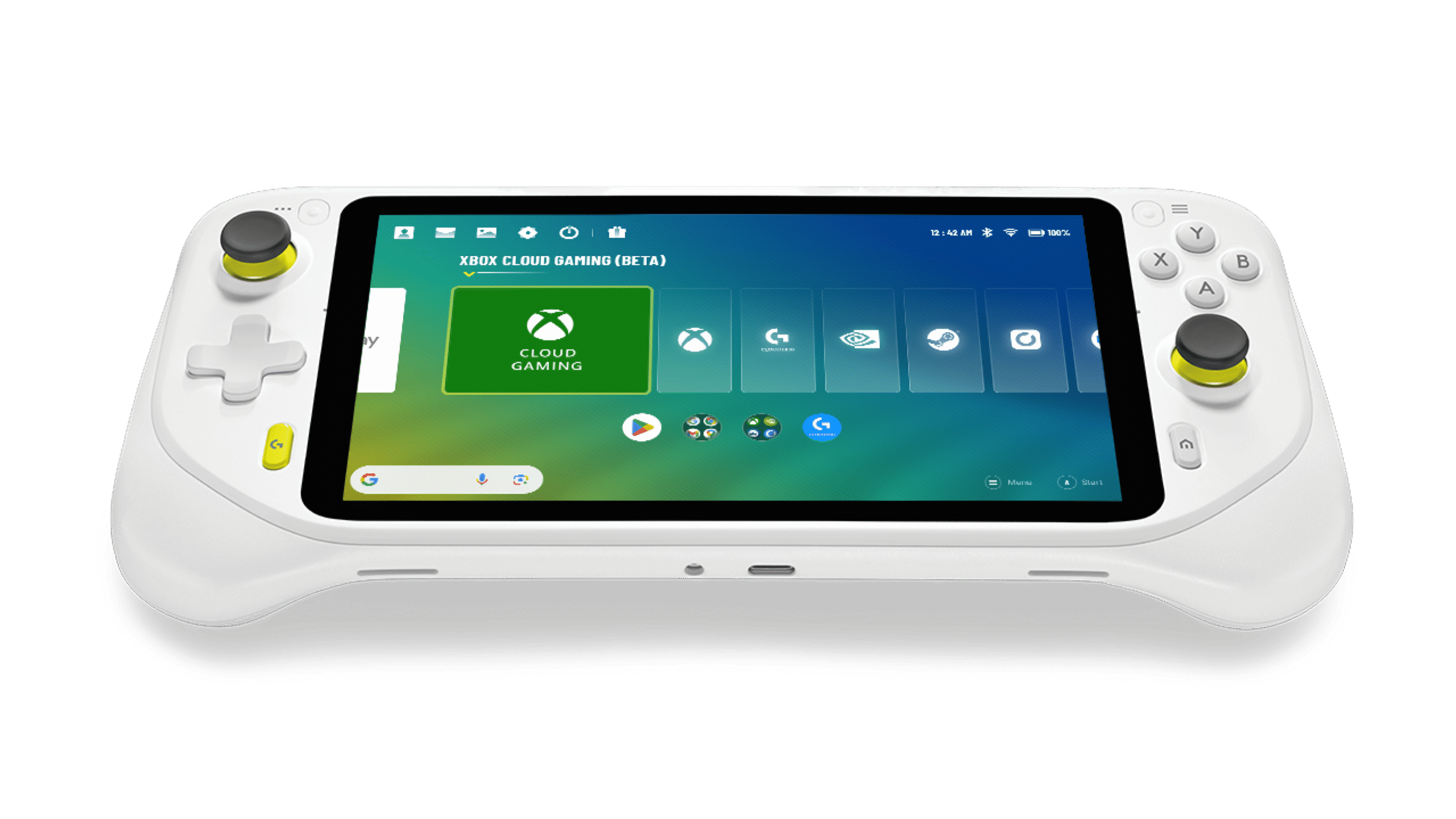
The Logitech G CLOUD is not a local-emulation powerhouse and never pretended to be one. Launched in North America on October 17, 2022 at $349.99, it was Logitech’s bet that the future of portable play was streaming: run the heavy lifting on a distant server through Xbox Cloud Gaming, GeForce NOW, or Steam Link over your home Wi-Fi, and let a light, comfortable Android tablet-with-grips handle the screen and the inputs. Inside is a Qualcomm Snapdragon 720G with an Adreno 618 GPU, 4GB of RAM, and 64GB of storage. That is a solidly mid-range 2020-era mobile chip, not a Dimensity 1200 or a Snapdragon 8-series, and it defines exactly what this device can and cannot do when the internet is switched off.
Emulation performance, generation by generation
Because it runs standard Android 11, the G CLOUD installs RetroArch, Dolphin, AetherSX2, and the rest straight from the Play Store or as sideloaded APKs, and its physical controls make it a genuinely pleasant emulation handheld inside the Adreno 618’s limits. Everything up to and including PlayStation 1, plus the 8- and 16-bit libraries, Game Boy Advance, and Sega Saturn’s lighter titles, runs at full speed without fiddling. Nintendo 64, Dreamcast, and PSP are comfortable, with the occasional demanding PSP game needing a resolution drop. The ceiling is GameCube and PS2: Dolphin needs the Vulkan backend and per-game patience, and while lighter GameCube games like Mario Kart: Double Dash become playable, heavier ones stutter into slideshow territory. PS2 through AetherSX2 is a mixed bag that leans on the same Vulkan tricks. Do not expect Switch, Wii U, or 3DS at anything like reliable speed; the 720G simply is not that class of silicon, and its four cores plus Adreno 618 are the wall you will keep hitting. Treat the local ceiling as “PS1, N64, Dreamcast, PSP solid, GameCube/PS2 case-by-case,” and you will be happy. The upside of that modest chip is thermals: it barely warms, never throttles into a fan-scream, and the mapped physical buttons mean you are not smearing fingerprints across a touchscreen the way you would emulating on a phone.
Screen, build and controls
The panel is the headline. A 7-inch 1920×1080 IPS touchscreen at 60Hz and 450 nits is sharper and larger than almost anything in the sub-$400 handheld bracket, and it flatters cloud streams and PSP-era 3D alike. At roughly 463 grams the G CLOUD is featherlight for its footprint, and the ergonomics are the best part of the whole package: full-size grips, a proper Xbox-style ABXY layout, a good d-pad, and clicky face buttons that feel like a real controller rather than a phone bolted to a bracket. The trade-offs are honest ones. The analog sticks are conventional potentiometer units, not Hall effect, so drift is a long-term possibility. The triggers are digital rather than analog, which stings for racing games. There is a 3.5mm jack and USB-C for charging, and the 6000mAh battery delivers a genuine 12-plus hours when streaming, since the chip is barely working.
Software and setup
Out of the box you get a Logitech-skinned Android 11 launcher built around the streaming services, with app tiles for Xbox Cloud Gaming, GeForce NOW, and the Google Play Store. It is locked down and cloud-first by design, but the underlying Android is fully accessible, so most owners immediately install Daijisho or Beacon as a front end, add RetroArch and standalone cores, and turn it into a tidy retro machine. The bootloader can be unlocked for deeper tinkering, and the XDA community has documented the process, though there is no thriving custom-firmware ecosystem here the way there is on Linux-based RG or Anbernic devices; muOS, Knulli, ROCKNIX, and ArkOS are Linux distributions and do not apply to this Android tablet. The realistic path is not reflashing the OS but taming the stock Android with better launchers and per-app settings. Logitech has kept the device on the market and even refreshed its store imagery into 2025, but security patches for a 2022 Snapdragon platform will not last forever, and there is no Android version bump on the horizon.
Price, value and who it is for
At its $349.99 list price the G CLOUD asked a lot for a mid-range chip, and reviewers were split precisely because your verdict depends on your Wi-Fi and your intentions. If you have Game Pass Ultimate or a GeForce NOW subscription, fast home internet, and you want the most comfortable way to stream AAA games around the house on a beautiful 1080p screen, it is excellent and the battery life is untouchable. If you want a do-everything local emulator, a Snapdragon 8 Gen 2 handheld or even a cheaper Anbernic will out-muscle it for raw compute. Buy the G CLOUD for the screen, the ergonomics, and cloud streaming; tolerate the 720G as a capable-but-capped local bonus, not the main event. Widely discounted below $300 since launch, it makes far more sense at that price.
📐 Size & Pocketability
⚖️ Weight vs Other Handhelds
🔋 Real-World Battery Estimator
⭐ Emulation Performance
📊 View How This Score is Calculated
The Hardware Power Score is an absolute metric. Perfect emulation of difficult, modern consoles awards significantly more points than standard retro consoles.
- 15× Multiplier: Modern PC
- 12× Multiplier: Switch, PS3, Xbox 360
- 10× Multiplier: Wii U
- 8× Multiplier: PS2, GameCube, Wii, Xbox
- 5× Multiplier: Saturn, Dreamcast, PSP
- 3× Multiplier: N64, PS1
- 1× Multiplier: SNES, GBA
Gen 8 & PC
Generation 7
Generation 6
Generation 5
Handhelds & Retro
⚡ Performance Benchmarks
Where Logitech G CLOUD Adreno 618 lands against the handhelds everyone knows. Every bar shares one scale, so longer genuinely means faster — add up to two rivals to compare.
CPU = Geekbench 6 multi-core · GPU = 3DMark Wild Life. Median real-world scores; every bar shares one scale — add up to two rivals to compare.
📋 Full Specifications
📺 Display
⚙️ Platform
💾 Memory
🕹️ Controls
📏 Body
🔋 Battery
⚖️ Verdict
✅ The Good
- Gorgeous 7-inch 1080p IPS screen and superb, lightweight controller-grade ergonomics
- Class-leading battery life, comfortably 12+ hours when cloud streaming
- Standard Android 11 means Play Store, sideloading, and full RetroArch/Dolphin access
- Excellent for Xbox Cloud Gaming, GeForce NOW, and Steam Link over solid Wi-Fi
❌ The Bad
- Snapdragon 720G caps local emulation at roughly PS1/N64/PSP; GameCube and PS2 are unreliable
- Potentiometer sticks (no Hall effect) and digital-only triggers
- Cloud-first premise makes it heavily dependent on fast, stable internet and subscriptions
📰 Latest News & Guides
The Ultimate Guide to ARMSX3: Android’s New PS3 Emulator, Competitor Comparisons, and Setup Tutorial
18/08/2026Pokémon Gold, Silver, and Crystal (Gen 2) Recomp Lands on Android
17/08/2026How to Play the Pokémon Red, Blue, or Yellow Recomp on Your Android, Windows, and Linux Devices
16/08/2026🔍 Similar Handhelds
Other handhelds that emulate up to PS2.