
🛒 Where to Buy
⚠️ Golden Rule of Retro Handhelds: Throw away the cheap MicroSD card that comes in the box — it will fail. And never use a high-wattage PD “Fast Charger” on these devices; it can damage the battery. Use a standard 5V/1.5A brick.
Device Overview: KONKR Pocket Fit Elite
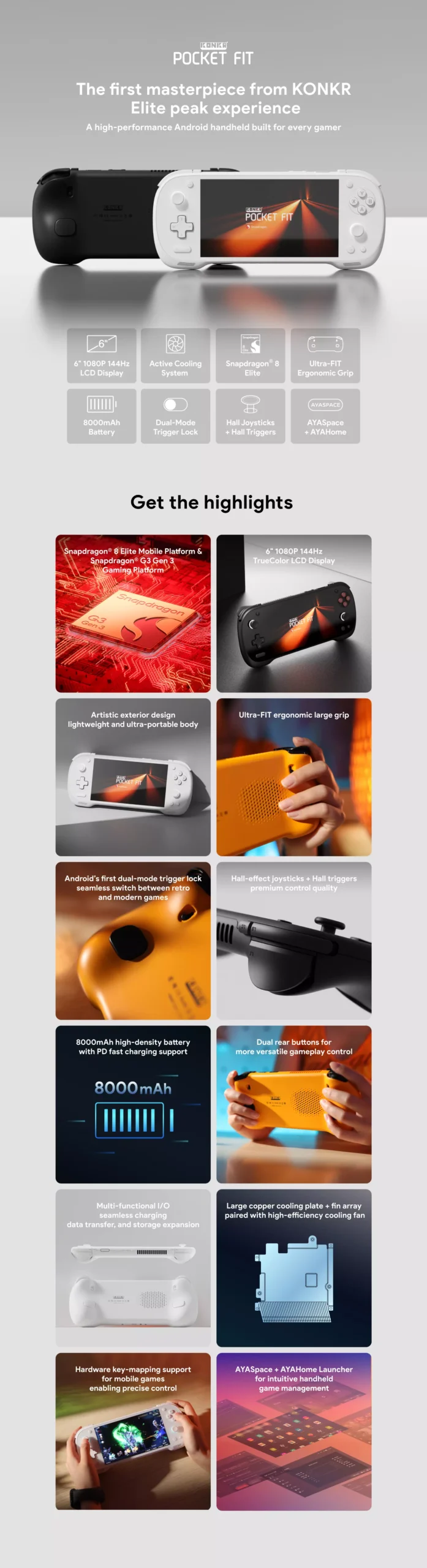
KONKR is AYANEO’s value-focused sub-brand, and the KONKR Pocket Fit Elite is the top rung of that small ladder. Take the ordinary Pocket Fit, pull out its gaming-tuned Snapdragon G3 Gen 3, and drop in Qualcomm’s current flagship Snapdragon 8 Elite: what you get is a 6-inch Android handheld that argues with the Retroid Pocket 5 and the AYN Odin 2 rather than the sub-$100 Linux crowd. This is not a Rockchip retro brick you flash with a hobbyist OS. It is a full Android 16 phone-class device wearing a controller shell, and its price, heat and appetite all reflect that.
Emulation performance, generation by generation
Because the 8 Elite pairs Kryo cores that boost past 4 GHz with an Adreno 830 GPU, the practical ceiling sits well above the usual retro-handheld conversation. Everything from the 8-bit and 16-bit eras through PS1, Saturn, Dreamcast, PSP and Nintendo DS is trivial: RetroArch cores or standalone apps like DuckStation, Flycast and PPSSPP run full speed with heavy upscaling and headroom left over. PS2 (via AetherSX2 or the NetherSX2 fork) and GameCube/Wii (Dolphin) are where this chip earns its keep, holding full speed with 2x to 4x internal resolution on the demanding titles that choke cheaper MediaTek and older Snapdragon boards. Nintendo Switch is the honest frontier. Forks such as Eden, the actively maintained successor after Yuzu’s shutdown, will boot a large slice of the library, but it wants the Gaming or Max power profile, throws off real heat, and stays sharply game-dependent. One genuinely odd wrinkle that reviewers keep flagging: the cheaper G3 Gen 3 sibling sometimes beats the 8 Elite at Switch specifically, because its open-source Turnip Adreno drivers are better tuned for that workload. So the Elite is the more powerful chip on paper, not automatically the better Switch machine. Wii U and PS3 remain out of reach on any Android handheld today.
Screen, build and controls
The 6-inch panel is a 1920×1080 LCD running 144 Hz, 16:9, roughly 367 PPI. It is bright and quick, but it is LCD, not OLED, so blacks read grey and contrast trails an OLED rival like the Odin 2 Portal. That is a deliberate cost choice. Controls are the strong suit here: asymmetrical Hall-effect sticks that will not drift, ringed with RGB; analog triggers with a dual mode that swaps between full linear travel and a snappier digital click, plus physical locks; clickable L3/R3; a complete L1/L2/R1/R2 shoulder set; and a proper d-pad. A 6-axis gyroscope covers motion aiming, and dual X-axis linear motors give haptics closer to a good phone than the buzzy rotary motors on budget units. At 386 g, with a grip that tapers from 17 to about 28 mm and a 225 mm width, this is a two-handed slab, not something for a jacket pocket. The “Pocket” name is optimistic.
Software and setup
Out of the box it runs Android 16 under KONKR and AYANEO’s own launcher and button-mapping layer. Because this is a locked Qualcomm Android device, the Linux custom-firmware ecosystem that defines cheaper handhelds does not apply: muOS, Knulli, ArkOS, ROCKNIX, Batocera and OnionOS cannot be flashed onto a Snapdragon 8 Elite, and expecting them to is the wrong mental model. The real “setup” work happens inside Android instead. You install RetroArch and the standalone emulators above, then hide the phone interface behind a console-style front end such as ES-DE (EmulationStation Desktop Edition) or Daijisho; EmuDeck’s Android edition can automate much of that scaffolding. Google Play, sideloading and streaming clients (Xbox, Moonlight, GeForce Now) all behave as on any Android tablet, and the USB 3.2 Gen 2 Type-C port outputs video up to 1440p at 144 Hz for docked play.
Price, value and who it is for
Elite pricing opened on crowdfunding around $269 for the 8 GB / 128 GB tier and climbed toward roughly $549 for the 24 GB / 1 TB build (LPDDR5X memory, UFS 4.0 storage on the higher configs), with retail settling near or above $320 depending on trim. That undercuts the Odin 2 and Retroid flagships while matching their silicon. It makes sense for someone who specifically wants near-top PS2, GameCube and Wii performance, a 144 Hz screen and room to experiment with Switch, and who is comfortable living inside Android rather than a tidy retro menu. It is weak value if you only play up to PSP or Dreamcast, where a $150 device is flawless; if you want OLED; or if a locked Android SoC with no Linux-CFW path bothers you. One caveat worth stating plainly: the Elite variant is new and thinly reviewed, and published spec sheets still disagree on small points such as the exact Bluetooth revision and Wi-Fi version, so treat the sub-spec details as provisional until more hands-on units circulate.
📐 Size & Pocketability
⚖️ Weight vs Other Handhelds
🔋 Real-World Battery Estimator
⭐ Emulation Performance
📊 View How This Score is Calculated
The Hardware Power Score is an absolute metric. Perfect emulation of difficult, modern consoles awards significantly more points than standard retro consoles.
- 15× Multiplier: Modern PC
- 12× Multiplier: Switch, PS3, Xbox 360
- 10× Multiplier: Wii U
- 8× Multiplier: PS2, GameCube, Wii, Xbox
- 5× Multiplier: Saturn, Dreamcast, PSP
- 3× Multiplier: N64, PS1
- 1× Multiplier: SNES, GBA
Gen 8 & PC
Generation 7
Generation 6
Generation 5
Handhelds & Retro
📋 Full Specifications
📺 Display
⚙️ Platform
💾 Memory
🕹️ Controls
📏 Body
🔋 Battery
⚖️ Verdict
✅ The Good
- Flagship Snapdragon 8 Elite with Adreno 830 pushes PS2, GameCube and Wii to full speed with 2x-4x upscaling, genuinely above the retro-handheld norm
- Drift-proof Hall-effect sticks and dual-mode analog triggers with physical locks, plus dual linear-motor haptics, make for a properly specced control deck
- Fast 6-inch 1080p 144 Hz LCD with USB-C 3.2 Gen 2 video output up to 1440p/144 Hz for docked play
- Large 8000 mAh battery with PD fast charging, and configurations up to 24 GB LPDDR5X and 1 TB UFS 4.0
❌ The Bad
- LCD rather than OLED means grey blacks and weaker contrast than similarly priced OLED rivals such as the Odin 2 Portal
- Locked Android 16 device on a Qualcomm SoC: none of the Linux custom firmware (muOS, Knulli, ArkOS, Batocera) can be flashed, so setup means wrangling Android emulators and front ends yourself
- Elite variant is newly launched and thinly reviewed, with spec sheets that disagree on details (Bluetooth revision, Wi-Fi version) and, oddly, weaker Switch emulation than the cheaper G3 Gen 3 in current testing
📰 Latest News & Guides
The Ultimate Guide to ARMSX3: Android’s New PS3 Emulator, Competitor Comparisons, and Setup Tutorial
18/08/2026Pokémon Gold, Silver, and Crystal (Gen 2) Recomp Lands on Android
17/08/2026How to Play the Pokémon Red, Blue, or Yellow Recomp on Your Android, Windows, and Linux Devices
16/08/2026🔍 Similar Handhelds
Other handhelds that emulate up to CURRENTGEN.