
🛒 Where to Buy
⚠️ Golden Rule of Retro Handhelds: Throw away the cheap MicroSD card that comes in the box — it will fail. And never use a high-wattage PD “Fast Charger” on these devices; it can damage the battery. Use a standard 5V/1.5A brick.
Device Overview: Game Pad Digital GPD Win 5
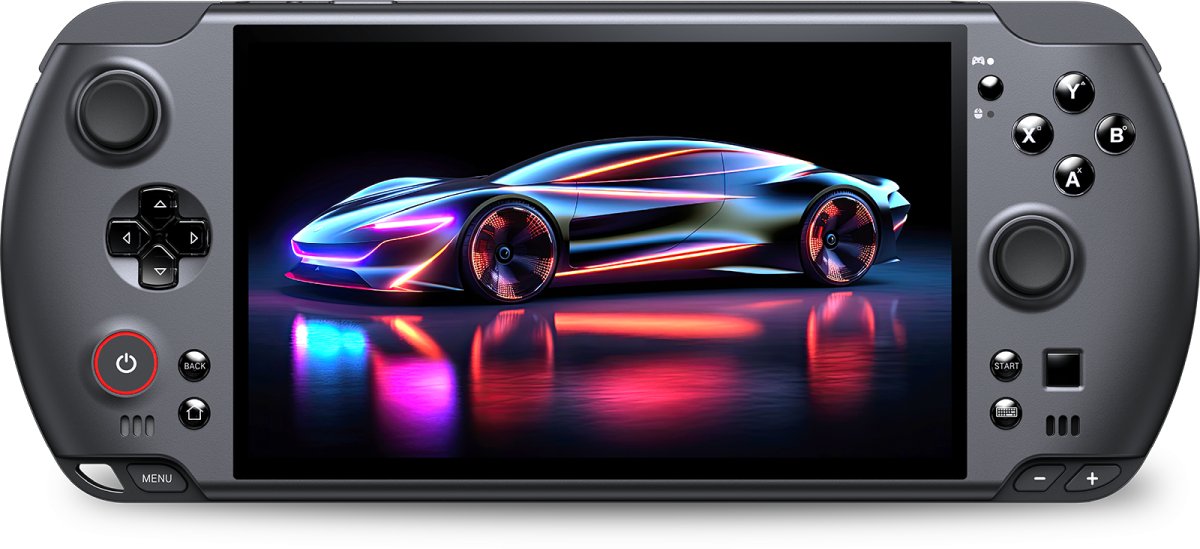
The Game Pad Digital GPD Win 5 is not a retro emulation toy; it is a full x86 Windows 11 PC compressed into a 565-gram slab, built around AMD’s “Strix Halo” silicon. Configurations run from the eight-core Ryzen AI Max 385 to the sixteen-core, thirty-two-thread Ryzen AI Max+ 395, the latter paired with a Radeon 8060S iGPU carrying 40 RDNA 3.5 compute units. That is desktop-class hardware, benchmarked by GPD and reviewers at roughly mobile RTX 4060 level, and it is the first handheld of its kind, which is why the entry price starts near $1,400 and the loaded 128 GB model crosses $2,600. For emulation the number that matters is not the GPU but the CPU: sixteen Zen 5 cores are exactly what the hardest emulators have always been starved of.
Emulation performance, generation by generation
Because this is a Windows machine you use the same emulators you would on a desktop, so the ceiling is effectively the entire catalog. PS2 on PCSX2 and GameCube/Wii on Dolphin run at 4x to 6x internal resolution without a second thought. Wii U on Cemu and 3DS on the Citra successors (Azahar, Lime3DS) are trivial. The interesting tier is where weaker handhelds fall over: RPCS3 lives and dies on raw thread count, and the 395’s sixteen cores push demanding PS3 titles that a Steam Deck chokes on. Xbox 360 through Xenia runs “extremely well” in DROIX’s testing, and original Xbox via xemu is a non-issue. Switch emulation, now handled by post-Ryujinx community forks such as Eden and Citron, scales to high internal resolutions here, limited more by emulator maturity than by this chip. Vita3K and heavy PC-era titles all have headroom. For a sense of the raw budget behind that, GPD’s own figures show DOOM: The Dark Ages at 120 fps and Gears of War Remastered at 60 fps at 1080p on an 80 W TDP, so native modern games, not emulation, are where the thermal headroom actually gets spent. Realistically the only thing this box cannot brute-force is a system nobody has written an emulator for yet.
Screen, build and controls
The 7-inch LTPS panel is native landscape at 1920×1080, 120 Hz with AMD FreeSync Premium variable refresh, 500 nits, and Gorilla Glass 6, a real jump from the Win 4’s 6-inch 60 Hz screen. VRR earns its keep on a handheld PC more than on a fixed console, because framerates swing hard at any given wattage. The controls are pure GPD: capacitive-touch analog sticks (GPD’s own listing also markets them as Hall-effect for drift resistance), a proper D-pad, ABXY, bumpers, and programmable L4/R4 rear paddles. The triggers are the standout, dual-mode Hall-effect units you toggle between long analog travel and a clicky short-throw switch using back levers, handy for jumping from a racing sim to a shooter. A 6-axis gyro and a fingerprint reader round it out. The big change from the Win 4: the slide-out keyboard is gone, a first for the Win line, so text entry falls back to touch or an external board. At 267 mm wide and 24 mm thick this is a large device, and the 80 Wh battery is detachable and hot-swappable, which is genuinely smart, though the optional external pack adds another 350 g. Storage runs from 1 to 4 TB of PCIe Gen4 NVMe, and GPD bundles a self-described world-first Mini SSD slot rated around 1600 MB/s alongside microSD, so expansion is unusually flexible.
Software and setup
Stock is Windows 11 Home, with all of Windows’ handheld baggage: driver updates, TDP wrangling, and a desktop UI that fights a 7-inch screen. The “custom firmware” reality here is not muOS or Knulli, which are for ARM Linux boxes, but the Windows-handheld tooling stack: Handheld Companion or GPD’s own WinControls for mapping and TDP profiles, Playnite as a couch front-end, and EmuDeck’s Windows installer to wire up every emulator above in one pass. Plenty of owners wipe Windows entirely for Bazzite, the SteamOS-style Fedora spin, to get a console-like Steam UI and tighter power management, and the OCuLink port lets you bolt on an external GPU at a desk. Budget an afternoon for wattage, fan curves, and VRAM allocation, since up to 96 GB of the LPDDR5X can be handed to the iGPU. Dual fans hold the chassis to around 48 C without the battery attached, and the bundled 180 W adapter refills the pack in roughly 1.5 hours.
Price, value and who it is for
This is the most expensive way to emulate anything, full stop. Starting around $1,400 and running past $2,600, the Win 5 costs three to six times a Steam Deck OLED and is aimed squarely at people who want native AAA PC gaming and no-compromise emulation in one device, and who will actually use USB4 and OCuLink docking. If your goal is retro up to PS2 and GameCube, this is absurd overkill; a $150 handheld does that job. Buy the Win 5 if PS3, Switch, and Xbox 360 emulation at high resolution, alongside current Windows releases, is the whole point, and the price genuinely does not scare you.
📐 Size & Pocketability
⚖️ Weight vs Other Handhelds
🔋 Real-World Battery Estimator
⭐ Emulation Performance
📊 View How This Score is Calculated
The Hardware Power Score is an absolute metric. Perfect emulation of difficult, modern consoles awards significantly more points than standard retro consoles.
- 15× Multiplier: Modern PC
- 12× Multiplier: Switch, PS3, Xbox 360
- 10× Multiplier: Wii U
- 8× Multiplier: PS2, GameCube, Wii, Xbox
- 5× Multiplier: Saturn, Dreamcast, PSP
- 3× Multiplier: N64, PS1
- 1× Multiplier: SNES, GBA
Gen 8 & PC
Generation 7
Generation 6
Generation 5
Handhelds & Retro
📋 Full Specifications
📺 Display
⚙️ Platform
💾 Memory
🕹️ Controls
📏 Body
🔋 Battery
⚖️ Verdict
✅ The Good
- Strix Halo APU (up to 16-core Zen 5 with Radeon 8060S, roughly RTX 4060-class) makes it the strongest emulation handheld you can buy, comfortably running PS3, Switch and Xbox 360 at high internal resolution
- 7-inch 1920×1080 120 Hz LTPS screen with FreeSync Premium VRR, 500 nits and Gorilla Glass 6, native landscape
- Detachable, hot-swappable 80 Wh battery plus USB4 (40 Gbps) and OCuLink for external-GPU and desktop docking
- Dual-mode Hall-effect triggers (analog/switch toggle) and up to 128 GB LPDDR5X, with up to 96 GB assignable as VRAM
❌ The Bad
- Extreme price: starts near $1,400 and tops $2,600, several times a Steam Deck OLED for the same pre-PS3 emulation
- Bulky and heavy (565 g bare, 267 mm wide, 24 mm thick) and it drops the Win 4's built-in slide-out keyboard
- Windows 11 handheld overhead: driver and TDP tuning, fan noise up to about 67 dB under load, and short battery life at full wattage
📰 Latest News & Guides
The Ultimate Guide to ARMSX3: Android’s New PS3 Emulator, Competitor Comparisons, and Setup Tutorial
18/08/2026Pokémon Gold, Silver, and Crystal (Gen 2) Recomp Lands on Android
17/08/2026How to Play the Pokémon Red, Blue, or Yellow Recomp on Your Android, Windows, and Linux Devices
16/08/2026🔍 Similar Handhelds
Other handhelds that emulate up to CURRENTGEN.