
🛒 Where to Buy
⚠️ Golden Rule of Retro Handhelds: Throw away the cheap MicroSD card that comes in the box — it will fail. And never use a high-wattage PD “Fast Charger” on these devices; it can damage the battery. Use a standard 5V/1.5A brick.
Device Overview: TRIMUI Smart Pro S
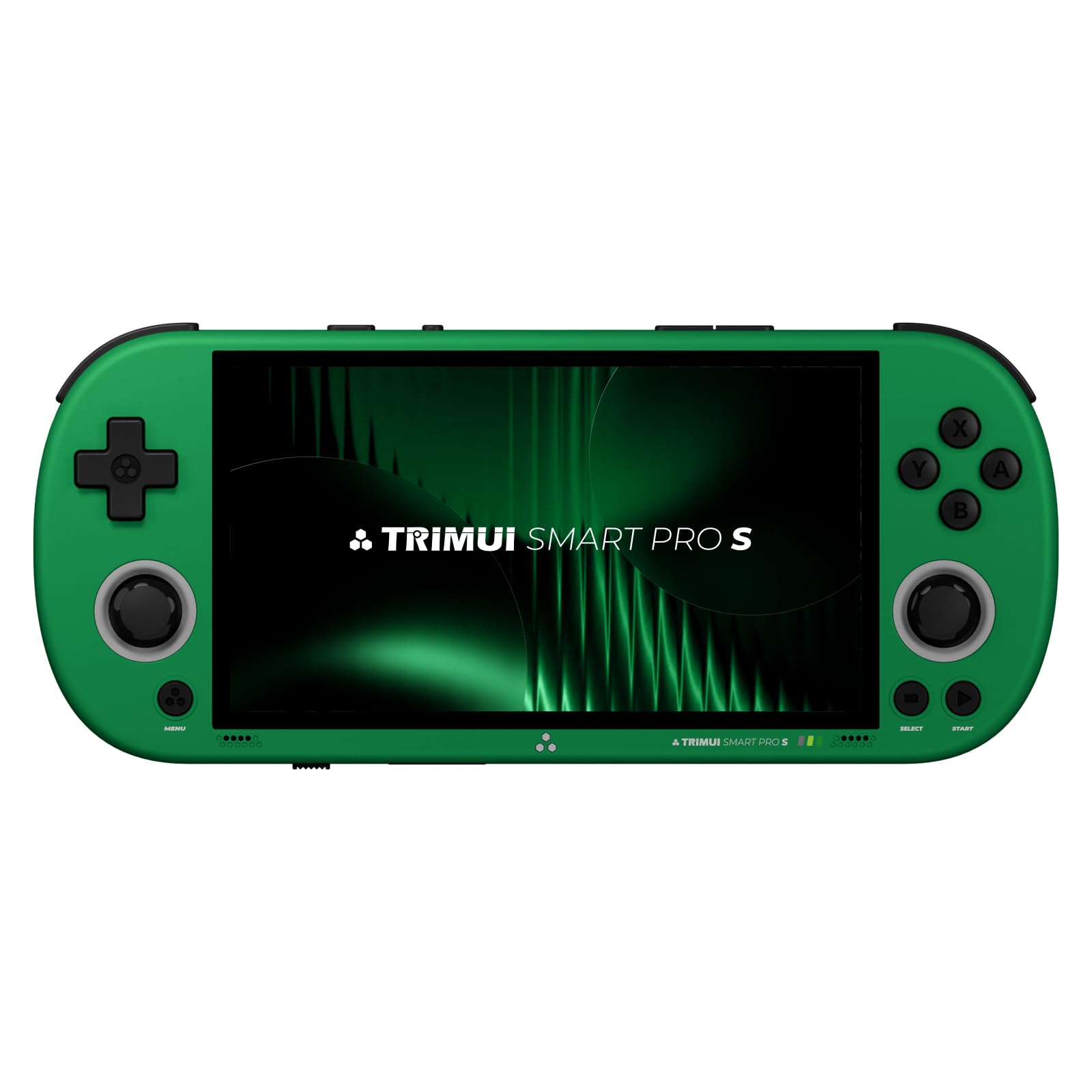
The TRIMUI Smart Pro S is a landscape Linux emulation handheld that keeps the widescreen shape of the original Smart Pro but swaps in a faster chip. It sits in the roughly $100 bracket, competing with dedicated retro boxes rather than the cheaper Android tablets-with-buttons that have flooded that price. The headline change is the move from the Allwinner A133P to the Allwinner A523: an octa-core Cortex-A55 SoC arranged as two quad-core clusters (one reaching 2.0GHz, the other topping out around 1.4GHz) paired with an Arm Mali-G57 MC1 GPU clocked at 744MHz. That is a real generational jump over the PowerVR GE8300 in the first model, and TRIMUI leans on it to push PSP and Dreamcast from “sometimes playable” to “mostly reliable.” What it is not is a Windows or Android powerhouse; there is still only 1GB of LPDDR4 here, and that ceiling shapes everything below. Storage is 8GB of eMMC plus a microSD slot that TRIMUI rates for cards up to 1TB, and connectivity has been modernised to WiFi 6 (802.11ax, dual-band) and Bluetooth 5.4 with a USB-C port and a 3.5mm jack.
Emulation performance, generation by generation
Everything through the 16-bit and 32-bit eras is effortless. NES, SNES, Genesis, Game Boy/Color/Advance, PS1 and Sega 32X all run at full speed under RetroArch cores like Snes9x, mGBA, and PCSX-ReARMed, typically with room for shaders. Nintendo 64 is the first real test and the A523 handles the bulk of the library well through Mupen64Plus, though the notoriously hard titles (the Rare-engine games, some racers) still stutter. Dreamcast via Flycast is genuinely usable now, a category the older A133P chip struggled with. PSP is the device’s real selling point: PPSSPP runs most of the catalogue at native or even 2x internal resolution, and the 720p panel makes that upscaling worthwhile. The demanding 3D showcases, God of War: Chains of Olympus being the usual benchmark, will force you back to native res and still drop frames. Saturn is the usual coin-flip, fine for 2D fighters and shooters but shaky on the 3D-heavy releases. PS2, GameCube, Wii and 3DS are out of reach; do not buy this for them. The active internal cooling fan matters here, keeping the A523 from throttling during long PSP sessions.
Screen, build and controls
The screen is a 4.96-inch fully laminated IPS panel at 1280×720, oriented widescreen, with touch support. It is bright, sharp and among the better displays in the sub-$100 tier, and its 16:9 shape flatters PSP and arcade content while wasting some space on square-ish 4:3 consoles. The chassis measures 187 x 80 x 17mm and weighs roughly 256 to 258 grams, so it is a two-handed slab rather than a pocketable clamshell. Controls are Vita-flavoured: small, squat analog sticks (TMR magnetic sensors, an upgrade over the original’s potentiometer sticks, though not marketed as Hall effect), a clicky raised d-pad that fixes the mushy flush pad of the first Smart Pro, short-throw face buttons, and L3/R3 stick clicks. The shoulder triggers are fully digital with no analog travel, so racing games lose fine throttle control. RGB accent lighting rings the sticks if you want it.
Software and setup
Out of the box it runs TRIMUI’s own Linux-based UI, which is clean and quick to navigate but light on features. The real value, as with every TRIMUI device, is the custom-firmware scene. Because the S uses a new SoC, that scene is still catching up: NextUI (the minimalist MinUI-style fork that dominates on the TRIMUI Brick), Knulli, and Spruce are all in alpha or nightly builds at launch rather than polished stable releases. Expect to flash a microSD, tinker with BIOS folders and per-core settings, and check community threads for the current recommended build. This is not a plug-and-play Android device; budget an afternoon if you want scraped box art, save states and clean per-system layouts working the way you like.
Price, value and who it is for
Street price lands around $85 to $100, with TRIMUI’s own bundle including a 64GB card running closer to $120. For that money you get the best PSP-and-below experience in the widescreen form factor, a standout screen, and an open Linux platform with a firmware community that will keep improving it. It is the right pick for someone who specifically wants a horizontal handheld for PSP, PS1, Dreamcast and arcade, and who enjoys or at least tolerates setup. It is the wrong pick if you want PS2/GameCube, a vertical shape for retro 4:3 systems, or a device that just works without flashing SD cards. Weighed against Android rivals near this price, it trades raw versatility for a cleaner emulation-first experience and better battery discipline from its 5000mAh cell (about six hours real-world). It also comes in an unusually wide colour range for a budget device, including black, white, a grey-and-red scheme, yellow and green, which is a small thing but rare at this price. Treat it as a focused retro machine that tops out at the sixth console generation, and it earns its money; ask it to be a do-everything emulator and it will disappoint.
📐 Size & Pocketability
⚖️ Weight vs Other Handhelds
🔋 Real-World Battery Estimator
⭐ Emulation Performance
📊 View How This Score is Calculated
The Hardware Power Score is an absolute metric. Perfect emulation of difficult, modern consoles awards significantly more points than standard retro consoles.
- 15× Multiplier: Modern PC
- 12× Multiplier: Switch, PS3, Xbox 360
- 10× Multiplier: Wii U
- 8× Multiplier: PS2, GameCube, Wii, Xbox
- 5× Multiplier: Saturn, Dreamcast, PSP
- 3× Multiplier: N64, PS1
- 1× Multiplier: SNES, GBA
Generation 7
Generation 6
Generation 5
Handhelds & Retro
📋 Full Specifications
📺 Display
⚙️ Platform
💾 Memory
🕹️ Controls
📏 Body
🔋 Battery
⚖️ Verdict
✅ The Good
- Allwinner A523 octa-core chip is a genuine leap over the original, making Dreamcast and most PSP reliably playable
- Excellent 4.96-inch 1280×720 laminated IPS screen, among the best in the sub-$100 class
- Active cooling fan prevents throttling during long PSP and N64 sessions
- Open Linux platform with an active CFW scene (NextUI, Knulli, Spruce) plus TMR magnetic sticks and a fixed clicky d-pad
❌ The Bad
- Only 1GB RAM caps it well short of PS2, GameCube and 3DS emulation
- Digital-only shoulder triggers with no analog travel hurt racing and driving games
- Custom firmware for the new A523 was still in alpha/nightly form at launch, so polished setups require patience
📰 Latest News & Guides
The Ultimate Guide to ARMSX3: Android’s New PS3 Emulator, Competitor Comparisons, and Setup Tutorial
18/08/2026Pokémon Gold, Silver, and Crystal (Gen 2) Recomp Lands on Android
17/08/2026How to Play the Pokémon Red, Blue, or Yellow Recomp on Your Android, Windows, and Linux Devices
16/08/2026🔍 Similar Handhelds
Other handhelds that emulate up to Saturn.