
🛒 Where to Buy
⚠️ Golden Rule of Retro Handhelds: Throw away the cheap MicroSD card that comes in the box — it will fail. And never use a high-wattage PD “Fast Charger” on these devices; it can damage the battery. Use a standard 5V/1.5A brick.
Device Overview: Game Console R39S
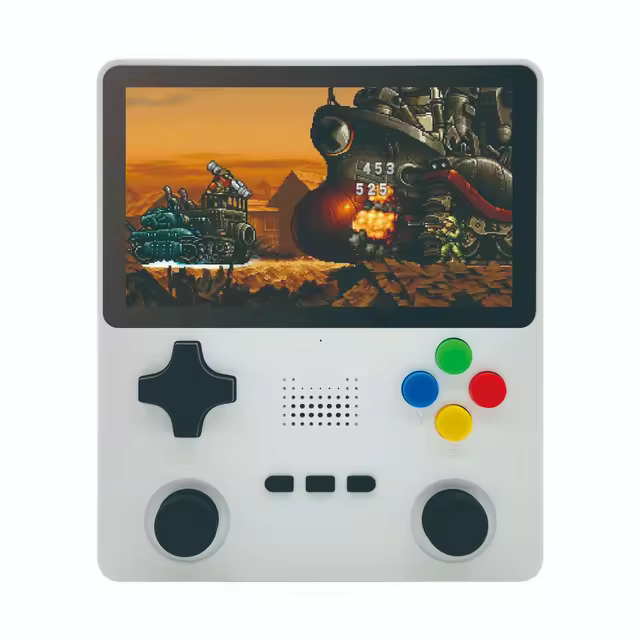
The “Game Console R39S” is the literal name printed on the box of a roughly $40 Chinese emulation handheld sold under no fixed brand across AliExpress, Temu and Amazon. It is the four-inch sibling of the wildly popular R36S: the same Rockchip silicon, the same open-source Linux software, a bigger screen and a pair of analog sticks bolted onto the shell. Anyone shopping for it should start by ignoring the marketing copy, because most listings are wrong about the one spec that matters most.
Emulation performance, generation by generation
Retail pages advertise a “Cortex-A55” or an RK3566. The actual chip, confirmed by the community handhelds wiki and by the device’s obvious R36S lineage, is a Rockchip RK3326: four ARM Cortex-A35 cores topping out around 1.5 GHz, a Mali-G31 MP2 GPU, and just 1 GB of DDR3L RAM. That is a low-power ARM SoC from 2018-era ODROID-GO Advance territory, not a pocket PC, and it sets a hard ceiling. Within that ceiling it is genuinely good. Everything 8- and 16-bit runs at full speed with room to spare: NES, SNES, Genesis, Game Boy through GBA, PC Engine, Master System. PlayStation 1 is the comfortable high point, with DuckStation and PCSX-ReARMed clearing the vast majority of the library. Arcade reaches Neo Geo, CPS1/2/3 and most FinalBurn Neo sets. Above that line the story gets honest fast. Nintendo 64 is a lottery under Mupen64Plus – Mario 64 and Ocarina play, but plenty of titles chug or glitch. Nintendo DS runs through DraStic and is fine for lighter games, though the single gigabyte of RAM and the weak cores surface as stutter in 3D-heavy ones. Dreamcast, Saturn and PSP are effectively out of reach; expect a handful of simple 2D exceptions and nothing reliable. RetroArch is the backbone here, with standalone DraStic and DuckStation cores doing the heavy lifting, and save states work across everything, which papers over the odd slow spot. If your want list stops at PS1, this device delivers. If it starts at PSP, buy something else.
Screen, build and controls
The 4.0-inch IPS panel is the headline upgrade over the R36S. It runs 800×600 in a 4:3 shape, roughly 250 PPI, under tempered glass. Colours are punchy and viewing angles wide indoors; like most cheap IPS handhelds it washes out in direct sunlight. The 4:3 ratio is the right call for retro content and leaves only slim bars on PS1 games. The chassis is plastic, about 112 x 130 mm with curved grips, and a touch chunky in the pocket. The dual analog sticks are a real asset for N64 and PS1, but they are ordinary potentiometer units, not Hall-effect, so drift over time is a fair worry. The d-pad draws the most complaints: stiff, with more travel than it should have, which hurts fighters and precise platformers. Shoulders are two clicky L/R buttons with no analog L2/R2 triggers. The single front-firing cavity speaker is loud enough but tinny, so the 3.5 mm headphone jack earns its keep. A 3200 mAh battery gets you five to seven hours depending on the system, with a roughly two-hour recharge over USB-C.
Software and setup
Out of the box it runs a modified EmuELEC build derived from the ODROID-GO Advance image, with around 20,000 games pre-loaded on the bundled microSD. That stock card is the weak link: unlabelled ROM dumps, dubious legality, and a menu that is clumsy to navigate. The good news is that the RK3326 platform is one of the best-supported in the hobby. You can wipe the card and flash ArkOS, ROCKNIX, AmberELEC or Batocera, all of which carry working configs for the R35S/R36S family the R39S shares – cleaner menus, proper scraping, better per-core settings and box art. One firmware caveat matters: because this is an RK3326 device, muOS, Knulli and OnionOS, which target Allwinner H700 and Miyoo hardware, are not for it. There is no Wi-Fi or Bluetooth, so ROM transfers mean pulling the card; connectivity is limited to USB-C (charge and OTG) plus the advertised TV-out.
Price, value and who it is for
It typically lists around $40 to $55 but routinely drops to $20 to $35 on Temu and AliExpress with coupons, and at that price it is hard to fault for what it is. The pitch is simple: a big-screen, dual-stick R36S for buyers who want PS1 and everything beneath it, cheaply. Skip it if you are chasing PSP, Dreamcast or Saturn, if you need Wi-Fi and clean firmware out of the box, or if you are a d-pad purist. Treat it as a $30 impulse buy, plan on flashing ArkOS or ROCKNIX and swapping the card for your own legally-owned ROMs, and set your expectations at the PS1 line. Do that, and the R39S is a lot of retro handheld for the money. Its natural rivals are the Allwinner H700 crowd such as the Anbernic RG35XX Plus, which trade the second stick and bigger screen for Wi-Fi and slicker firmware; pick the R39S when the 4-inch panel and twin sticks matter more to you than wireless. Just do not believe the spec sheet on the box.
📐 Size & Pocketability
⚖️ Weight vs Other Handhelds
🔋 Real-World Battery Estimator
⭐ Emulation Performance
📊 View How This Score is Calculated
The Hardware Power Score is an absolute metric. Perfect emulation of difficult, modern consoles awards significantly more points than standard retro consoles.
- 15× Multiplier: Modern PC
- 12× Multiplier: Switch, PS3, Xbox 360
- 10× Multiplier: Wii U
- 8× Multiplier: PS2, GameCube, Wii, Xbox
- 5× Multiplier: Saturn, Dreamcast, PSP
- 3× Multiplier: N64, PS1
- 1× Multiplier: SNES, GBA
Generation 6
Generation 5
Handhelds & Retro
⚡ Performance Benchmarks
Where Game Console R39S Mali-G31 MP2 lands against the handhelds everyone knows. Every bar shares one scale, so longer genuinely means faster — add up to two rivals to compare.
CPU = Geekbench 6 multi-core · GPU = 3DMark Wild Life. Median real-world scores; every bar shares one scale — add up to two rivals to compare.
📋 Full Specifications
📺 Display
⚙️ Platform
💾 Memory
🕹️ Controls
📏 Body
🔋 Battery
⚖️ Verdict
✅ The Good
- Confirmed RK3326 platform gets excellent, well-documented custom firmware (ArkOS, ROCKNIX, AmberELEC and Batocera all run)
- Bigger 4.0-inch 800×600 4:3 IPS screen plus dual analog sticks are real upgrades over the 3.5-inch R36S
- Runs everything up to and including PlayStation 1 at full speed, plus Neo Geo and CPS arcade
- Very cheap, often $20 to $35 on sale, with a 3200 mAh battery good for five to seven hours
❌ The Bad
- Retail listings misstate the chip (claim RK3566/Cortex-A55) when it is really an RK3326/Cortex-A35, and sourcing for this no-name device is thin and inconsistent
- Only 1 GB RAM and weak A35 cores make N64 and DS inconsistent and put PSP, Dreamcast and Saturn out of reach
- No Wi-Fi or Bluetooth, ordinary drift-prone (non-Hall) sticks, and a stiff long-throw d-pad
📰 Latest News & Guides
The Ultimate Guide to ARMSX3: Android’s New PS3 Emulator, Competitor Comparisons, and Setup Tutorial
18/08/2026Pokémon Gold, Silver, and Crystal (Gen 2) Recomp Lands on Android
17/08/2026How to Play the Pokémon Red, Blue, or Yellow Recomp on Your Android, Windows, and Linux Devices
16/08/2026🔍 Similar Handhelds
Other handhelds that emulate up to PSP.