
🛒 Where to Buy
⚠️ Golden Rule of Retro Handhelds: Throw away the cheap MicroSD card that comes in the box — it will fail. And never use a high-wattage PD “Fast Charger” on these devices; it can damage the battery. Use a standard 5V/1.5A brick.
Device Overview: Datafrog SF3000
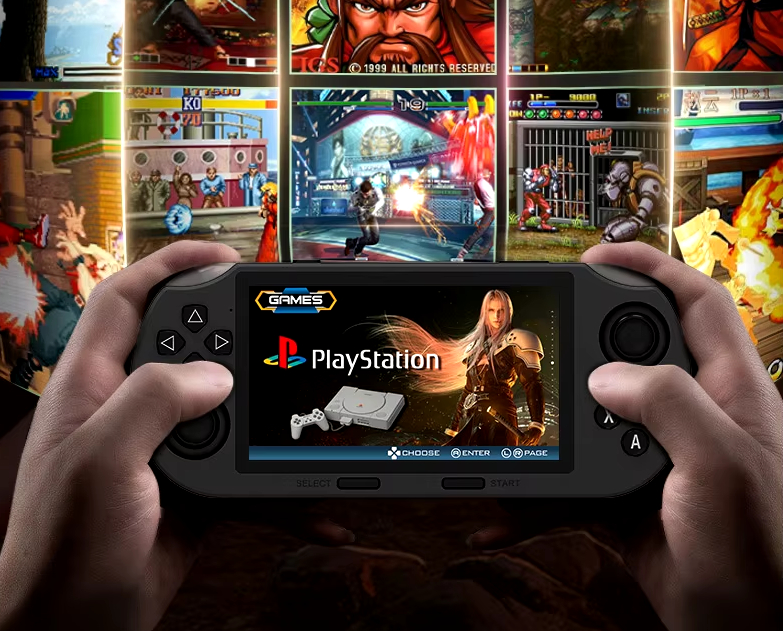
The Datafrog SF3000 is a sub-$35 horizontal handheld that borrows the PSP’s silhouette and almost none of its ambition. It sits one rung above Datafrog’s viral SF2000: the same family of cheap “TV-game” silicon, a bigger 4.5-inch screen, a lone analog stick bolted above the face buttons, and a battery that doubles as a phone charger. The listings promise emulation “up to” PlayStation, Nintendo 64 and Dreamcast. Treat that with the suspicion it deserves. Underneath the sixth-generation costume, this is an 8- and 16-bit machine, and it is best judged as one.
Emulation performance, generation by generation
The SF3000 is built on an HCSEMI (HiChip) C3100, a dual-core MIPS 74Kf-class chip clocked at 1.2 GHz. That is not a Rockchip or Allwinner Linux board like an R36S or an Anbernic; it is a repurposed set-top/plug-and-play processor, the grown-up sibling of the SF2000’s single-core B210. Emulation runs through picoarch, a trimmed-down libretro runtime, not full RetroArch. Understand that and the performance makes sense. NES, Game Boy, Game Boy Color, Master System, PC Engine and Genesis/Mega Drive run at or near full speed. SNES is mostly fine, with the usual stumbles on Super FX and SA-1 carts (Star Fox, Yoshi’s Island). Game Boy Advance is playable but not flawless; demanding scenes drop frames and audio can crackle. Older arcade boards such as CPS1 and the lighter Neo Geo titles are hit and miss but often enjoyable. PlayStation 1 is where the marketing collapses: a few 2D titles limp along, but 3D games are a slideshow, and stock firmware barely attempts it. N64, Dreamcast and PSP are simply not happening on this hardware. Buy it for everything up to and including GBA, and you will not be disappointed; buy it for PS1 and you will.
Screen, build and controls
The 4.5-inch IPS panel runs 854×480 in a 16:9 frame, roughly 217 PPI. It is sharp enough and bright enough for the money, but the widescreen ratio means 4:3 retro games sit in pillarboxed bars unless you stretch them into distortion. The chassis is glossy plastic in the mould of a PSP-1000, with a kickstand on the back and, oddly, TV-out and OTG so it can push video to a screen or top up a phone. The control layout is the SF3000’s strangest decision: a single analog stick perched above the ABXY buttons, where your thumb does not naturally rest. There is a d-pad, four face buttons, L1/R1 up front and rear-mounted L2/R2 triggers. None of it is Hall effect; the stick is a budget potentiometer and the buttons are ordinary membrane-and-rubber. For d-pad-driven 8- and 16-bit games the controls are perfectly serviceable; the moment a game actually wants that stick, the placement fights you.
Software and setup
One honest correction up front: some spec sheets claim the SF3000 runs EmuELEC with 2 GB of RAM. That is almost certainly copy-paste error. EmuELEC is an ARM-only distribution and will not run on a MIPS chip, and community documentation points to roughly 256 MB of RAM, not 2 GB. What you actually get is a proprietary FrogUI-style Linux menu on the microSD card, with a small fixed set of cores (around fourteen) and clumsy save handling. The saving grace is the community. TreeFrog UI, a picoarch-based front-end fork, replaces the stock menu across the SF3000 and its siblings (GB350, SF3500, SF3000 HD) and expands the library to roughly seventy cores with proper save states, per-core options and better scaling. Wi-Fi and Bluetooth are absent, so there is no netplay, online store or over-the-air update; everything you play is loaded onto the card yourself. Installing it is a card-flashing exercise, not a polished wizard, but it is what turns the SF3000 from a toy into a usable emulator. Note that the ARM-world custom firmwares people expect (muOS, Knulli, ArkOS, ROCKNIX, Batocera) do not apply here; this chip lives in its own small ecosystem.
Price, value and who it is for
Datafrog sells the SF3000 for roughly $26 to $33 depending on the bundled microSD card, occasionally packaged with one or two 2.4 GHz wireless controllers for a few dollars more. At that price it is an impulse buy, and as an 8- to 16-bit plus GBA machine with a big screen and a built-in power bank, it earns its keep. It is for the buyer who wants a cheap, cheerful retro handheld for the couch or a long flight, is comfortable flashing a microSD card, and has zero expectation of PS1 or newer. It is the wrong device for anyone who believes the sixth-generation claims, wants dual sticks in a sane position, or expects the mature Anbernic/ARM firmware scene. Documentation is thinner than for mainstream handhelds and the exact RAM figure is still disputed, so a little skepticism is warranted. Judged honestly against its $30 asking price rather than its box art, the Datafrog SF3000 is a fun, flawed little machine.
🔋 Real-World Battery Estimator
⭐ Emulation Performance
📊 View How This Score is Calculated
The Hardware Power Score is an absolute metric. Perfect emulation of difficult, modern consoles awards significantly more points than standard retro consoles.
- 15× Multiplier: Modern PC
- 12× Multiplier: Switch, PS3, Xbox 360
- 10× Multiplier: Wii U
- 8× Multiplier: PS2, GameCube, Wii, Xbox
- 5× Multiplier: Saturn, Dreamcast, PSP
- 3× Multiplier: N64, PS1
- 1× Multiplier: SNES, GBA
Generation 5
Handhelds & Retro
📋 Full Specifications
📺 Display
⚙️ Platform
💾 Memory
🕹️ Controls
📏 Body
🔋 Battery
⚖️ Verdict
✅ The Good
- Genuinely cheap at roughly $26-$33, and the built-in power bank plus TV-out add real utility
- Runs NES, Genesis, SNES and most GBA games well through picoarch
- Large 4.5-inch 854×480 IPS screen that punches above its price
- Active community firmware (TreeFrog UI) expands it from ~14 to ~70 cores with proper save states
❌ The Bad
- Marketing claims of PS1/N64/Dreamcast are false; the MIPS C3100 chip tops out around GBA
- Bizarre control layout with the single analog stick placed above the face buttons, and no Hall effect
- Thin, contradictory documentation: some listings misstate EmuELEC and 2GB RAM (likely ~256MB, MIPS-based)
📰 Latest News & Guides
The Ultimate Guide to ARMSX3: Android’s New PS3 Emulator, Competitor Comparisons, and Setup Tutorial
18/08/2026Pokémon Gold, Silver, and Crystal (Gen 2) Recomp Lands on Android
17/08/2026How to Play the Pokémon Red, Blue, or Yellow Recomp on Your Android, Windows, and Linux Devices
16/08/2026🔍 Similar Handhelds
Other handhelds that emulate up to SNES.