
🛒 Where to Buy
⚠️ Golden Rule of Retro Handhelds: Throw away the cheap MicroSD card that comes in the box — it will fail. And never use a high-wattage PD “Fast Charger” on these devices; it can damage the battery. Use a standard 5V/1.5A brick.
Device Overview: FunKey S
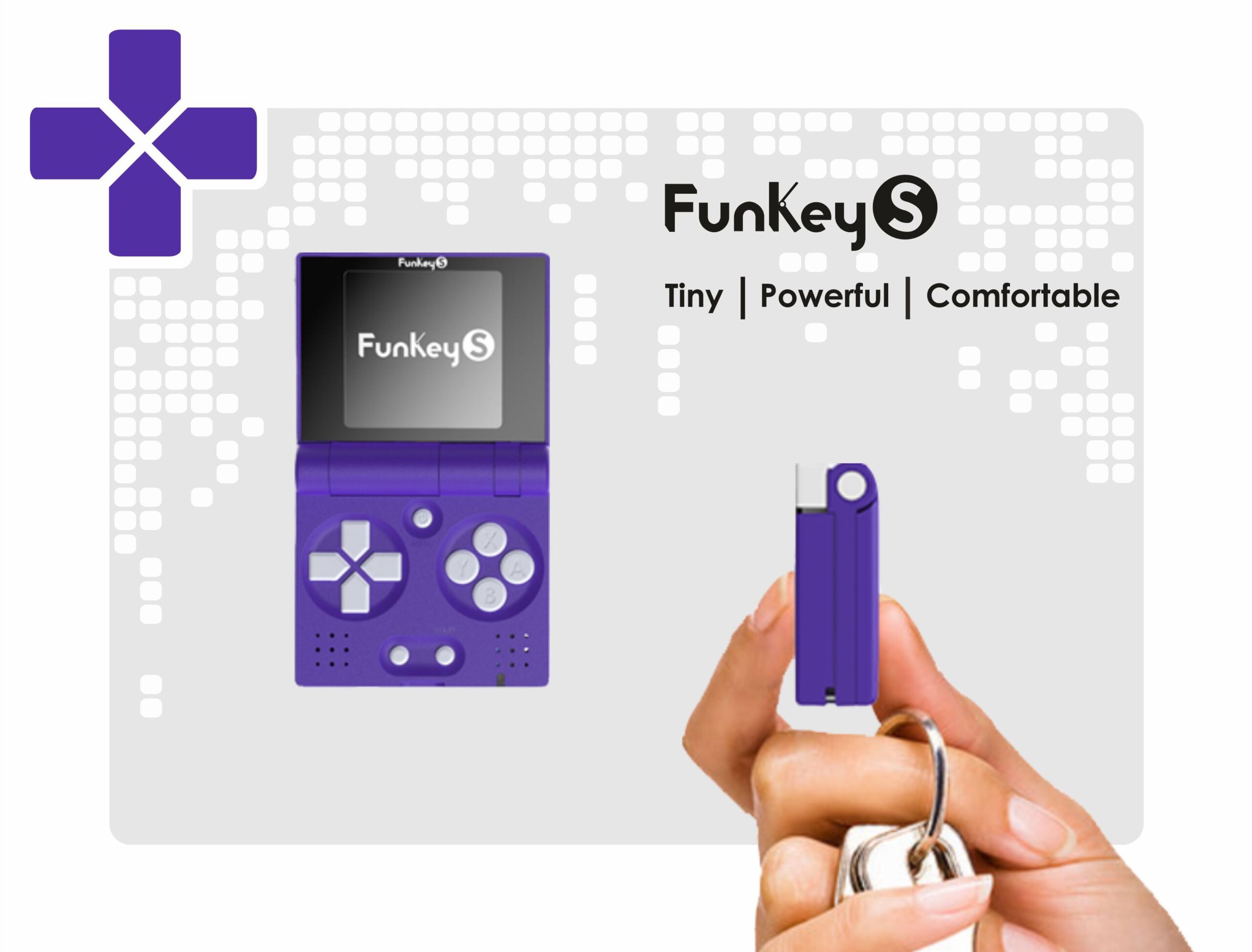
The FunKey S is a Game Boy Advance SP shrunk to keychain scale: a magnetically clasped clamshell measuring 42.5 x 44.5 x 13.8 mm and weighing roughly 30 grams. It began as a Kickstarter project from a small French team in 2020 and shipped in 2021, and its entire stack is open source, from the FunKey OS Linux build to the case STL files you can 3D-print yourself. This is not a device you buy for raw power. You buy it because it emulates 8- and 16-bit libraries convincingly while folding down small enough to hang off your house keys, and almost nothing else on the market commits to that idea as fully.
Emulation performance, generation by generation
The chip is an Allwinner V3s, a single-core ARM Cortex-A7 clocked at 1.2 GHz with 64 MB of DDR2 packaged on-die. Critically, the V3s has no dedicated GPU, so every frame is rendered in software on that lone CPU core. Judge it against that reality, not against an RK3326 or a Windows stick. Game Boy, Game Boy Color, NES, Master System, Game Gear, Neo Geo Pocket and WonderSwan run flawlessly at full speed. SNES and Genesis are the comfortable ceiling and play cleanly, including most of the games that lean on the SNES’s heavier chips. Game Boy Advance runs well across the bulk of the library, though a handful of the most demanding 3D or heavily-scaled titles will chug. PlayStation 1 is the genuine frontier: the FunKey team ships a PCSX4ALL-based core and simpler 2D and RPG titles are playable, but polygon-heavy 3D games drop frames and lean on frameskip. Do not expect anything beyond PS1, and do not expect N64, DS or PSP. The emulators are individual FunKey OS ports rather than a full RetroArch shell, which keeps overhead low on this modest silicon. Power comes from a small 410 mAh cell, and real-world runtime lands in the three-hour range, so this is a device for a bus ride or a coffee queue, not an all-day travel companion. It charges over micro-USB, not USB-C, which is a minor daily annoyance in 2026.
Screen, build and controls
The display is a 1.54-inch IPS LCD at 240 x 240, a 1:1 square running at 60 Hz and around 220 ppi. It is genuinely sharp for its size, and the square panel suits the vertical and near-square aspect ratios of Game Boy and arcade content better than a widescreen would. But it is tiny, and text-heavy RPGs and menu-dense games are hard on the eyes; this is the device’s defining compromise, not a footnote. The clamshell is plastic and light, held shut by magnets, and the hinge doubles as the sleep/wake trigger so closing the lid suspends your game. Audio comes from a single 10 mm mono speaker rated at 500 mW, which is tinny but audible, and there is no headphone jack, so quiet play means muting it entirely. Controls are a proper d-pad, ABXY, and L1/R1 shoulder buttons, plus Power and an Fn shortcut key. There are no analog sticks, no analog or Hall-effect triggers, and no rumble. For the systems it targets that button layout is complete, but the absence of sticks is another reason PS1 is a stretch rather than a home.
Software and setup
It boots into FunKey OS, a purpose-built Buildroot Linux with a clean scrolling launcher, per-emulator save states, and automatic save-on-power-loss so you can just close the lid mid-game. Setup is refreshingly blunt: flash the official image to a microSD (up to 128 GB), drop your ROMs into the matching folders, and go. Because the whole platform is open, the community has produced forked images with added cores, cover-art packs and tweaks, and the project publishes full developer documentation. What you will not find is the mainstream custom-firmware circus that surrounds Anbernic and Miyoo hardware. muOS, Knulli, ArkOS, ROCKNIX and Batocera do not target the V3s, so there is no Onion-style ecosystem here. FunKey OS itself is the open project, and for a device this focused that is largely enough.
Price, value and who it is for
It launched at roughly 62 euros on Kickstarter and settled around 70 to 80 US dollars at retail, and availability has come in production waves rather than continuous stock. That is not cheap for the silicon inside, and a same-price Miyoo or Anbernic gives you a far bigger screen and a stronger chip. The FunKey S is not competing on specs. It is competing on the specific joy of a fully working GBA-class emulator that lives on your keyring and snaps shut like a locket. If you want a couch machine for long RPG sessions, buy something bigger. If you want the smallest credible retro handheld that still plays SNES well and you find the novelty genuinely charming rather than gimmicky, nothing else scratches that itch the same way.
📐 Size & Pocketability
⚖️ Weight vs Other Handhelds
🔋 Real-World Battery Estimator
⭐ Emulation Performance
📊 View How This Score is Calculated
The Hardware Power Score is an absolute metric. Perfect emulation of difficult, modern consoles awards significantly more points than standard retro consoles.
- 15× Multiplier: Modern PC
- 12× Multiplier: Switch, PS3, Xbox 360
- 10× Multiplier: Wii U
- 8× Multiplier: PS2, GameCube, Wii, Xbox
- 5× Multiplier: Saturn, Dreamcast, PSP
- 3× Multiplier: N64, PS1
- 1× Multiplier: SNES, GBA
Generation 5
Handhelds & Retro
📋 Full Specifications
📺 Display
⚙️ Platform
💾 Memory
🕹️ Controls
📏 Body
🔋 Battery
⚖️ Verdict
✅ The Good
- Astonishingly small and light (about 30 g) with a magnetic clamshell that suspends your game the instant you close it
- Flawless full-speed emulation of Game Boy, NES, Master System, Game Gear and handhelds, with SNES and Genesis as a comfortable ceiling
- Sharp 1.54-inch 240×240 IPS panel and a real d-pad plus L1/R1, a complete layout for the 8- and 16-bit systems it targets
- Fully open source, from FunKey OS and the emulator ports to the printable case files, with blunt drag-and-drop ROM setup
❌ The Bad
- The 1.54-inch square screen is punishingly small for text-heavy RPGs and menu-dense games
- Single-core Allwinner V3s with no GPU means PS1 is a shaky frontier and anything past it (N64, DS, PSP) is off the table
- No analog sticks, no Hall-effect controls, no WiFi or Bluetooth, and none of the major custom-firmware distros (muOS, Knulli, ArkOS) support it
📰 Latest News & Guides
The Ultimate Guide to ARMSX3: Android’s New PS3 Emulator, Competitor Comparisons, and Setup Tutorial
18/08/2026Pokémon Gold, Silver, and Crystal (Gen 2) Recomp Lands on Android
17/08/2026How to Play the Pokémon Red, Blue, or Yellow Recomp on Your Android, Windows, and Linux Devices
16/08/2026🔍 Similar Handhelds
Other handhelds that emulate up to PS1.