
🛒 Where to Buy
⚠️ Golden Rule of Retro Handhelds: Throw away the cheap MicroSD card that comes in the box — it will fail. And never use a high-wattage PD “Fast Charger” on these devices; it can damage the battery. Use a standard 5V/1.5A brick.
Device Overview: Anbernic RG-351M
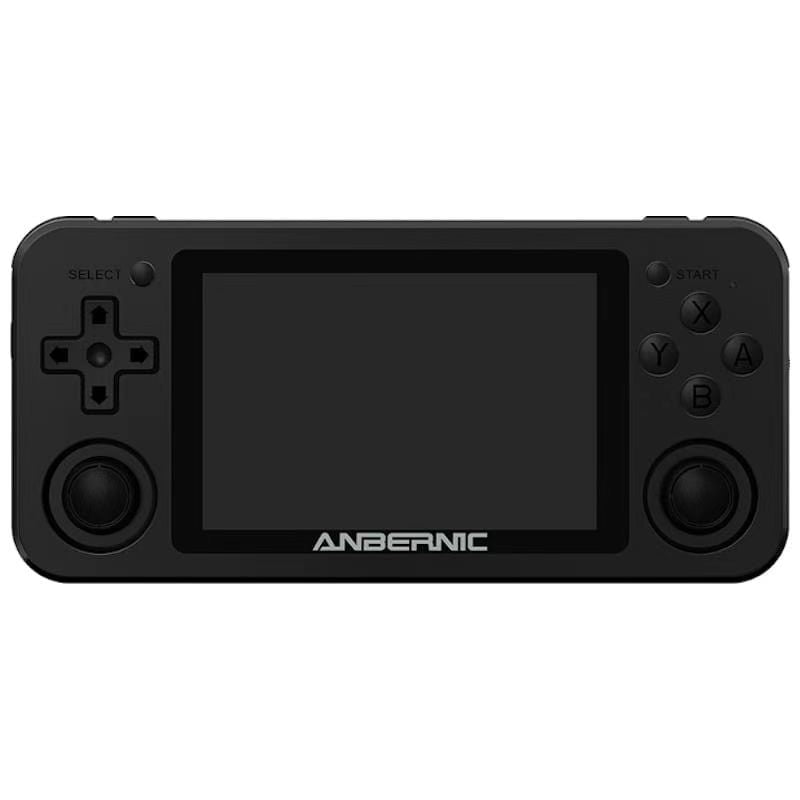
The Anbernic RG-351M is the metal-bodied member of the RG351 family, released at the start of 2021 as a CNC-milled aluminium counterpart to the plastic RG351P. Everything behind the shell is shared with its cheaper sibling: the same Rockchip RK3326 board, the same 3.5-inch screen, the same Linux firmware. What you pay extra for is the housing and one genuinely useful addition, built-in Wi-Fi, which the RG351P lacked. That makes the RG-351M a specific proposition rather than a do-everything machine. It is a beautifully built 8-to-32-bit handheld that happens to run some heavier systems, not a device you buy for N64 or PSP.
Emulation performance, generation by generation
The RK3326 is a quad-core Cortex-A35 clocked at 1.5GHz paired with a Mali-G31 MP2 GPU and just 1GB of DDR3L RAM. Those are modest numbers, and they define a clear ceiling. Everything from the NES, Master System, Genesis/Mega Drive, PC Engine, SNES and Game Boy Advance runs at full speed through RetroArch cores such as Snes9x, Genesis Plus GX and gpSP, with no compromises. Arcade emulation via FBNeo and MAME 2003-Plus covers CPS1/2, most Neo Geo and the bulk of the 1980s-90s catalogue. PlayStation 1 is the comfortable top of the “just works” tier, with PCSX ReARMed running the PS1 library at full speed. Above that line things get conditional. Nintendo DS through DraStic is playable but asks you to accept a compromised screen layout on a 480×320 panel, since two DS screens do not sit comfortably on one small display. Nintendo 64 via Mupen64Plus is the device’s real weak spot: Super Mario 64 and Mario Kart 64 hover near full speed, but demanding titles like GoldenEye 007 stutter and drop audio, and per-game tinkering is the norm rather than the exception. Dreamcast through Flycast is genuinely hit-or-miss, with 2D fighters holding up while 3D-heavy games such as Crazy Taxi crackle and drop frames. PSP via PPSSPP runs lighter 2D and simpler 3D games but runs out of headroom on anything ambitious, held back as much by the 1GB of RAM as by the GPU. Saturn is largely a no. Treat this as a machine that is flawless up to PS1 and a gamble beyond it.
Screen, build and controls
The 3.5-inch IPS panel is 480×320, a 3:2 ratio with OCA full lamination, so the glass sits directly on the pixels with no air gap and no muddy layer between you and the image. Colours and viewing angles are good. The catch is that 3:2 does not divide cleanly into the 4:3 output of the SNES, PS1 or arcade boards, so you choose between small pillarboxes or slight stretching. The aluminium shell is the reason to own this model: CNC-machined, cool to the touch, and clearly a step above the plastic P at 152x71x18mm and around 260 grams. Controls are the RG351 standard, with a proper membrane d-pad, ABXY, and two parallel analogue sticks wearing Switch-style caps. Be clear-eyed here: those sticks are ordinary potentiometer units, not Hall effect, and they do not click, so there is no L3/R3. The shoulders are four digital buttons rather than analogue triggers. Battery life is a genuine strength: the 3500 mAh cell delivers roughly eight hours of 16-bit play and tops up in about four hours. There is a 3.5mm headphone jack, stereo speakers, 2.4GHz Wi-Fi, and two microSD slots so the firmware card and your ROM card stay physically separate.
Software and setup
Out of the box the RG-351M ships with a 351ELEC-derived dual-boot Linux image on the bundled card, which works but is not where most owners end up. The RK3326 has one of the strongest custom-firmware scenes of any budget chip. ArkOS is the popular pick for a clean, EmulationStation-based setup with strong per-system control; AmberELEC (the continuation of 351ELEC) is the polished, auto-configuring option; and ROCKNIX (formerly JELOS) is the actively maintained modern alternative. Batocera also runs on the board. Setup is the usual routine: flash a firmware image to a microSD, then use the second card slot for ROMs, since the dual-slot design keeps the OS and your library physically separate. The built-in Wi-Fi makes RetroAchievements and network scraping painless, which is the one practical edge over the RG351P.
Price, value and who it is for
The RG-351M launched at around $130, roughly $30 to $40 above the plastic RG351P. In 2026 it is an older device, since the RK3326 has been superseded by faster H700 and RK3566 handhelds that actually make N64 and PSP dependable, so buy the RG-351M for what it does well rather than its spec sheet. It suits someone who wants a genuinely premium metal handheld for retro up to the PlayStation 1, values the fixed 3:2 screen and pocketable size, and is happy to treat DS, N64, Dreamcast and PSP as occasional bonuses. If you need those heavier systems to be reliable, spend your money on a newer chip instead.
📐 Size & Pocketability
⚖️ Weight vs Other Handhelds
🔋 Real-World Battery Estimator
⭐ Emulation Performance
📊 View How This Score is Calculated
The Hardware Power Score is an absolute metric. Perfect emulation of difficult, modern consoles awards significantly more points than standard retro consoles.
- 15× Multiplier: Modern PC
- 12× Multiplier: Switch, PS3, Xbox 360
- 10× Multiplier: Wii U
- 8× Multiplier: PS2, GameCube, Wii, Xbox
- 5× Multiplier: Saturn, Dreamcast, PSP
- 3× Multiplier: N64, PS1
- 1× Multiplier: SNES, GBA
Generation 6
Generation 5
Handhelds & Retro
⚡ Performance Benchmarks
Where Anbernic RG-351M Mali-G31 MP2 lands against the handhelds everyone knows. Every bar shares one scale, so longer genuinely means faster — add up to two rivals to compare.
CPU = Geekbench 6 multi-core · GPU = 3DMark Wild Life. Median real-world scores; every bar shares one scale — add up to two rivals to compare.
📋 Full Specifications
📺 Display
⚙️ Platform
💾 Memory
🕹️ Controls
📏 Body
🔋 Battery
⚖️ Verdict
✅ The Good
- CNC aluminium shell is genuinely premium and durable, a real step up from the plastic RG351P
- Flawless full-speed emulation for everything up to and including PlayStation 1
- OCA-laminated 3.5-inch IPS screen gives a bright, clean image with no air gap
- Excellent custom-firmware support (ArkOS, AmberELEC, ROCKNIX) plus onboard Wi-Fi for RetroAchievements and scraping
❌ The Bad
- 1GB of RAM and the aging RK3326 make N64, Dreamcast and PSP unreliable and needing per-game tinkering
- Potentiometer sticks (no Hall effect), no clickable L3/R3, and digital rather than analogue shoulder triggers
- 3:2 screen does not map cleanly onto 4:3 systems, forcing pillarboxing or stretching
📰 Latest News & Guides
The Ultimate Guide to ARMSX3: Android’s New PS3 Emulator, Competitor Comparisons, and Setup Tutorial
18/08/2026Pokémon Gold, Silver, and Crystal (Gen 2) Recomp Lands on Android
17/08/2026How to Play the Pokémon Red, Blue, or Yellow Recomp on Your Android, Windows, and Linux Devices
16/08/2026🔍 Similar Handhelds
Other handhelds that emulate up to DS.