
🛒 Where to Buy
⚠️ Golden Rule of Retro Handhelds: Throw away the cheap MicroSD card that comes in the box — it will fail. And never use a high-wattage PD “Fast Charger” on these devices; it can damage the battery. Use a standard 5V/1.5A brick.
Device Overview: AYANEO Pocket S Mini
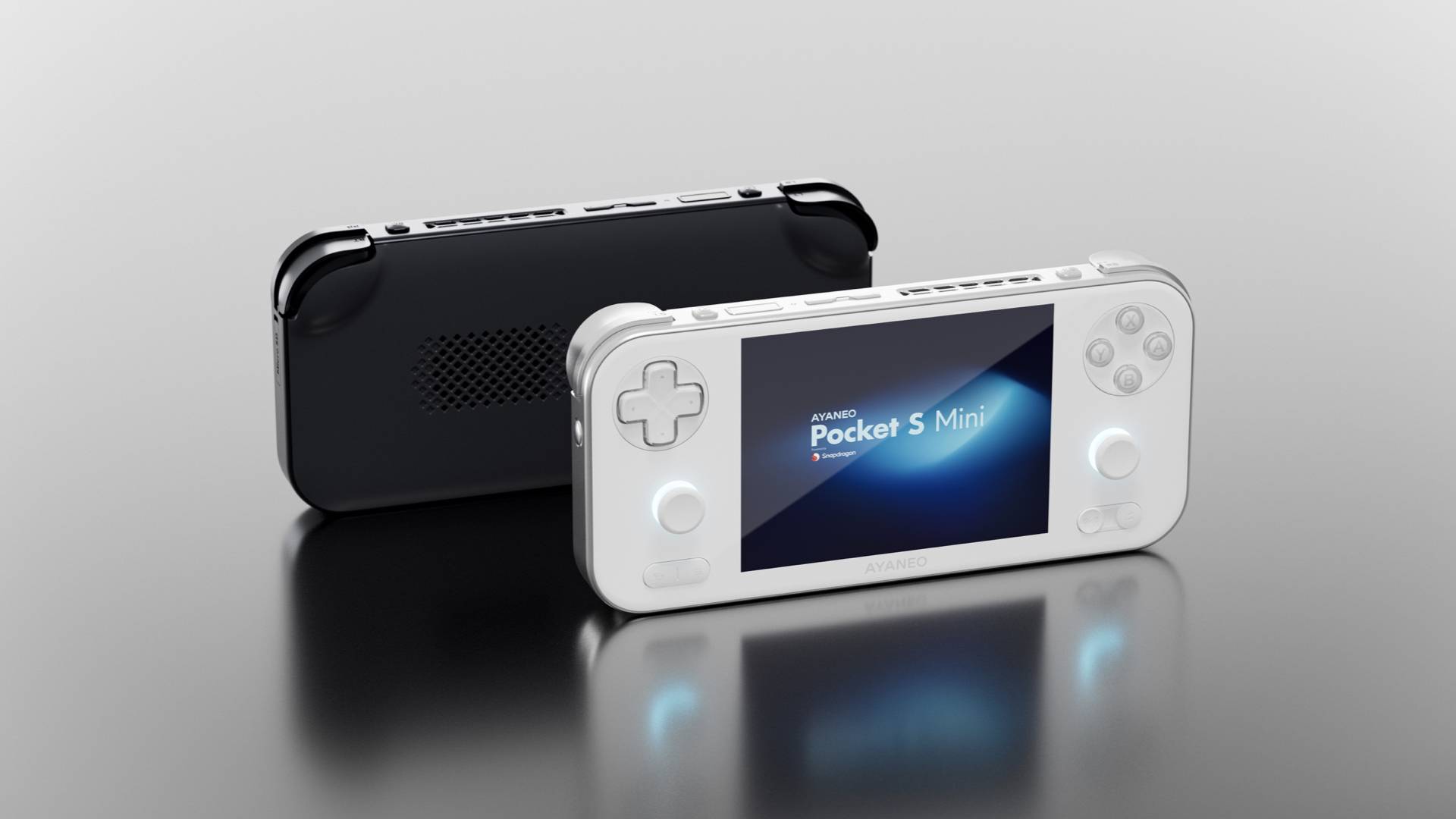
The AYANEO Pocket S Mini takes the internals of 2024’s Pocket S and pours them into a smaller shell built around one specific idea: a true 4:3 screen. Its 4.2-inch LCD runs at 1280×960, the aspect ratio the SNES, PS1, GBA, DS, arcade boards and most pre-widescreen consoles were actually drawn for, so those games fill the glass edge to edge instead of floating between black pillars. This is an ARM Android device, not one of AYANEO’s x86 Windows machines like the Kun. It runs the same Qualcomm Snapdragon G3x Gen 2 that powers the full-size Pocket S, the Pocket EVO and the AYN Odin 2, here packed into a 305g, 167mm-wide metal slab. Buy it for retro emulation and Android games, not for native PC titles.
Emulation performance, generation by generation
The G3x Gen 2 is a 4nm octa-core Kryo chip clocked to 3.36GHz with the 1GHz Adreno A32 GPU, and AYANEO cools it with an active fan, so it holds clocks longer than a passively cooled phone would. Everything through the sixth generation is trivial: PS1 on DuckStation, N64 on Mupen cores, Dreamcast on Flycast and PSP on PPSSPP all run at full speed with heavy internal-resolution upscaling. PS2 through the NetherSX2 fork of AetherSX2 clears most of the library at 2x-3x native, and GameCube and Wii on Dolphin are comfortable around 2x. The 4:3 panel pays off hardest right here: DS via DraStic, 3DS via Lime3DS, and every 4:3 arcade or 8/16-bit system look correct rather than stretched. Switch is the ceiling. Yuzu-descended forks such as Eden, Citron and Sudachi push a real chunk of the catalogue at 30-60fps, but results swing with GPU drivers and the game, and because the Switch renders 16:9 you sacrifice the top and bottom of this screen to letterboxing. That same square shape works against modern 16:9 Android games and cloud streaming, which pillarbox or crop. PS3 is off the table, and native Windows x86 games only run through translation layers like Winlator or GameNative. In raw terms this is the identical emulation ceiling to every other G3x Gen 2 handheld; the Mini’s only hardware differentiator is the screen it renders onto.
Screen, build and controls
The screen is also the Mini’s weakest link. The 4:3 shape and roughly 381ppi sharpness are lovely, but it is a 60Hz LCD that reviewers repeatedly call dim, outdoor play is a genuine struggle, there is no 120Hz mode so black-frame insertion for CRT-style motion clarity is off the menu, and some units show visible ghosting. It is, bluntly, a budget-tier panel on a premium-priced device. The rest of the build is where AYANEO earns its money: a CNC-machined all-metal frame and a high-strength glass front, RGB Hall-effect joysticks and Hall linear triggers that rule out drift and stick wear, a 6-axis gyro, dual X-axis linear haptic motors and a fingerprint reader built into the power button. The controls are not flawless, the sticks are small and the L1/R2 triggers run thin, but Hall sensors on both sticks and triggers at this size remain rare. The battery is the other sore point: AYANEO advertised 6000mAh, then a supplier issue meant retail units shipped with 4700mAh, and it shows, roughly four hours of PS2 or GameCube drops it under 30%. Connectivity is USB 3.2 Gen 2 Type-C with 10Gbps and DisplayPort 1.4 alt mode, plus Wi-Fi 6, Bluetooth 5.3 and a microSD slot.
Software and setup
The Pocket S Mini runs Android 14 with AYANEO’s AYASpace launcher layered on top for performance profiles, RGB and button mapping. Set expectations correctly: this is Android on Snapdragon, so the Linux custom-firmware world that defines cheap Rockchip and Allwinner handhelds, muOS, Knulli, ArkOS, ROCKNIX, Batocera and OnionOS, simply does not apply. You will not flash an SD card and boot into a new OS. Your “custom setup” instead means staying in Android and assembling a front end: Daijishou or ES-DE to organise ROMs, RetroArch plus standalone emulators per system, and optionally a cleaner launcher than AYASpace. It is more work than a plug-and-play OnionOS device, but you keep Google Play, Xbox and GeForce cloud streaming and native Android games. One caveat: reviewers hit real friction with the Play Store on these units, freezing during downloads and error pop-ups when launching games, so budget some setup patience.
Price, value and who it is for
Pricing runs $319 for 8GB/128GB on UFS 3.1, $399 for 12GB/256GB and $479 for the 16GB/512GB Retro Power edition on UFS 4.0, in Ice Soul White, Obsidian Black and an NES-inspired Retro Power finish. The problem is that the same G3x Gen 2 lives inside the larger Pocket S and the AYN Odin 2, both of which hand you a bigger, brighter screen and, on the Odin, more battery for similar or less money. The Mini’s case for existing is narrow and genuine: it is the best-built handheld with a true 4:3 screen, and if your library is DS, PS1, arcade, SNES and GBA, nothing else feels this correct. Buy it if that aspect ratio and a pocketable metal build are the whole point. Skip it if you want brightness, long battery life, native Windows gaming, or a device that boots straight into a curated retro OS.
📐 Size & Pocketability
⚖️ Weight vs Other Handhelds
🔋 Real-World Battery Estimator
⭐ Emulation Performance
📊 View How This Score is Calculated
The Hardware Power Score is an absolute metric. Perfect emulation of difficult, modern consoles awards significantly more points than standard retro consoles.
- 15× Multiplier: Modern PC
- 12× Multiplier: Switch, PS3, Xbox 360
- 10× Multiplier: Wii U
- 8× Multiplier: PS2, GameCube, Wii, Xbox
- 5× Multiplier: Saturn, Dreamcast, PSP
- 3× Multiplier: N64, PS1
- 1× Multiplier: SNES, GBA
Gen 8 & PC
Generation 7
Generation 6
Generation 5
Handhelds & Retro
⚡ Performance Benchmarks
Where AYANEO Pocket S Mini Adreno A32 lands against the handhelds everyone knows. Every bar shares one scale, so longer genuinely means faster — add up to two rivals to compare.
CPU = Geekbench 6 multi-core · GPU = 3DMark Wild Life. Median real-world scores; every bar shares one scale — add up to two rivals to compare.
📋 Full Specifications
📺 Display
⚙️ Platform
💾 Memory
🕹️ Controls
📏 Body
🔋 Battery
⚖️ Verdict
✅ The Good
- True 4:3 1280×960 screen fills the glass for SNES, PS1, DS, GBA and arcade games with no pillarboxing, a shape almost no rival still makes
- RGB Hall-effect joysticks and Hall linear triggers plus an active cooling fan mean no stick drift and sustained clocks through PS2 and GameCube
- Snapdragon G3x Gen 2 clears PS1 through PS2, GameCube/Wii and a large slice of the Switch library, scaling up to 16GB LPDDR5X and 512GB UFS 4.0
- CNC all-metal frame with glass front, 6-axis gyro, X-axis linear haptics and a fingerprint power button, all at a pocketable 305g
❌ The Bad
- Dim 60Hz LCD with reported ghosting and no black-frame insertion, a budget panel on a premium-priced device and rough to see outdoors
- 4700mAh battery (AYANEO advertised 6000mAh before a supplier change) manages only about four hours of PS2 or GameCube, short for the class
- Same G3x Gen 2 as the cheaper, bigger Pocket S and AYN Odin 2, the 4:3 shape letterboxes 16:9 Switch, modern Android and streaming, and Play Store glitches are reported
📰 Latest News & Guides
The Ultimate Guide to ARMSX3: Android’s New PS3 Emulator, Competitor Comparisons, and Setup Tutorial
18/08/2026Pokémon Gold, Silver, and Crystal (Gen 2) Recomp Lands on Android
17/08/2026How to Play the Pokémon Red, Blue, or Yellow Recomp on Your Android, Windows, and Linux Devices
16/08/2026🔍 Similar Handhelds
Other handhelds that emulate up to CURRENTGEN.