
🛒 Where to Buy
⚠️ Golden Rule of Retro Handhelds: Throw away the cheap MicroSD card that comes in the box — it will fail. And never use a high-wattage PD “Fast Charger” on these devices; it can damage the battery. Use a standard 5V/1.5A brick.
Device Overview: Miyoo Mini Flip
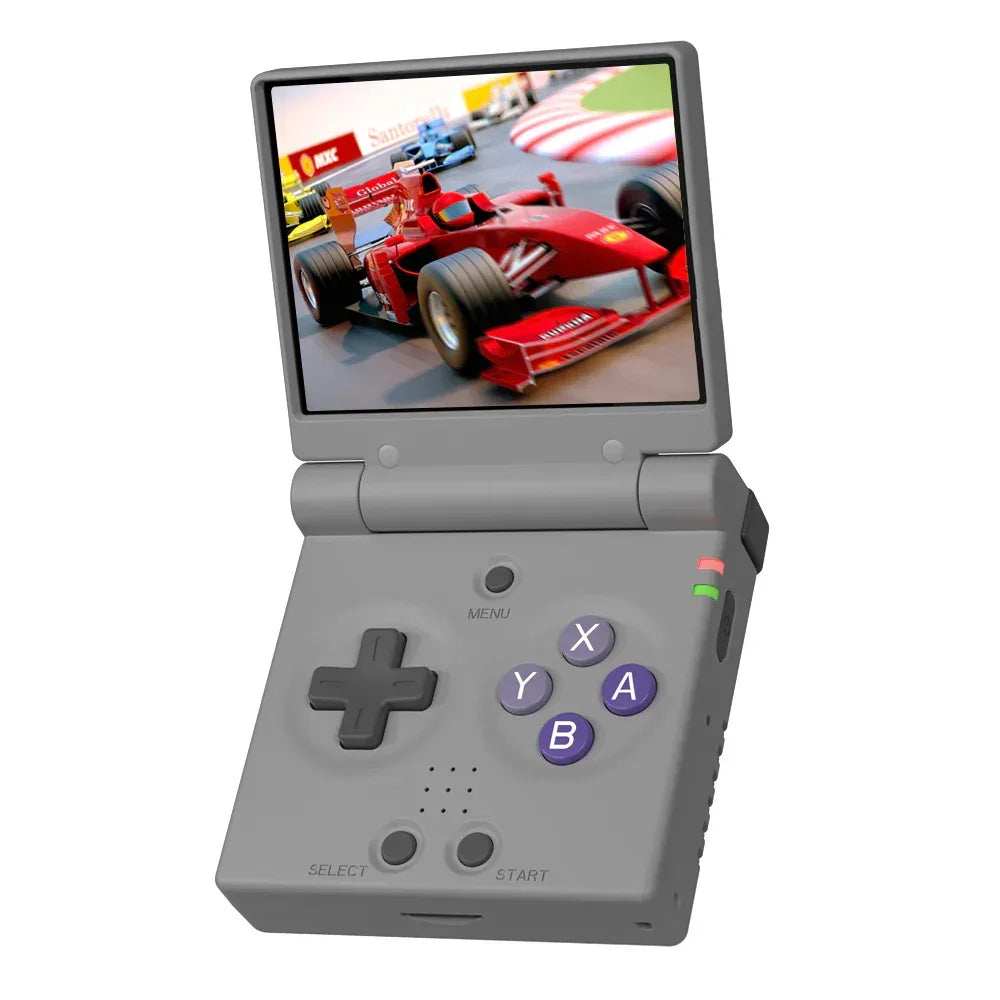
The Miyoo Mini Flip is a clamshell reworking of the pocketable formula that turned the original Miyoo Mini into a cult object. It folds shut to roughly the footprint of a Game Boy Advance SP, runs the same SigmaStar SSD202D chip found in the Miyoo Mini Plus, and aims squarely at 8- and 16-bit libraries you play in five-minute bursts. This is not a performance device and it never pretends to be one. The pitch is simpler than that: a real cross d-pad and a hinge-protected screen that live in a jacket pocket for around sixty dollars, from a maker whose Mini line already has a proven custom-firmware following. It launched in October 2025 as a size-first companion to the larger 3.5-inch Miyoo Flip rather than a replacement for it.
Emulation performance, generation by generation
The SSD202D is a dual-core ARM Cortex-A7 at 1.2 GHz with only 128 MB of DDR3, and its ceiling has been mapped exhaustively because it is the identical silicon in the Miyoo Mini and Mini Plus. NES, Game Boy, Game Boy Color, Master System, Game Gear, Genesis/Mega Drive, PC Engine and SNES all run at full speed through RetroArch cores such as Snes9x 2005, Gambatte and Genesis Plus GX. Game Boy Advance is comfortable on the mGBA and gpSP cores. Neo Geo and CPS-1/CPS-2 arcade boards play well under FinalBurn Neo, and most MAME sets from that era hold up. PlayStation 1 is the realistic top: PCSX ReARMed carries the bulk of the 2D and lighter 3D catalog, but demanding titles stutter and load-heavy games strain the 128 MB budget. Nintendo DS technically boots under a DraStic build, yet a single 2.8-inch screen with no stylus makes it a curiosity rather than a way to play. N64, Saturn, Dreamcast and PSP are off the table. This chip was never built for them, and no firmware changes that.
Screen, build and controls
The 2.8-inch IPS panel is the headline upgrade over cheaper Minis. It is genuinely bright, holds up in daylight, and its 750×560 resolution sits close to 4:3 and integer-scales 8- and 16-bit output cleanly at roughly 334 ppi. The clamshell is the whole idea. Closed it measures about 66 x 68 x 24 mm and the lid shields the glass; open it apes a GBA SP with more vertical room than the panel size implies. Controls are a proper cross d-pad, ABXY face buttons, and four small shoulder buttons set in a single row across the top edge, mapped as L1, L2, R1 and R2, all digital and none of them dual-stage analog triggers. There are no analog sticks and no Hall-effect anything, which is fine for the library it targets and a hard wall for anything that needs a stick. Reviewers note the shoulder buttons can feel stiff and want a deliberate top-down press, and the hinge locks firmly enough to need two hands to open. Connectivity is sparse: 2.4 GHz Wi-Fi for RetroAchievements and netplay, USB-C for charging, one microSD slot, and no Bluetooth, no 3.5 mm jack and no video out. The 2500 mAh battery lasts roughly three to four hours, less once you push PS1 and screen brightness.
Software and setup
Out of the box it runs Miyoo’s own Linux-based stock OS, which is functional but plain. The real reason to own this device is OnionOS, the community firmware that defined the original Mini and that most resellers now flash before shipping; many bundles arrive with OnionOS and a 64 GB card already loaded. Onion adds clean box art, fast save states, sleep and resume, per-system settings and RetroAchievements, and it turns the handheld from serviceable into genuinely pleasant. MinUI is the minimalist alternative if you want a stripped-back menu and slightly better battery discipline. One point worth being blunt about: the muOS, ArkOS, Knulli, ROCKNIX and Batocera projects you read about elsewhere target Allwinner and Rockchip hardware, not this SigmaStar chip, so they are not part of the Mini Flip’s world. Setup is SD-card work on a PC rather than an app store, so budget an afternoon if you start from a blank card.
Price, value and who it is for
At about $60, with retail creeping toward $70-80 depending on the seller, colour and bundle, the Mini Flip sells a form factor more than a spec sheet. It is for the person who already knows they want retro up to PS1 in the smallest credible clamshell, values the protected screen and the SP-era nostalgia, and does not mind that N64 is out of reach. If you want analog sticks, Dreamcast or PSP, or simply a bigger screen, the money goes further on an Anbernic RG35XX-series unit or a used Rockchip handheld. As a coat-pocket machine for Game Boy, SNES and Genesis, it does precisely what it claims and little else, and it does it with more charm than its price suggests. Buy it for the form factor and the OnionOS ecosystem, not for the raw silicon, and it rarely disappoints.
📐 Size & Pocketability
🔋 Real-World Battery Estimator
⭐ Emulation Performance
📊 View How This Score is Calculated
The Hardware Power Score is an absolute metric. Perfect emulation of difficult, modern consoles awards significantly more points than standard retro consoles.
- 15× Multiplier: Modern PC
- 12× Multiplier: Switch, PS3, Xbox 360
- 10× Multiplier: Wii U
- 8× Multiplier: PS2, GameCube, Wii, Xbox
- 5× Multiplier: Saturn, Dreamcast, PSP
- 3× Multiplier: N64, PS1
- 1× Multiplier: SNES, GBA
Generation 5
Handhelds & Retro
📋 Full Specifications
📺 Display
⚙️ Platform
💾 Memory
🕹️ Controls
📏 Body
🔋 Battery
⚖️ Verdict
✅ The Good
- Clamshell design protects the screen and folds to near GBA SP size for a genuinely pocketable retro machine
- Bright, sharp 2.8-inch 750×560 IPS panel that integer-scales 8- and 16-bit games cleanly
- Mature OnionOS custom firmware is well supported on this exact chip and often pre-installed by sellers
- Strong value at roughly $60 for flawless play up to SNES/Genesis and mostly-playable PS1
❌ The Bad
- Weak SigmaStar SSD202D with 128 MB RAM caps it at PS1; N64, Dreamcast, Saturn and PSP are out of reach
- No analog sticks and only digital in-line shoulder buttons, which some reviewers find stiff
- Sparse I/O: no Bluetooth, no 3.5 mm headphone jack, no video out, and modest 3-4 hour battery life
📰 Latest News & Guides
The Ultimate Guide to ARMSX3: Android’s New PS3 Emulator, Competitor Comparisons, and Setup Tutorial
18/08/2026Pokémon Gold, Silver, and Crystal (Gen 2) Recomp Lands on Android
17/08/2026How to Play the Pokémon Red, Blue, or Yellow Recomp on Your Android, Windows, and Linux Devices
16/08/2026🔍 Similar Handhelds
Other handhelds that emulate up to DS.