
🛒 Where to Buy
⚠️ Golden Rule of Retro Handhelds: Throw away the cheap MicroSD card that comes in the box — it will fail. And never use a high-wattage PD “Fast Charger” on these devices; it can damage the battery. Use a standard 5V/1.5A brick.
Device Overview: AYANEO Pocket DMG
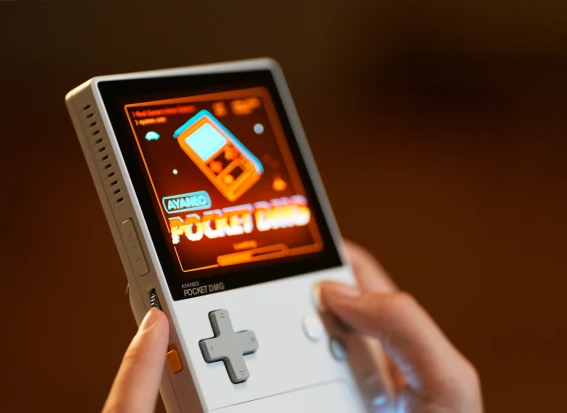
The AYANEO Pocket DMG is a deliberate tribute to Nintendo’s 1989 Game Boy, right down to the vertical slab shape, the off-centre screen and the “DMG” tag lifted from the original grey brick. Underneath the nostalgia sits a genuinely high-end Android emulation machine: a Qualcomm Snapdragon G3x Gen 2 with an Adreno A32 GPU, up to 16GB of LPDDR5X memory, and a 3.92-inch OLED panel. This is not a budget retro toy in the Anbernic or Miyoo mould. It is one of the most expensive vertical handhelds on the market, and AYANEO clearly built it for people who want the best screen and the strongest ARM silicon in a Game Boy silhouette rather than the best value.
Emulation performance, generation by generation
The G3x Gen 2 sits roughly in the same performance tier as a Snapdragon 8 Gen 2, which makes the Pocket DMG one of the fastest Android retro handhelds you can buy. Everything up to and including the sixth generation runs without drama. NES, SNES, Genesis, Game Boy and GBA, PS1 on DuckStation, N64, Dreamcast on Redream or Flycast, and PSP on PPSSPP all hold full speed with headroom, and PSP in particular runs at high internal resolutions cleanly. Nintendo DS through MelonDS and 3DS through the Citra forks (Lime3DS, Azahar) are comfortable. The interesting territory is the sixth and seventh generation: GameCube and Wii on Dolphin are largely playable, and PS2 through AetherSX2 or the NetherSX2 fork runs the bulk of the library, though heavier titles still want per-game tweaks. Nintendo Switch is the honest ceiling. Forks like Eden, Sudachi and Citron will boot a number of games on this chip, but Android Switch emulation is unstable, legally fraught after Yuzu’s shutdown, and should be treated as a bonus rather than a reason to buy. Battery life tracks that ceiling through three power profiles: expect around two hours of Max-mode PS2 or GameCube from the 6000mAh cell, but closer to twelve to fifteen hours if you cap output to 8- and 16-bit systems in Saving mode, with 25W USB-C PD charging to refill it. Do not read this like a Windows gaming PC: there is no x86, no Steam, no native PC ports.
Screen, build and controls
The screen is the reason to want one. It is a 3.92-inch OLED at 1240 x 1080, an almost-square 8:7 aspect running at 60Hz, 419 PPI and roughly 450 nits peak. That squarish shape is a real design decision, not a gimmick: 4:3 and portrait content such as Game Boy, GBC, arcade verticals, DS stacked screens and PS1 fills the panel beautifully, while 16:9 material letterboxes heavily. Build quality is excellent, with a metal frame, swappable magnetic shoulder-button caps and a linear vibration motor. A six-axis gyroscope handles motion aiming, a dedicated turbo button sits on the shoulder, and microSD expansion supplements internal storage that spans 128GB to 1TB; the chassis measures 91.5 x 151 x 22.3mm. Controls are where the Game Boy homage bites back. There is a single Hall-effect analog stick tucked into the bottom-left corner, and it is small and awkward to reach; the second stick is replaced by a trackpad for mouse and camera duties. The D-pad sits up top and the four face buttons are shallow. The shoulder buttons are not Hall-effect. At about 278 grams it is dense and finger-stretching rather than truly pocketable, and there is no 3.5mm headphone jack, so audio is USB-C or Bluetooth 5.3 only.
Software and setup
This is an Android 13 device, and that shapes the whole software story. It ships with Google Play plus AYANEO’s own AYAHome and AYASpace launchers, and you configure it the Android way: install RetroArch, standalone emulators such as PPSSPP, Dolphin, AetherSX2, DuckStation and MelonDS, and a front-end like ES-DE or Daijisho. Crucially, the Linux custom-firmware scene people associate with cheaper handhelds, meaning muOS, Knulli, ArkOS, ROCKNIX, Batocera and OnionOS, does not apply here. Those images target Rockchip Linux boards, not Snapdragon Android hardware, so anyone expecting to flash muOS onto this should reset that expectation. The upside of Android is flexibility: streaming apps, Google Play Games and Moonlight all work out of the box. The downside is that the 8:7 screen occasionally fights native Android apps that assume a widescreen layout.
Price, value and who it is for
Pricing started around $339 for the 8GB/128GB early-bird tier and climbs past $600, with an RRP near $699, for the maxed 16GB/1TB configuration. That is a lot of money for a device whose realistic emulation ceiling, strong PS2 and GameCube, is matched by cheaper competitors such as the Retroid Pocket 5 or AYANEO’s own Pocket S. You are paying a premium for the OLED panel, the metal build and the Game Boy costume. It makes sense for collectors and enthusiasts who specifically want a boxy DMG-shaped machine with the nicest possible screen for retro and portrait-friendly systems, and who are happy to sideload their own setup. Anyone chasing pure price-to-performance, or who needs dual sticks for comfortable PS2 and GameCube play, should look elsewhere.
📐 Size & Pocketability
⚖️ Weight vs Other Handhelds
🔋 Real-World Battery Estimator
⭐ Emulation Performance
📊 View How This Score is Calculated
The Hardware Power Score is an absolute metric. Perfect emulation of difficult, modern consoles awards significantly more points than standard retro consoles.
- 15× Multiplier: Modern PC
- 12× Multiplier: Switch, PS3, Xbox 360
- 10× Multiplier: Wii U
- 8× Multiplier: PS2, GameCube, Wii, Xbox
- 5× Multiplier: Saturn, Dreamcast, PSP
- 3× Multiplier: N64, PS1
- 1× Multiplier: SNES, GBA
Gen 8 & PC
Generation 7
Generation 6
Generation 5
Handhelds & Retro
⚡ Performance Benchmarks
Where AYANEO Pocket DMG Adreno A32 lands against the handhelds everyone knows. Every bar shares one scale, so longer genuinely means faster — add up to two rivals to compare.
CPU = Geekbench 6 multi-core · GPU = 3DMark Wild Life. Median real-world scores; every bar shares one scale — add up to two rivals to compare.
📋 Full Specifications
📺 Display
⚙️ Platform
💾 Memory
🕹️ Controls
📏 Body
🔋 Battery
⚖️ Verdict
✅ The Good
- Superb 3.92-inch 1240×1080 OLED whose square 8:7 shape suits Game Boy, arcade and 4:3 systems perfectly
- Snapdragon G3x Gen 2 is among the fastest ARM chips in a retro handheld, running Dolphin and PS2 well with tuning
- Premium metal build with swappable magnetic shoulder caps, a drift-free Hall-effect stick and a faithful Game Boy DMG design
- Full Android 13 with Google Play, so streaming, Moonlight and any emulator or front-end you want are available
❌ The Bad
- Very expensive, climbing toward $669-699, far more than similarly capable Android rivals
- Single, awkwardly placed analog stick plus a trackpad instead of a second stick hampers dual-stick systems
- No 3.5mm headphone jack, and at roughly 278g it is a stretch for genuine pocket use
📰 Latest News & Guides
The Ultimate Guide to ARMSX3: Android’s New PS3 Emulator, Competitor Comparisons, and Setup Tutorial
18/08/2026Pokémon Gold, Silver, and Crystal (Gen 2) Recomp Lands on Android
17/08/2026How to Play the Pokémon Red, Blue, or Yellow Recomp on Your Android, Windows, and Linux Devices
16/08/2026🔍 Similar Handhelds
Other handhelds that emulate up to CURRENTGEN.