
🛒 Where to Buy
⚠️ Golden Rule of Retro Handhelds: Throw away the cheap MicroSD card that comes in the box — it will fail. And never use a high-wattage PD “Fast Charger” on these devices; it can damage the battery. Use a standard 5V/1.5A brick.
Device Overview: Dealbay G28
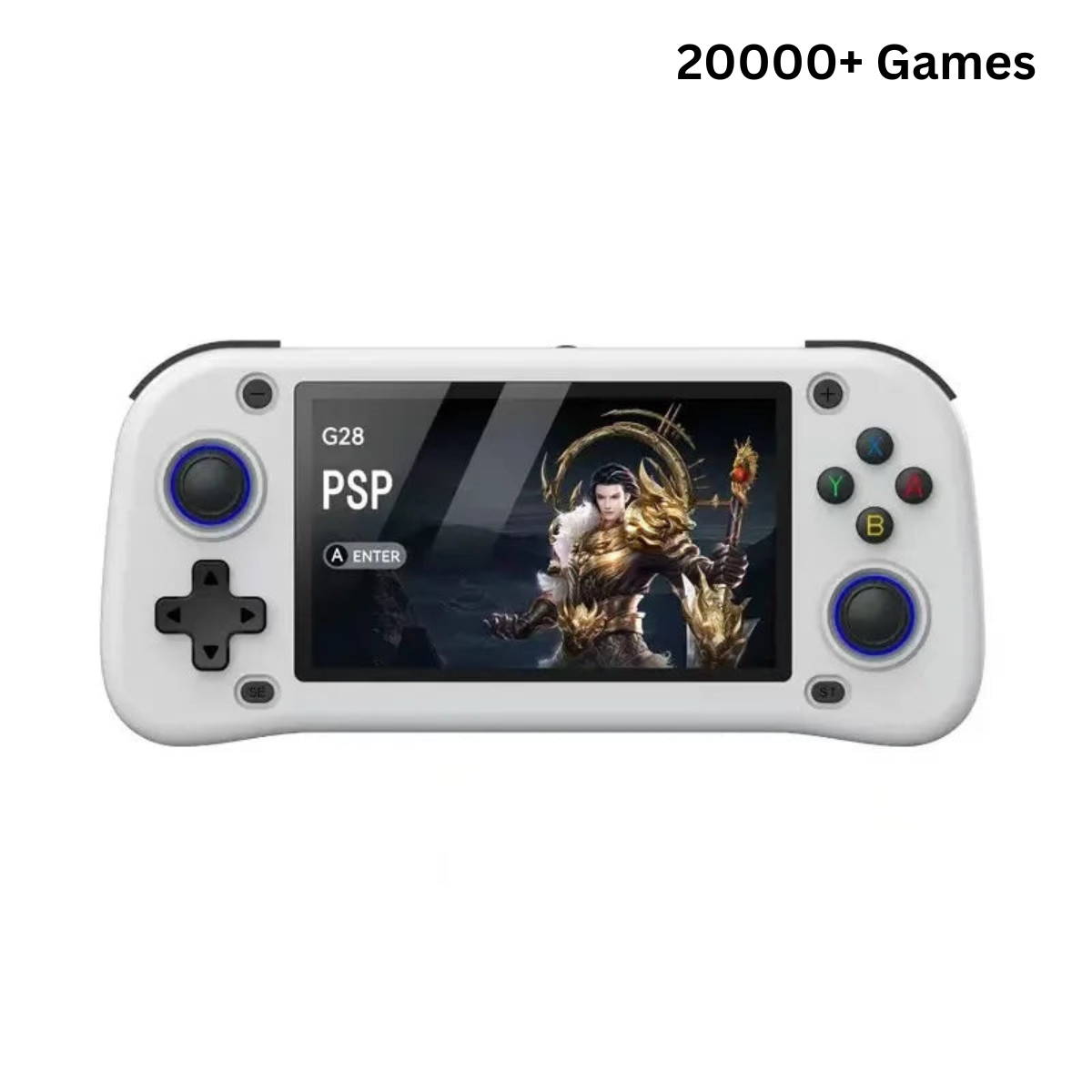
The Dealbay G28 is a sub-$40 pocket emulator built around the Rockchip RK3128, a chip that first showed up in cheap Android TV boxes over a decade ago. It is not a new design so much as a new label on a well-worn generic template: a small PSP-style shell, a 4.3-inch screen, dual sticks ringed by RGB, and a microSD card pre-stuffed with a claimed 20,000 games. “Dealbay” is a seller brand rather than a manufacturer, so the same board surfaces under a dozen other names. Judge it for what it actually is, an impulse-buy toy for 8- and 16-bit libraries, and it makes sense. Judge it against anything running a modern Rockchip or Allwinner chip and it comes apart fast.
Emulation performance, generation by generation
The RK3128 is four Cortex-A7 cores at roughly 1.3 GHz paired with a Mali-400 MP2 GPU, the low-power ARM class you find at the bottom of the market and nothing like the x86 silicon in a Windows handheld. Within that ceiling it behaves predictably. NES, Master System, Game Boy and Game Boy Color, and Genesis/Mega Drive run at full speed with headroom. SNES is fine for the ordinary library, though SuperFX and SA-1 titles such as Star Fox and Super Mario RPG will stutter. Game Boy Advance is comfortable, and the small arcade sets (CPS1, CPS2, older Neo Geo) mostly hold up. PlayStation 1 is the honest ceiling and the reason to buy one: most 2D and lighter 3D games such as the early Final Fantasy entries play well, while heavier 3D like Gran Turismo drops frames and misses effects. Nintendo 64 and PSP are bullet points on a box, not real features, so expect single-digit frame rates and mangled audio on anything demanding. Treat any listing that promises smooth N64 or Dreamcast as fiction. The emulators are baked into the stock image rather than exposed as named cores, so you are not choosing standalone RetroArch builds here.
Screen, build and controls
The panel is a 4.3-inch IPS at 480 x 272, the exact PSP resolution, which is the wrong shape for square 4:3 systems and leaves black bars on most retro content. At around 128 PPI it is sharp enough at arm’s length and the viewing angles are genuinely good for the money, but 480 x 272 is coarse by 2026 standards. The shell is light plastic measuring roughly 105 x 46 x 20.5 mm, small enough to vanish into a jacket pocket. It carries two analog sticks, a D-pad, ABXY, Start/Select/Home, a dedicated screenshot key, and stacked L1/L2/R1/R2 shoulders. None of it is premium: the sticks are conventional potentiometer units with no Hall-effect sensors, the triggers are digital rather than analog, and there is no gyro. The RGB glow around the sticks is pure decoration. A 2100 mAh battery (some listings say 2000 mAh) charges over USB-C and returns about four hours, modest but fair for the footprint.
Software and setup
Out of the box the G28 boots a locked Linux menu that scrolls the preloaded card: plug-and-play, no Wi-Fi, no accounts, no updates. That simplicity is the entire pitch. The catch matters if you are the tinkering sort. The RK3128 is not supported by the custom-firmware scene that makes other budget handhelds worthwhile. muOS, Knulli, ArkOS, and ROCKNIX target newer Rockchip RK3326/RK3566 and Allwinner H700 hardware, and none of them run on this chip; OnionOS is a Miyoo Mini project and irrelevant here too. So what ships is what you keep. You can swap the microSD, reorganize folders, and add your own legally dumped ROMs, but you cannot reflash it into a better machine. Connectivity is bare: USB-C, a microSD slot, and a video-out port for TV play, with no Bluetooth or Wi-Fi. Sources even disagree on whether a 3.5 mm headphone jack is present, so assume you may be stuck with the rear-firing speaker or a USB-C adapter.
Price, value and who it is for
Street price runs about $30 to $45 depending on the bundled card. At that number the G28 is a gift-tier or glovebox device: hand it to a kid for Sonic and Pokemon, keep it in a bag for a flight, or buy it as a curiosity to see what a decade-old TV-box chip can still do. The preloaded card and its 20,000-game claim are the usual grey-area bundle, padded with duplicates and hacks, and you should plan to curate your own folders rather than trust the count. What it is not is a keeper for anyone who cares about screen shape, output quality, or the freedom to install better software. For a little more cash, an RK3566-class handheld with a 4:3 screen and full ROCKNIX or muOS support is a categorically better buy. One honest caveat: because “Dealbay” is a reseller badge on a generic board, the published specs contradict each other, and RAM in particular is listed as both 1 GB and 4 GB, with 1 GB far likelier on an RK3128. Buy it for what is confirmed and cheap, not for the spec sheet.
🔋 Real-World Battery Estimator
⭐ Emulation Performance
📊 View How This Score is Calculated
The Hardware Power Score is an absolute metric. Perfect emulation of difficult, modern consoles awards significantly more points than standard retro consoles.
- 15× Multiplier: Modern PC
- 12× Multiplier: Switch, PS3, Xbox 360
- 10× Multiplier: Wii U
- 8× Multiplier: PS2, GameCube, Wii, Xbox
- 5× Multiplier: Saturn, Dreamcast, PSP
- 3× Multiplier: N64, PS1
- 1× Multiplier: SNES, GBA
Generation 5
Handhelds & Retro
📋 Full Specifications
📺 Display
⚙️ Platform
💾 Memory
🕹️ Controls
📏 Body
🔋 Battery
⚖️ Verdict
✅ The Good
- Genuinely pocketable at about 105 x 46 x 20.5 mm and light, with a decent IPS panel for the price
- Runs NES, Genesis, Master System, SNES, GBA and most PlayStation 1 games at full or near-full speed
- Plug-and-play stock firmware with a large preloaded card needs no setup, Wi-Fi or accounts
- Costs roughly $30 to $45, cheap enough to be an impulse or gift purchase
❌ The Bad
- The RK3128 is a hard wall: N64, PSP and Dreamcast are effectively unplayable despite marketing claims
- No custom-firmware support (muOS, Knulli, ArkOS and ROCKNIX all skip this chip), so you are locked to the stock OS
- Generic reseller hardware with contradictory published specs (RAM listed as both 1 GB and 4 GB) and thin documentation
📰 Latest News & Guides
The Ultimate Guide to ARMSX3: Android’s New PS3 Emulator, Competitor Comparisons, and Setup Tutorial
18/08/2026Pokémon Gold, Silver, and Crystal (Gen 2) Recomp Lands on Android
17/08/2026How to Play the Pokémon Red, Blue, or Yellow Recomp on Your Android, Windows, and Linux Devices
16/08/2026🔍 Similar Handhelds
Other handhelds that emulate up to PS.