
🛒 Where to Buy
⚠️ Golden Rule of Retro Handhelds: Throw away the cheap MicroSD card that comes in the box — it will fail. And never use a high-wattage PD “Fast Charger” on these devices; it can damage the battery. Use a standard 5V/1.5A brick.
Device Overview: AYANEO Flip DS
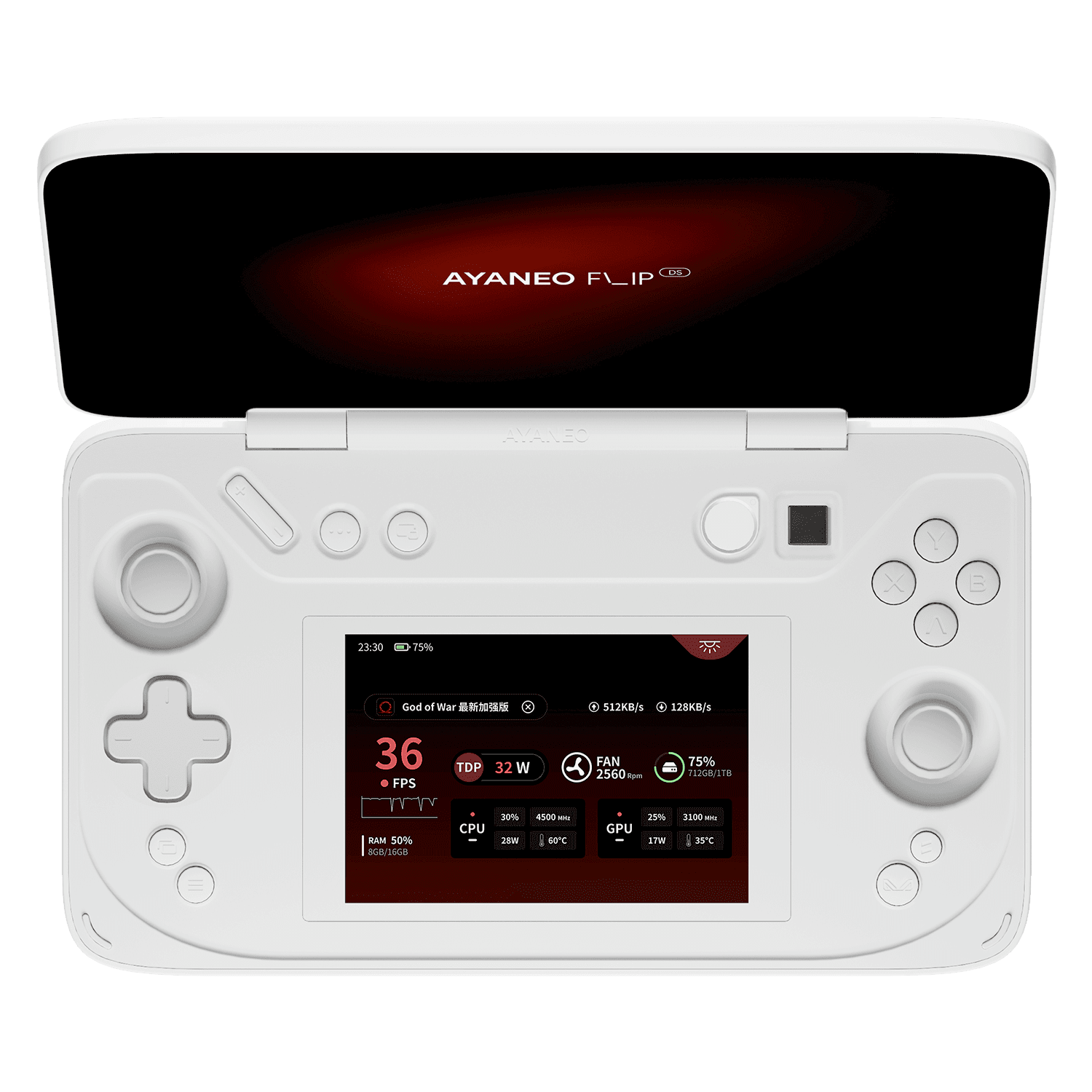
The AYANEO Flip DS is the handheld nobody else built: a clamshell Windows PC with two screens, shaped like a Nintendo DS that went to the gym. Fold it open and you get a 7-inch 1080p IPS panel up top running at 120Hz, and a 3.5-inch 960×640 touchscreen sitting below it on the lower deck, right above the controls. Inside is an AMD Ryzen 7 7840U (a Ryzen 7 8840U option exists for about $40 more), 8 Zen 4 cores and a Radeon 780M iGPU, locked to a 28W TDP. Early-bird pricing started at $739 and climbs past $1,400 for the 64GB/2TB build.
Positioning is the easy part: this is the only handheld on the market designed from the silicon out for native dual-screen DS and 3DS emulation. The single-screen Flip KB swaps the lower display for a physical keyboard and costs roughly $40 less, which tells you exactly what you are paying the premium for. A Steam Deck plays your PC library better and costs half as much, but it cannot show you the bottom screen of a 3DS game on a real second panel. That second screen is the entire reason this device exists, and AYANEO knows it.
Emulation performance, generation by generation
The 7840U is the same chip in the ROG Ally, and it emulates accordingly. PS2, GameCube and Wii run effortlessly at full speed with upscaling headroom to spare. PS3 and Wii U are realistic with per-game tuning. Switch is playable but title-dependent. Xbox 360 is the rough edge, hit-or-miss and CPU-bound. Reviewers comfortably pushed it through current AAA too, Cyberpunk 2077 and Baldur’s Gate 3, just not for long on battery.
The standout is what the two screens do for Nintendo’s dual-screen libraries. In Citra / Lime3DS, you assign the 3DS top screen to the main panel and drop the bottom screen onto the lower display, so map and inventory live exactly where the hardware intended. Cemu recreates the Wii U GamePad layout, and Star Fox Zero finally stops forcing you to flick your eyes off-screen. melonDS handles DS, though it has no native dual-screen output, so you stretch its window across both panels manually. Capacitive touch instead of a resistive stylus makes precision titles like Spirit Tracks or Meteos fiddly.
Screen, build and controls
The clamshell hinge is sturdy and locks at multiple angles. At 650g (180 x 102 x 29.8mm) it is dense rather than heavy, and the fold-shut design protects both screens in a bag. The main 120Hz panel is sharp at 400 nits; the 3.5-inch lower screen is a genuine secondary display, not a gimmick strip. Controls are smaller than a full handheld’s, with recessed sticks and a flat D-pad that draw mild complaints but stay usable. The lower screen sits close enough to the thumbs that touch input during play actually works.
Software and setup
It runs Windows 11, and Windows treats the lower panel as a plain second monitor. AYASpace 2.0 drives performance profiles and quick-access overlays on that screen, but getting clean dual-screen emulation takes effort: you create a second emulator window, drag it down, and frequently lean on third-party tools. Borderless Gaming kills the taskbar bleeding onto the lower display, and Handheld Companion covers motion controls where the built-in mapping falls short. This is the Windows tax in full: more flexible than any locked-down console emulation box, and more fiddly than anyone wanting plug-and-play will enjoy.
Price, value and who it’s for
Battery is the hard limit. The 46.2Wh pack gives roughly two hours at reduced TDP and under one hour flat out, so this is a couch and commute machine, not an all-day one. Pair that with a starting price near $739 and a top trim past $1,400, and the audience narrows sharply. The Flip DS is for the person who owns a DS, a 3DS and a Wii U, misses the two-screen layout specifically, and wants one box that reproduces it accurately while also running modern PC games. For everyone else, a Steam Deck does more gaming for less. For that one buyer, nothing else comes close.
📐 Size & Pocketability
⚖️ Weight vs Other Handhelds
🔋 Real-World Battery Estimator
⭐ Emulation Performance
📊 View How This Score is Calculated
The Hardware Power Score is an absolute metric. Perfect emulation of difficult, modern consoles awards significantly more points than standard retro consoles.
- 15× Multiplier: Modern PC
- 12× Multiplier: Switch, PS3, Xbox 360
- 10× Multiplier: Wii U
- 8× Multiplier: PS2, GameCube, Wii, Xbox
- 5× Multiplier: Saturn, Dreamcast, PSP
- 3× Multiplier: N64, PS1
- 1× Multiplier: SNES, GBA
Gen 8 & PC
Generation 7
Generation 6
Generation 5
Handhelds & Retro
⚡ Performance Benchmarks
Where AYANEO Flip DS Radeon 780M lands against the handhelds everyone knows. Every bar shares one scale, so longer genuinely means faster — add up to two rivals to compare.
CPU = Geekbench 6 multi-core · GPU = 3DMark Wild Life. Median real-world scores; every bar shares one scale — add up to two rivals to compare.
📋 Full Specifications
📺 Display
⚙️ Platform
💾 Memory
🕹️ Controls
📏 Body
🔋 Battery
⚖️ Verdict
✅ The Good
- Only handheld with a true second screen for accurate DS, 3DS and Wii U dual-screen emulation
- Ryzen 7 7840U handles PS2, GameCube and Wii effortlessly, plus modern AAA titles
- Protective clamshell design with a sturdy multi-angle hinge and a sharp 7-inch 120Hz main panel
- Full Windows 11 flexibility plus AYASpace overlays on the lower touchscreen
❌ The Bad
- Weak battery: about two hours at low TDP, under one hour at full performance
- Expensive, from ~$739 early-bird to over $1,400 for top configs
- Clean dual-screen emulation needs manual setup and third-party tools (Borderless Gaming, Handheld Companion)
📰 Latest News & Guides
The Ultimate Guide to ARMSX3: Android’s New PS3 Emulator, Competitor Comparisons, and Setup Tutorial
18/08/2026Pokémon Gold, Silver, and Crystal (Gen 2) Recomp Lands on Android
17/08/2026How to Play the Pokémon Red, Blue, or Yellow Recomp on Your Android, Windows, and Linux Devices
16/08/2026🔍 Similar Handhelds
Other handhelds that emulate up to CURRENTGEN.