
🛒 Where to Buy
⚠️ Golden Rule of Retro Handhelds: Throw away the cheap MicroSD card that comes in the box — it will fail. And never use a high-wattage PD “Fast Charger” on these devices; it can damage the battery. Use a standard 5V/1.5A brick.
Device Overview: AYANEO Air Pro
The AYANEO Air Pro is the OLED, big-battery member of the 2022 AYANEO Air trio, and it is easy to misread. It looks like a retro emulation gadget, but it is a full Windows 11 PC shrunk into a 450g shell built around an AMD Zen 3 laptop APU. The base model ships a six-core Ryzen 5 5560U with Radeon Vega 6 graphics; step-up configurations run the eight-core Ryzen 7 5825U with Vega 8. Its entire pitch was being the smallest genuinely x86 handheld you could buy at launch, wrapped around a 5.5-inch 1080p AMOLED panel. That combination made it desirable and expensive in equal measure, and it dates the device: AYANEO has since discontinued the Air line in favor of the faster Air 1S.
Emulation performance, generation by generation
Because this runs desktop Windows on an x86 APU, its ceiling is set by the Vega integrated GPU and the low TDP, not by an ARM chip. Anything through the fifth console generation is trivial: NES, SNES, Genesis, PS1 (DuckStation), N64, Dreamcast (Flycast) and PSP (PPSSPP) all run at full speed with heavy upscaling. Nintendo DS and 3DS through melonDS and Citra are comfortable. GameCube and Wii on Dolphin are a strength, often at 2x-3x internal resolution. PlayStation 2 on PCSX2 is largely excellent, with only the most demanding titles asking you to drop resolution. Wii U on Cemu and PS Vita on Vita3K are both playable. The device starts to sweat higher up: Switch via Ryujinx sits in mid-tier territory, fine at native resolution for lighter games but fighting the 8W default power limit on heavy titles. PS3 through RPCS3 is GPU-limited here; lighter and 2D games are enjoyable while heavy 3D games struggle. Xbox 360 via Xenia remains experimental on any handheld and is not a reason to buy this one. The real limiter is thermals and the modest default 8W TDP; pushing toward the roughly 18W ceiling helps demanding emulators but drains the 38Wh battery quickly and spins the fan up.
Screen, build and controls
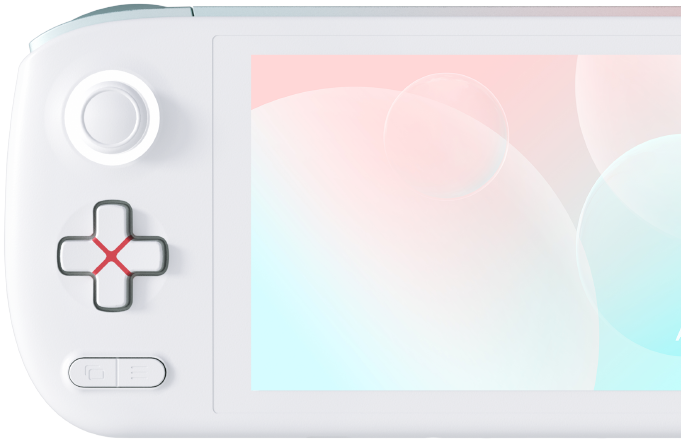
The 5.5-inch AMOLED is the headline part. It is a 1920×1080, roughly 404 PPI, 60Hz panel with deep OLED blacks and around 109% NTSC coverage. At only about 350 nits it is dimmer than you would like outdoors, and packing 1080p into 5.5 inches is arguably overkill for retro content, though it makes Windows text and modern menus crisp. Controls are a genuine highlight: Hall effect analog sticks and Hall effect triggers that resist drift and stiction, LED-ringed thumbsticks, a competent d-pad, a gyroscope, extra shoulder buttons, and a fingerprint reader built into the power button. The trade-offs are physical. At around 450g and 21.6-29.6mm thick, it is chunky for its screen size, the shell is plastic, and the small fan is audible under load.
Software and setup
It boots into Windows 11, and that is both its power and its friction. Windows on a 5.5-inch touchscreen means tiny targets and desktop wrangling, so almost nobody uses it raw. The practical setup is a front-end launcher such as Playnite or AYANEO’s own AYASpace, plus EmuDeck for Windows or a RetroArch and standalone-emulator stack to organize ROMs and cores. Some owners wipe Windows entirely and install a Linux console layer like Batocera or ChimeraOS for a couch-friendly interface, though driver and power-management support on the Air Pro is fussier than on a Steam Deck, and results vary by BIOS revision. One honest clarification: the popular custom firmwares you hear about for cheap handhelds, muOS, Knulli, ArkOS and ROCKNIX, are built for ARM Rockchip and Allwinner boards and do not run on this x86 machine. The relevant ecosystems here are EmuDeck, RetroArch, standalone emulators and, if you go Linux, Batocera.
Price, value and who it is for
Value was never this device’s argument. The base 5560U model with 16GB and 512GB launched around 699 USD via Indiegogo, the 5825U configurations started near 999 USD, and a maxed 32GB/2TB build ran to about 1,399 USD. That was Steam Deck and ROG Ally money for a slower chip; you were paying a premium for the OLED panel and the pocketable size, not raw frames per dollar. Now discontinued and superseded by the Air 1S, it turns up used at more sensible prices. Buy it if you specifically want the smallest OLED x86 handheld, mainly play indie titles, and treat emulation up to the GameCube, Wii and PS2 era as the core use case. Skip it if you want long battery life, demanding 2023-and-later AAA games, or a device you can pick up and play without any Windows tinkering.
📐 Size & Pocketability
⚖️ Weight vs Other Handhelds
🔋 Real-World Battery Estimator
⭐ Emulation Performance
📊 View How This Score is Calculated
The Hardware Power Score is an absolute metric. Perfect emulation of difficult, modern consoles awards significantly more points than standard retro consoles.
- 15× Multiplier: Modern PC
- 12× Multiplier: Switch, PS3, Xbox 360
- 10× Multiplier: Wii U
- 8× Multiplier: PS2, GameCube, Wii, Xbox
- 5× Multiplier: Saturn, Dreamcast, PSP
- 3× Multiplier: N64, PS1
- 1× Multiplier: SNES, GBA
Gen 8 & PC
Generation 7
Generation 6
Generation 5
Handhelds & Retro
📋 Full Specifications
📺 Display
⚙️ Platform
💾 Memory
🕹️ Controls
📏 Body
🔋 Battery
⚖️ Verdict
✅ The Good
- Gorgeous 5.5-inch 1080p AMOLED with deep blacks in a genuinely pocketable body
- Full x86 Windows 11 PC, so it runs native PC games and desktop emulators, not just ARM cores
- Hall effect sticks and triggers plus extra shoulder buttons and a fingerprint power button
- Strong emulation up through GameCube, Wii and PS2, and comfortable for indies
❌ The Bad
- 38Wh battery drains fast once you raise the TDP for demanding titles
- Windows on a 5.5-inch screen is fiddly and needs front-end and emulator setup to be pleasant
- Expensive at launch and now discontinued, with only ~350 nit brightness and a plastic, fan-audible build
📰 Latest News & Guides
The Ultimate Guide to ARMSX3: Android’s New PS3 Emulator, Competitor Comparisons, and Setup Tutorial
18/08/2026Pokémon Gold, Silver, and Crystal (Gen 2) Recomp Lands on Android
17/08/2026How to Play the Pokémon Red, Blue, or Yellow Recomp on Your Android, Windows, and Linux Devices
16/08/2026🔍 Similar Handhelds
Other handhelds that emulate up to CURRENTGEN.