
🛒 Where to Buy
⚠️ Golden Rule of Retro Handhelds: Throw away the cheap MicroSD card that comes in the box — it will fail. And never use a high-wattage PD “Fast Charger” on these devices; it can damage the battery. Use a standard 5V/1.5A brick.
Device Overview: Anbernic RG-353V
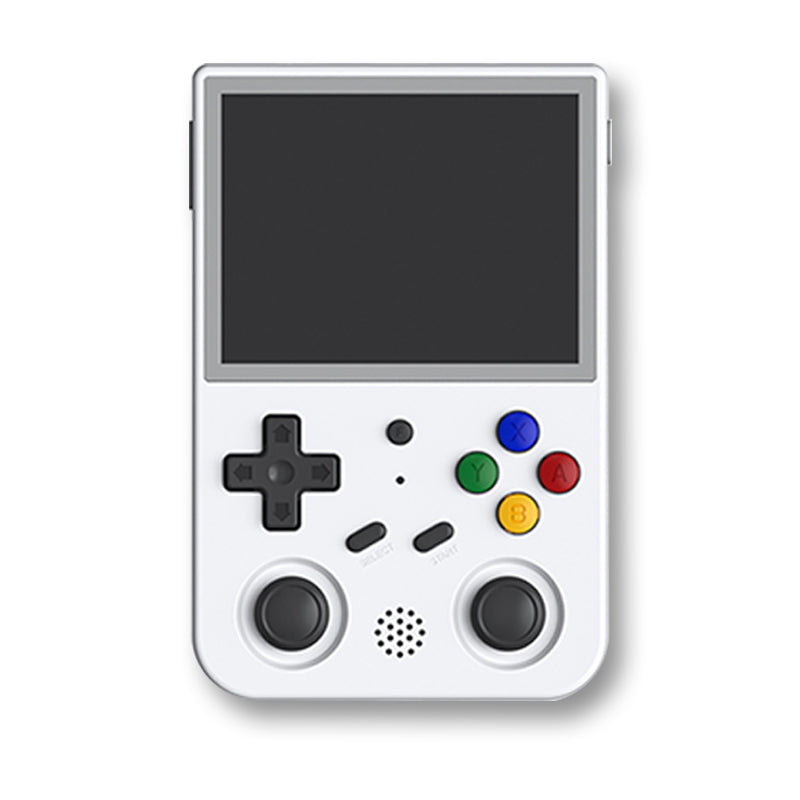
The Anbernic RG-353V is a vertical, Game Boy-shaped handheld that Anbernic released in late 2022 as the portrait sibling of the horizontal RG353P. The “V” stands for vertical, and the tall 12.6 x 8.3 cm body with a 3.5-inch 4:3 screen perched above the controls is a deliberate throwback to the original DMG Game Boy. Under that nostalgia sits a Rockchip RK3566, the same mid-range ARM chip Anbernic used across most of its 2022-2023 Linux handhelds, so the device’s real ceiling is set by that silicon rather than by the shape of the shell. At roughly $110 it slots between the cheaper RG35XX line below it and the horizontal RG353 models beside it, and it shares its internals with the whole RG353 family, so everything said here about the chip applies to those siblings too.
Emulation performance, generation by generation
The RK3566 is a quad-core Cortex-A55 clocked to 1.8GHz with a Mali-G52 GPU and, on the V, 2GB of LPDDR4. In practice everything through the 16-bit era and the fifth generation runs full speed: NES, SNES, Genesis, Game Boy and GBA, TurboGrafx and Neo Geo are effortless. PlayStation 1 holds a locked 60fps across the vast majority of the library through the DuckStation or PCSX ReARMed cores. PSP is where judgement is needed; lighter 2D and isometric titles run well in PPSSPP, but 3D-heavy games often need frameskip or a resolution drop to stay smooth. Nintendo 64 and Dreamcast are the genuine ceiling and they are honestly hit-or-miss. Star Fox 64 and Crazy Taxi can approach full speed, while Perfect Dark, Conker, or a demanding Flycast title will chug. Saturn through the Beetle core is a coin flip, playable in 2D fighters and rough in anything 3D. Arcade emulation via FBNeo and MAME is strong up to the CPS and Neo Geo boards, with heavier late-90s 3D arcade hardware falling outside its reach. Do not buy this for GameCube, Wii, PS2, 3DS, or Switch; the RK3566 cannot touch those, and any store listing claiming otherwise is lying.
Screen, build and controls
The 3.5-inch IPS panel runs a native 640×480, and that is the single best reason to pick this device: a clean, integer-friendly 4:3 that flatters CRT-era games far better than the stretched widescreen panels on many rivals. Colours are punchy and viewing angles are full. The shell is plastic but well assembled at 180 grams, with two offset analog sticks sitting below the face buttons. Those sticks are standard potentiometer units, not Hall effect; they work fine out of the box but can develop drift over time, though they are Joy-Con compatible and swappable for Hall parts if you care. The D-pad is solid, the four shoulder buttons are digital with no analog L2/R2, and the V includes a touchscreen the cheaper VS drops. You also get dual microSD slots (one for the OS, one for ROMs), USB-C, a mini-HDMI output for TV play, dual-band Wi-Fi, Bluetooth 4.2, and a 3.5mm jack.
Software and setup
Out of the box the RG-353V dual-boots Android 11 and a Linux emulation OS from a bootable card, and honestly the stock software is the weakest part of the package: functional but cluttered. The device’s real strength is a deep custom-firmware scene, because the RK3566 is among the best-supported chips in the hobby. On the Linux side, ArkOS is the community favourite for its simplicity, while ROCKNIX (the successor to JELOS) and AmberELEC offer slicker EmulationStation front-ends with RetroAchievements and network scraping built in. Batocera also runs well if you prefer its ecosystem. On the Android side, GammaOS strips LineageOS down to a fast, debloated build that makes Android worth using for streaming and standalone apps. Note that muOS and OnionOS, which you will see recommended for Anbernic’s Allwinner and Miyoo handhelds, do not target this chip; the RK3566 has its own firmware lineup. Setup means flashing an image to a microSD, which is beginner-friendly thanks to well-written ArkOS and ROCKNIX guides.
Price, value and who it is for
At launch the RG-353V was $113 in the 2GB touchscreen configuration, with the RG353VS at $90 for 1GB and no touch. Today, with newer RG35XX Plus and RG40XX models offering similar RK3566-class power for less, the 353V’s value rests almost entirely on its form factor. If you specifically want a vertical, Game Boy-style handheld with dual sticks and a true 4:3 panel for PS1-and-below emulation, nothing else in this price band nails that brief the way this does. If you play mostly landscape systems, or you need N64 and Dreamcast to run reliably rather than occasionally, spend elsewhere. It is a specialist device that knows exactly what it is, and buyers who want that portrait shape, and are willing to flash a custom firmware to unlock it, will stay happy with it for years.
📐 Size & Pocketability
⚖️ Weight vs Other Handhelds
🔋 Real-World Battery Estimator
⭐ Emulation Performance
📊 View How This Score is Calculated
The Hardware Power Score is an absolute metric. Perfect emulation of difficult, modern consoles awards significantly more points than standard retro consoles.
- 15× Multiplier: Modern PC
- 12× Multiplier: Switch, PS3, Xbox 360
- 10× Multiplier: Wii U
- 8× Multiplier: PS2, GameCube, Wii, Xbox
- 5× Multiplier: Saturn, Dreamcast, PSP
- 3× Multiplier: N64, PS1
- 1× Multiplier: SNES, GBA
Generation 6
Generation 5
Handhelds & Retro
⚡ Performance Benchmarks
Where Anbernic RG-353V ARM Mali-G52 MP2 (2EE) lands against the handhelds everyone knows. Every bar shares one scale, so longer genuinely means faster — add up to two rivals to compare.
CPU = Geekbench 6 multi-core · GPU = 3DMark Wild Life. Median real-world scores; every bar shares one scale — add up to two rivals to compare.
📋 Full Specifications
📺 Display
⚙️ Platform
💾 Memory
🕹️ Controls
📏 Body
🔋 Battery
⚖️ Verdict
✅ The Good
- True 640×480 4:3 IPS panel that is ideal for CRT-era 8/16-bit games and PS1
- Vertical Game Boy-style form factor with dual analog sticks and a touchscreen (on the V)
- Excellent custom-firmware support (ArkOS, ROCKNIX, AmberELEC, Batocera, GammaOS) thanks to the well-documented RK3566
- Dual microSD slots, USB-C, dual-band Wi-Fi and mini-HDMI TV output at a ~$110 price
❌ The Bad
- RK3566 tops out around PS1/PSP; N64, Dreamcast and Saturn are inconsistent and GameCube/PS2 are off the table
- Standard potentiometer analog sticks rather than Hall effect, so they can drift over time
- Cluttered stock dual-boot software means you will want to flash custom firmware to get the best of it
📰 Latest News & Guides
The Ultimate Guide to ARMSX3: Android’s New PS3 Emulator, Competitor Comparisons, and Setup Tutorial
18/08/2026Pokémon Gold, Silver, and Crystal (Gen 2) Recomp Lands on Android
17/08/2026How to Play the Pokémon Red, Blue, or Yellow Recomp on Your Android, Windows, and Linux Devices
16/08/2026🔍 Similar Handhelds
Other handhelds that emulate up to PSP.