
🛒 Where to Buy
⚠️ Golden Rule of Retro Handhelds: Throw away the cheap MicroSD card that comes in the box — it will fail. And never use a high-wattage PD “Fast Charger” on these devices; it can damage the battery. Use a standard 5V/1.5A brick.
Device Overview: Asus ROG Xbox Ally
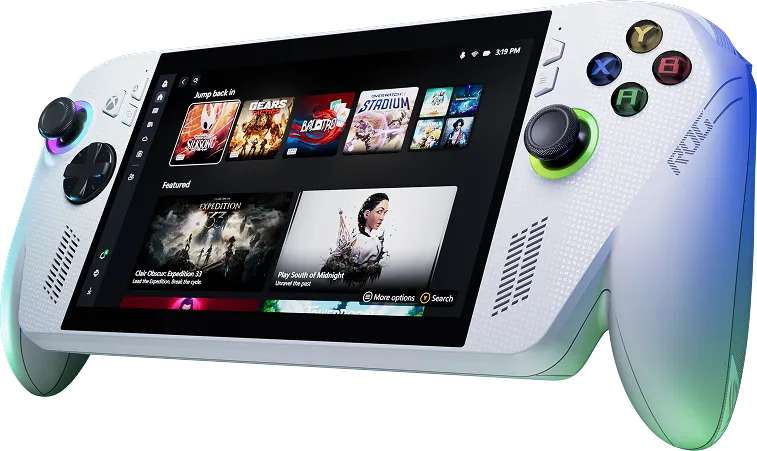
The Asus ROG Xbox Ally is the cheaper of the two handhelds Asus and Microsoft launched together on October 16, 2025, and the first ROG Ally to wear Xbox branding on the shell. At $599.99 it slots directly against the Steam Deck rather than the flagship Ally X, and the silicon makes that comparison unavoidable: an AMD Ryzen Z2 A with four Zen 2 cores, eight threads, and eight RDNA 2 compute units running at 1.6 GHz. That is, give or take a few percent, the same hardware budget Valve shipped in 2022. What you are paying the premium for is Windows 11, the full Xbox app ecosystem, and Asus’s ergonomics, not a generational leap in raw power.
Emulation performance, generation by generation
Because this is a full x86 Windows machine, it runs the entire desktop emulation stack rather than the trimmed ARM ports found on Anbernic-class devices. Everything up to the sixth console generation is effortless: NES, SNES, Genesis, PS1 and Nintendo 64 through RetroArch or standalone cores run pinned to their refresh caps with power to spare. PSP on PPSSPP and Dreamcast on Flycast are equally trivial, often upscaled to 3x internal resolution. GameCube and Wii on Dolphin are where the Z2 A settles into its natural home; most first-party libraries hold full speed at 2x, though CPU-heavy outliers will dip. PlayStation 2 through PCSX2 is broadly playable but not the flawless experience the marketing implies, and the weak four-core CPU shows in the harder-to-emulate games. Switch emulation via Ryujinx forks and PlayStation 3 through RPCS3 are the ceiling: some titles run, many stutter, and both are heavily CPU-bound in exactly the way this chip is weakest. Wii U on Cemu sits in between and is usually fine. Treat anything past the GameCube era as “sometimes,” not “always.”
Screen, build and controls
The 7-inch panel is a 1080p IPS running at 120Hz with variable refresh, 500 nits, and Gorilla Glass Victus over the touchscreen. It is bright and fluid, but it is still IPS; there is no OLED option here, and next to a Steam Deck OLED the blacks look grey. The bigger story is the redesign. Asus borrowed the wraparound contoured grips from an Xbox controller and moulded them into the chassis, and the result is genuinely more comfortable to hold for long sessions than the flat-backed 2023 Ally, despite the device weighing 670g. Controls are Xbox-standard: offset full-size sticks, a proper d-pad, ABXY, bumpers, two assignable back paddles, HD haptics, and a six-axis IMU. The analog triggers are Hall effect, so they will not wear out, but the main thumbsticks are conventional potentiometer units, the same drift-prone design Asus has used across the Ally line. That is the one hardware corner that will bother owners two years from now.
Software and setup
This ships with Windows 11 Home booting into the new Xbox full-screen experience, a console-style launcher that aggregates Game Pass, Steam, Epic and Battle.net into one grid and suspends the desktop shell to claw back RAM. It is a real improvement over raw Windows on a 7-inch screen, and it is the single best argument for buying this over a Steam Deck. It is still Windows underneath, though, so you inherit driver updates, the occasional launcher login loop, and antivirus nags. For emulation, forget the ARM custom-firmware scene: muOS, Knulli, ArkOS, ROCKNIX and OnionOS are all built for Linux ARM boards and will not touch this hardware. The relevant tools are EmuDeck’s Windows installer, which lays down RetroArch, PCSX2, Dolphin, RPCS3 and a front end in one pass, and Batocera, which you can boot from a microSD or a second drive if you want a locked-down console-like OS without disturbing Windows. Xbox Cloud Gaming and GeForce Now are also baked in, and the newest AAA releases honestly look better streamed than run natively.
Price, value and who it is for
At $599.99 the value question is sharp. You are paying roughly $200 more than a Steam Deck LCD for near-identical gaming performance, and the justification is entirely Windows, Game Pass integration, the nicer grips, and the 120Hz screen. The 60Wh battery is a genuine step up from the 2023 original’s 40Wh pack; expect roughly two to five hours depending on the TDP profile, respectable but not class-leading. Buy the standard Xbox Ally if you live inside Game Pass, want native Windows flexibility, and refuse to fight a Linux front end. If you mostly emulate up to GameCube and Wii, or you want OLED, the Steam Deck OLED is the smarter buy and undercuts it. And if you genuinely want PS3, Switch and modern AAA at 1080p, the $999 Ally X with its Z2 Extreme is the only model in this family that actually delivers it; this one does not.
📐 Size & Pocketability
⚖️ Weight vs Other Handhelds
🔋 Real-World Battery Estimator
⭐ Emulation Performance
📊 View How This Score is Calculated
The Hardware Power Score is an absolute metric. Perfect emulation of difficult, modern consoles awards significantly more points than standard retro consoles.
- 15× Multiplier: Modern PC
- 12× Multiplier: Switch, PS3, Xbox 360
- 10× Multiplier: Wii U
- 8× Multiplier: PS2, GameCube, Wii, Xbox
- 5× Multiplier: Saturn, Dreamcast, PSP
- 3× Multiplier: N64, PS1
- 1× Multiplier: SNES, GBA
Gen 8 & PC
Generation 7
Generation 6
Generation 5
Handhelds & Retro
📋 Full Specifications
📺 Display
⚙️ Platform
💾 Memory
🕹️ Controls
📏 Body
🔋 Battery
⚖️ Verdict
✅ The Good
- Boots into the Xbox full-screen experience, which unifies Game Pass, Steam and Epic into one launcher and frees up RAM versus raw Windows 11
- Xbox-style wraparound grips make it noticeably more comfortable for long sessions than the flat-backed 2023 Ally, even at 670g
- Full x86 Windows runs the complete desktop emulator suite (Dolphin, PCSX2, RPCS3, RetroArch) plus EmuDeck and Batocera natively, with no ARM porting limits
- Bright 7-inch 1080p 120Hz IPS screen with variable refresh and Gorilla Glass Victus
❌ The Bad
- The Ryzen Z2 A is essentially Steam Deck-class silicon, so native AAA gaming still means 720-900p, FSR upscaling and 30fps targets
- Main thumbsticks are drift-prone potentiometers rather than Hall effect (only the triggers are Hall effect)
- At $599.99 it costs about $200 more than a Steam Deck LCD for near-identical performance, with no OLED option
📰 Latest News & Guides
The Ultimate Guide to ARMSX3: Android’s New PS3 Emulator, Competitor Comparisons, and Setup Tutorial
18/08/2026Pokémon Gold, Silver, and Crystal (Gen 2) Recomp Lands on Android
17/08/2026How to Play the Pokémon Red, Blue, or Yellow Recomp on Your Android, Windows, and Linux Devices
16/08/2026🔍 Similar Handhelds
Other handhelds that emulate up to CURRENTGEN.