
🛒 Where to Buy
⚠️ Golden Rule of Retro Handhelds: Throw away the cheap MicroSD card that comes in the box — it will fail. And never use a high-wattage PD “Fast Charger” on these devices; it can damage the battery. Use a standard 5V/1.5A brick.
Device Overview: Anbernic RG DS
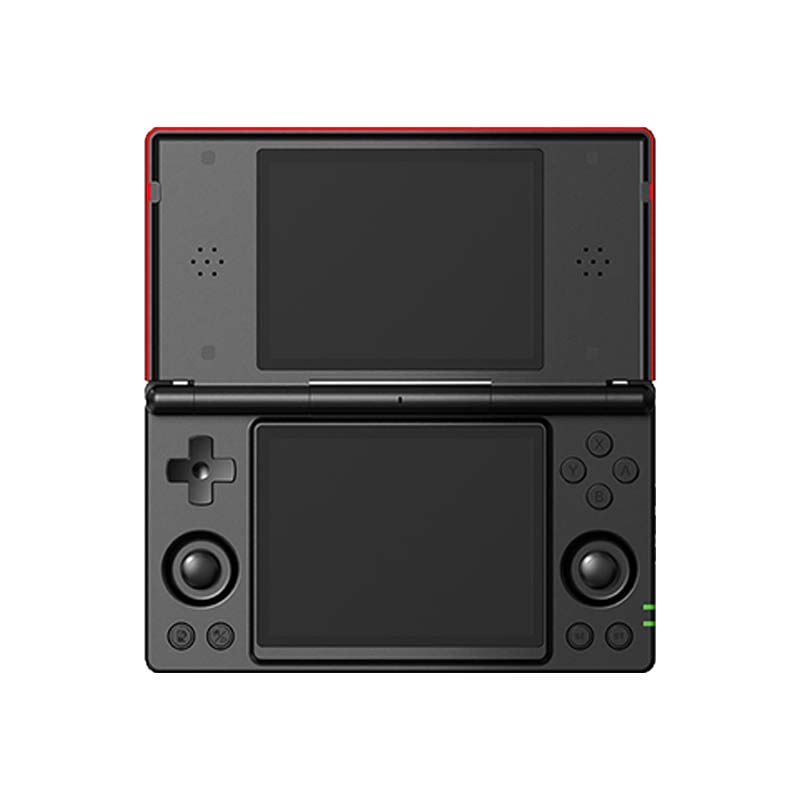
The Anbernic RG DS is the company’s first clamshell, and its entire reason to exist is stacked in the name: two 4-inch screens, one above the other, so Nintendo DS games run the way they were drawn instead of being squeezed side by side or letterboxed onto a single panel. It launched in December 2025 at $99.99, with early pre-orders dipping to around $94. Rather than chase horsepower, Anbernic spent the budget on the form factor, and that trade-off defines everything about the device. Inside is a Rockchip RK3568, a quad-core Cortex-A55 clocked to 2.0GHz with a Mali-G52 2EE GPU, paired with 3GB of RAM and 32GB of eMMC storage. That is a modest, power-efficient chip, not a performance part, and anyone reading the RG DS as a pocket station for anything heavier than its namesake is going to be disappointed.
Emulation performance, generation by generation
The second screen implies DS ambition, and DS is exactly where it lands. Out of the box the default emulator is DraStic, the mature ARM-optimised Nintendo DS core, and it runs the library at full speed at native resolution. There is no meaningful GPU headroom to upscale, so games look sharp but not sharpened. The upstream caveat matters: melonDS, the more accurate and DSi-capable emulator, runs poorly on the RK3568, so DSi-enhanced titles and higher-accuracy playback are effectively off the table. If your goal is playing DS ROMs on real DS-shaped hardware, it delivers. If you wanted a 3DS machine, this is not it. 3DS emulation is not viable on this silicon, and Anbernic does not pretend otherwise.
Everything below DS is comfortable. NES, SNES, Genesis, Game Boy/Color/Advance and PlayStation 1 all run full speed through RetroArch. PSP through PPSSPP handles a large slice of the catalogue at native resolution, though demanding 3D titles need per-game settings and will not upscale cleanly. Nintendo 64 via Mupen64Plus-Next and Dreamcast via Flycast are playable but selective: lighter games are fine, heavy ones stutter. Saturn is hit-or-miss. GameCube, Wii, PS2 and 3DS sit above the ceiling; treat them as unsupported. This is a 32-bit-and-below machine with a DS specialty bolted on top, and judged on that scope it does the job.
Screen, build and controls
Both panels are 4-inch IPS at 640×480 with OCA full lamination and capacitive multi-touch, and a capacitive stylus is included for the lower screen, a genuine upgrade over the original DS’s resistive digitizer. The 4:3 640×480 shape maps DS’s 256×192 output cleanly. The clamshell hinge feels solid, and at 321g across a 16 x 9.1cm footprint it is chunky but pocketable. Controls are the compromise. There is a proper d-pad, which carries most DS input, plus low-profile clicky face buttons and shoulder buttons. Anbernic also fitted two analog sticks, but reviewers found them set deep and slippery, awkward for precise 360-degree movement. That is not a dealbreaker given the DS itself had no sticks, but do not buy this for stick-heavy PSP or N64 play. The sticks are not Hall effect; the only Hall component is the magnetic switch that sleeps the device when the lid closes. A six-axis gyroscope, vibration motor, stereo speakers and a 3.5mm headphone jack round it out. The 4000mAh battery is rated around 6 hours and recharges in roughly 3.5 hours over 5V/1.6A.
Software and setup
It ships on Android 14, with Anbernic also advertising a 64-bit Linux mode. Android is the practical choice: it gives you DraStic, RetroArch, PPSSPP, standalone stores, local and Moonlight game streaming, plus Bluetooth controller and TV output, and it is what the reviews ran on. The custom-firmware picture is where you should temper expectations. The usual Rockchip CFW ecosystem (muOS, Knulli, ROCKNIX, ArkOS, Batocera) is built around single-screen devices, and driving two independent 640×480 panels is a non-trivial port. As of launch there is no established, mature CFW image that fully handles the dual-screen output, so plan to live on stock Android rather than assuming a drop-in ROCKNIX build exists. Storage expands via microSD (Anbernic quotes up to 2TB), and wireless is dual-band Wi-Fi a/b/g/n/ac with Bluetooth 4.2.
Price, value and who it is for
At $99.99 the RG DS is the cheapest credible way to play Nintendo DS the way it was meant to be seen: vertically stacked, touch on the bottom, stylus in hand. That is a narrow but real pitch. If you specifically want DS and DS-era-and-below systems in a clamshell, and you accept native-resolution output and merely adequate analog sticks, it is easy to recommend. If you want a do-everything handheld that also chews through PS2 or 3DS, or you care about a polished custom-firmware scene, spend your money elsewhere, because both the RK3568 and the unusual two-screen layout push against that. It is a focused tool, and it is honest about what it is.
📐 Size & Pocketability
⚖️ Weight vs Other Handhelds
🔋 Real-World Battery Estimator
⭐ Emulation Performance
📊 View How This Score is Calculated
The Hardware Power Score is an absolute metric. Perfect emulation of difficult, modern consoles awards significantly more points than standard retro consoles.
- 15× Multiplier: Modern PC
- 12× Multiplier: Switch, PS3, Xbox 360
- 10× Multiplier: Wii U
- 8× Multiplier: PS2, GameCube, Wii, Xbox
- 5× Multiplier: Saturn, Dreamcast, PSP
- 3× Multiplier: N64, PS1
- 1× Multiplier: SNES, GBA
Generation 6
Generation 5
Handhelds & Retro
📋 Full Specifications
📺 Display
⚙️ Platform
💾 Memory
🕹️ Controls
📏 Body
🔋 Battery
⚖️ Verdict
✅ The Good
- Genuine vertically-stacked dual 4-inch screens, the only sub-$100 way to play Nintendo DS in its native two-screen layout
- Runs the full DS library at full speed via DraStic, plus everything from 8-bit through PS1 and most PSP
- Included capacitive stylus and OCA-laminated multi-touch panels are a real upgrade over the original DS's resistive screen
- Solid clamshell build with a d-pad, gyroscope, vibration, stereo speakers and a 3.5mm headphone jack, all for $99.99
❌ The Bad
- RK3568 chip cannot handle 3DS, GameCube, Wii or PS2, and melonDS/DSi playback runs poorly
- Analog sticks are set deep and slippery, and are not Hall effect
- No mature custom firmware for the dual-screen layout at launch, so you are stuck on stock Android
📰 Latest News & Guides
The Ultimate Guide to ARMSX3: Android’s New PS3 Emulator, Competitor Comparisons, and Setup Tutorial
18/08/2026Pokémon Gold, Silver, and Crystal (Gen 2) Recomp Lands on Android
17/08/2026How to Play the Pokémon Red, Blue, or Yellow Recomp on Your Android, Windows, and Linux Devices
16/08/2026🔍 Similar Handhelds
Other handhelds that emulate up to PSP.