
🛒 Where to Buy
⚠️ Golden Rule of Retro Handhelds: Throw away the cheap MicroSD card that comes in the box — it will fail. And never use a high-wattage PD “Fast Charger” on these devices; it can damage the battery. Use a standard 5V/1.5A brick.
Device Overview: Anbernic RG Cube
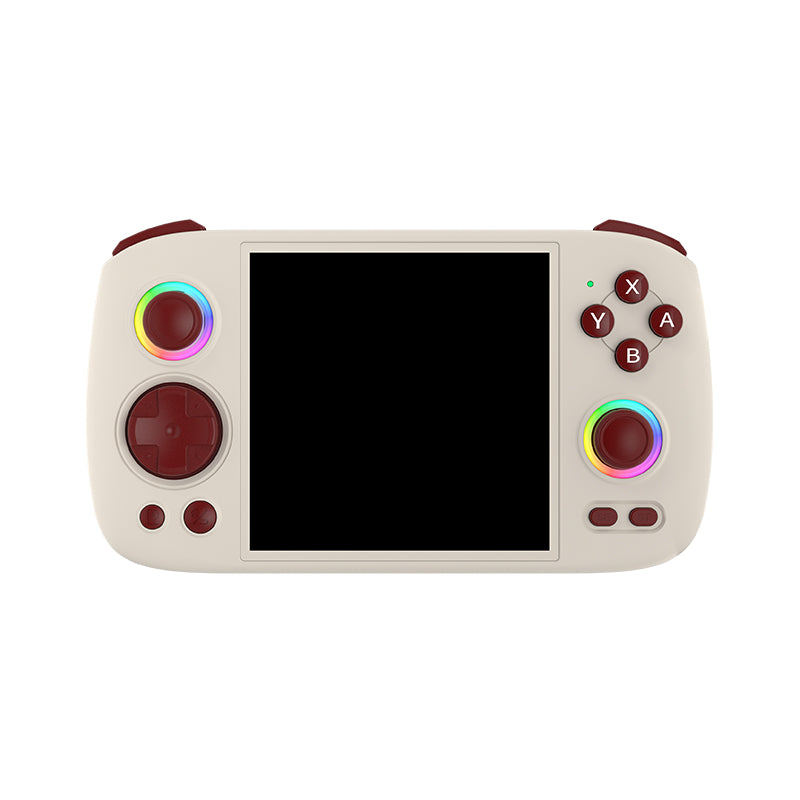
The Anbernic RG Cube is the oddball of Anbernic’s 2024 lineup: a chunky little brick built around a 3.95-inch 1:1 square display running at 720×720. That aspect ratio is the entire reason it exists. A square panel shows a stacked Nintendo DS layout at a sensible size, and it stops vertically-oriented arcade shooters and Game Boy titles from wasting most of the glass. Inside sits the Unisoc Tiger T820, the same 6nm octa-core chip Anbernic uses in the RG406H and RG476H, paired with 8GB of LPDDR4X, 128GB of UFS 2.2 storage and Android 13. A 5200mAh battery keeps it fed. It launched at roughly $150-170 and now drifts around $140 on sale, which puts it squarely in mid-tier Android-handheld territory.
Emulation performance, generation by generation
The T820 is a competent mid-range mobile SoC with a Mali-G57 GPU, not a Snapdragon flagship and emphatically not a Windows x86 machine, so calibrate expectations accordingly. Everything up to and including the 32-bit and sixth-generation era is comfortable. NES, SNES, Genesis, arcade/MAME and Game Boy Advance are trivial; PS1 through DuckStation and Nintendo 64 through M64Plus FZ run at full speed. PSP via PPSSPP is a genuine strength, holding 60fps across most of the library with only the heaviest 3D games needing an internal-resolution nudge. Sega Saturn on Yaba Sanshiro and Dreamcast on Flycast are largely solved. Nintendo DS through DraStic is where the square screen earns its keep, showing both screens stacked without shrinking either one. The seventh-generation ceiling is where honesty matters: GameCube and Wii on Dolphin, and PS2 on AetherSX2/NetherSX2, are playable but selective. Lighter titles such as Luigi’s Mansion, Final Fantasy X or Wind Waker run acceptably, while demanding ones like Metroid Prime or God of War drop frames and force resolution cuts. Switch emulation is not a realistic proposition on this hardware. Treat GameCube and PS2 as a bonus, not a headline. Heavy sessions pull battery life down to roughly five to six hours from the seven you get on light 16-bit work.
Screen, build and controls
The 720×720 IPS panel is OCA-laminated, multi-touch, bright and sharp, and refreshes at 60Hz. For 4:3 and square content it is genuinely better than a widescreen handheld; for anything 16:9 – PSP, Dreamcast, most modern Android games – you eat thick letterbox bars top and bottom, and there is no getting around that. The body is dense at 256g and 153 x 86 x 18mm, with a real hand-filling grip rather than a flat slab. The controls are the standout for the money: Hall-effect analog sticks and Hall-effect analog triggers, so no stick drift and no mushy potentiometer creep over time, with RGB lighting rings around the sticks if you want them. You get a full shoulder set including L2/R2, an offset D-pad and face buttons. Connectivity covers dual-band Wi-Fi 5 (802.11ac), Bluetooth 5.0, a 3.5mm headphone jack, microSD expansion up to 2TB, and USB-C that carries 1080p DisplayPort video out to a TV.
Software and setup
This is an Android handheld, not a Linux one, and that distinction dictates the entire software story. Out of the box you get stock Android 13 with Anbernic’s launcher, the Google Play Store and normal app installs: RetroArch, standalone emulators, Daijisho or ES-DE as a front-end, plus Moonlight or Xbox cloud streaming if you want them. There is no muOS, Knulli, ArkOS, ROCKNIX, OnionOS or Batocera here – those are Rockchip and Allwinner Linux firmwares that do not target the T820 Cube, so ignore any listing that implies otherwise. The relevant “custom firmware” is GammaOS, a debloated Android build maintained for Anbernic’s T820 devices that strips the bundled cruft and tightens battery and consistency. Realistically, most owners stay on stock Android, install their emulators, and spend an evening mapping controls and scraping box art before it feels finished. Anbernic ships firmware updates through the device rather than a public archive, so keeping an eye on their support channels for a build that fixes early control-mapping quirks is worth the effort.
Price, value and who it is for
At around $140 the Cube is neither the cheapest way to emulate PS1 nor powerful enough to be a serious PS2 machine. What you are actually paying for is the square screen and the Hall-effect controls in one package, and whether that is worth it depends entirely on your library. Buy it if you are a Nintendo DS obsessive, a vertical-shmup or Game Boy purist, or someone who simply likes the novelty of a cube-shaped grip that still runs full Android with a store on it. Skip it if you mostly play 16:9 content, if you want GameCube and PS2 as your daily diet (get a Snapdragon device instead), or if you want a plug-and-play Linux handheld with zero setup. It is a deliberately niche gadget that knows precisely what it is, and it commits to the concept without apology.
📐 Size & Pocketability
⚖️ Weight vs Other Handhelds
🔋 Real-World Battery Estimator
⭐ Emulation Performance
📊 View How This Score is Calculated
The Hardware Power Score is an absolute metric. Perfect emulation of difficult, modern consoles awards significantly more points than standard retro consoles.
- 15× Multiplier: Modern PC
- 12× Multiplier: Switch, PS3, Xbox 360
- 10× Multiplier: Wii U
- 8× Multiplier: PS2, GameCube, Wii, Xbox
- 5× Multiplier: Saturn, Dreamcast, PSP
- 3× Multiplier: N64, PS1
- 1× Multiplier: SNES, GBA
Gen 8 & PC
Generation 7
Generation 6
Generation 5
Handhelds & Retro
⚡ Performance Benchmarks
Where Anbernic RG Cube Mali-G57 MP4 lands against the handhelds everyone knows. Every bar shares one scale, so longer genuinely means faster — add up to two rivals to compare.
CPU = Geekbench 6 multi-core · GPU = 3DMark Wild Life. Median real-world scores; every bar shares one scale — add up to two rivals to compare.
📋 Full Specifications
📺 Display
⚙️ Platform
💾 Memory
🕹️ Controls
📏 Body
🔋 Battery
⚖️ Verdict
✅ The Good
- Genuine Hall-effect sticks and Hall-effect analog triggers at a mid-tier price, so no drift and no trigger creep
- The 720×720 square screen is a real advantage for stacked Nintendo DS, 4:3 systems and vertical arcade shooters
- Full Android 13 with the Play Store means Moonlight, Xbox cloud streaming and any Android game, not just emulators
- Strong through PSP, Saturn, Dreamcast, N64 and PS1, with a bright OCA-laminated 60Hz panel and USB-C 1080p video out
❌ The Bad
- The 1:1 screen letterboxes every 16:9 system (PSP, Dreamcast, modern Android games) with thick bars
- GameCube and PS2 are selective and inconsistent, and Switch emulation is off the table on the T820
- No Linux custom-firmware scene (muOS/Knulli/ArkOS/ROCKNIX do not apply); you are stuck configuring stock Android or GammaOS yourself
📰 Latest News & Guides
The Ultimate Guide to ARMSX3: Android’s New PS3 Emulator, Competitor Comparisons, and Setup Tutorial
18/08/2026Pokémon Gold, Silver, and Crystal (Gen 2) Recomp Lands on Android
17/08/2026How to Play the Pokémon Red, Blue, or Yellow Recomp on Your Android, Windows, and Linux Devices
16/08/2026🔍 Similar Handhelds
Other handhelds that emulate up to PS2.