
🛒 Where to Buy
⚠️ Golden Rule of Retro Handhelds: Throw away the cheap MicroSD card that comes in the box — it will fail. And never use a high-wattage PD “Fast Charger” on these devices; it can damage the battery. Use a standard 5V/1.5A brick.
Device Overview: Powkiddy RGB10MAX3
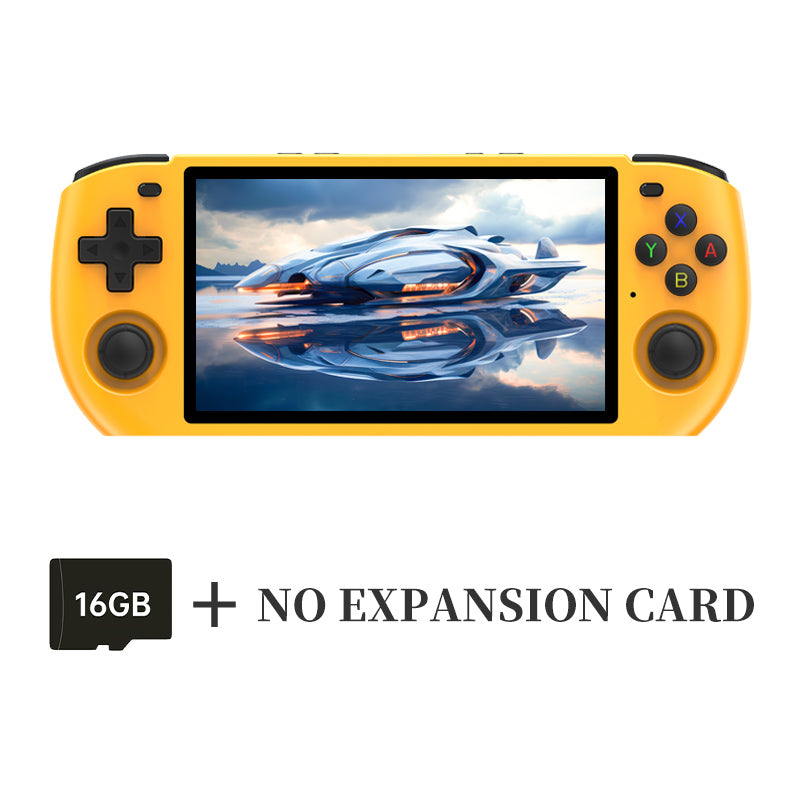
The RGB10MAX3 is Powkiddy doing what Powkiddy does best: taking a chip everyone already knows, wrapping it in a horizontal shell, and undercutting the competition on price. The chip here is the Rockchip RK3566, the same quad-core Cortex-A55 silicon paired with a Mali-G52 2EE GPU that powers the Anbernic RG353 line and Powkiddy’s own RGB30. There is exactly 1GB of LPDDR4 alongside it, and that number matters more than the clock speed when you start pushing the machine. What sets this one apart from the rest of the RK3566 crowd is the screen: a 5.0-inch, 1280×720, 16:9 IPS panel, fully OCA-laminated, in a landscape body with dual sticks and proper grips. Against the Anbernic RG353V/VS (3.5-inch, 4:3) it is a different shape of device entirely, and against the RG40XX H (it shares the 16:9 horizontal idea but runs the weaker H700) it trades raw chip parity for a bigger, sharper display. Inside Powkiddy’s range it sits as the big-screen, big-battery RK3566 option rather than the RGB30’s pocketable 1:1 square.
Emulation performance, generation by generation
Set expectations at the chip, not the marketing copy. The RK3566 is a competent 8- and 16-bit machine and that is where it lives most happily. NES, SNES, Genesis, Master System, Game Boy/Color/Advance, Neo Geo, and arcade up through CPS and most early MAME romsets run at full speed in RetroArch without you ever touching a setting. PS1 is the comfortable ceiling: Beetle PSX HW and the standard PCSX cores hold full speed across the vast majority of the library, with only the heaviest 3D titles asking for frameskip. GBA via mGBA is flawless. The DS is where the “up to DS” claim earns an asterisk — DraStic runs many titles well, but the dual-screen layout on a single 16:9 panel is a compromise and the heavier 3D DS games chug. N64 through mupen64plus-next is selective: Mario 64 and the lighter platformers are fine, but expansion-pak and demanding titles (anything Conker- or Majora-adjacent) drop frames. Dreamcast on Flycast is similarly a per-game lottery — 2D fighters and lighter 3D are playable, but it is not a “load anything” situation. PSP via PPSSPP is the same story: GBA-tier 2D and lighter 3D titles run, but God of War and the showcase 3D games are not realistic. Stop there. PS2, GameCube, Wii, and 3DS are off the table — the RK3566 does not have the CPU or the RAM headroom, and no firmware will change that.
Screen, build and controls
The panel is the actual reason to buy this over a cheaper RK3566 box. At 5 inches and 720p it is sharp enough that integer-scaled SNES and PS1 look genuinely clean, and the lamination kills the air gap that makes budget handhelds look cloudy. The body is plastic, weighs in around 340g, and measures roughly 189 x 76mm with grips that swell to about 33mm at the back — it is a two-handed, sit-down device, not a pocket one. Controls are dual symmetrical analog sticks (reported to be Hall-effect, though Powkiddy’s own listing is quiet on that point, so treat it as likely-not-guaranteed), a top-placed D-pad, and a stacked L1/L2, R1/R2 shoulder layout. Stereo speakers fire from the bottom, there is a 3.5mm jack, USB-C charging with OTG, and crucially two microSD slots — one for the OS, one for your games. A 4000mAh battery delivers a believable 8 hours on 16-bit content, less when you lean on PS1 and PSP.
Software and setup
This is the part to read before you buy. The RGB10MAX3 ships on JELOS, and JELOS has dropped all RK3566 support — the team stepped away from supplying handheld makers after the emulator legal fallout. So the firmware in the box is a dead end for updates. The good news is the active replacement is purpose-built: ROCKNIX, the community successor aimed squarely at Rockchip devices, runs here and is where you should land. ArkOS and Batocera images for RK3566 hardware are also in play depending on community packaging at the time you read this. None of this is plug-and-play the way a Steam Deck is — you will be flashing a microSD, scraping artwork, and reading a setup guide. If that sentence sounds like a chore rather than a hobby, this is not your handheld.
Price, value and who it’s for
Launch pricing landed near $70 with a code and the MSRP floats up toward $90. At $70 it is a lot of screen and battery for the money; at $90 the value argument softens, because Anbernic’s RK3566 devices are right there with more polished stock software. Buy the RGB10MAX3 if you want the largest, sharpest RK3566 screen in a horizontal grip-shell, you are happy living through PS1 with selective N64/DC/PSP, and flashing ROCKNIX sounds like part of the fun. Skip it if you want it to work perfectly out of the box, if you need PSP or N64 to be reliable rather than occasional, or if 1GB of RAM and a now-orphaned stock OS are deal-breakers. It is an honest budget RK3566 handheld with one genuinely good screen — no more, no less.
📐 Size & Pocketability
⚖️ Weight vs Other Handhelds
🔋 Real-World Battery Estimator
⭐ Emulation Performance
📊 View How This Score is Calculated
The Hardware Power Score is an absolute metric. Perfect emulation of difficult, modern consoles awards significantly more points than standard retro consoles.
- 15× Multiplier: Modern PC
- 12× Multiplier: Switch, PS3, Xbox 360
- 10× Multiplier: Wii U
- 8× Multiplier: PS2, GameCube, Wii, Xbox
- 5× Multiplier: Saturn, Dreamcast, PSP
- 3× Multiplier: N64, PS1
- 1× Multiplier: SNES, GBA
Generation 6
Generation 5
Handhelds & Retro
⚡ Performance Benchmarks
Where PowKiddy RGB10MAX3 ARM Mali-G52 MP2 (2EE) lands against the handhelds everyone knows. Every bar shares one scale, so longer genuinely means faster — add up to two rivals to compare.
CPU = Geekbench 6 multi-core · GPU = 3DMark Wild Life. Median real-world scores; every bar shares one scale — add up to two rivals to compare.
📋 Full Specifications
📺 Display
⚙️ Platform
💾 Memory
🕹️ Controls
📏 Body
🔋 Battery
⚖️ Verdict
✅ The Good
- Large, sharp 5.0-inch 720p IPS panel with full OCA lamination — the best screen reason to pick this over cheaper RK3566 boxes
- Dual symmetrical analog sticks and a comfortable horizontal grip shell, well-suited to PS1 and 16-bit libraries
- 4000mAh battery delivers a genuine ~8 hours on 8/16-bit content, plus dual microSD slots (one for OS, one for games)
- Aggressive pricing, often near $70 with a launch code — a lot of screen and battery for the money
❌ The Bad
- Ships on JELOS, which has dropped all RK3566 support, so the stock OS is an update dead end and you must flash ROCKNIX/ArkOS yourself
- Only 1GB LPDDR4 RAM caps the ceiling — N64, Dreamcast and PSP are selective at best, and PS2/GameCube are impossible
- Not pocketable: plastic build around 340g with grips, a sit-down device rather than a grab-and-go one
📰 Latest News & Guides
The Ultimate Guide to ARMSX3: Android’s New PS3 Emulator, Competitor Comparisons, and Setup Tutorial
18/08/2026Pokémon Gold, Silver, and Crystal (Gen 2) Recomp Lands on Android
17/08/2026How to Play the Pokémon Red, Blue, or Yellow Recomp on Your Android, Windows, and Linux Devices
16/08/2026🔍 Similar Handhelds
Other handhelds that emulate up to PSP.