
🛒 Where to Buy
⚠️ Golden Rule of Retro Handhelds: Throw away the cheap MicroSD card that comes in the box — it will fail. And never use a high-wattage PD “Fast Charger” on these devices; it can damage the battery. Use a standard 5V/1.5A brick.
Device Overview: Anbernic RG-503
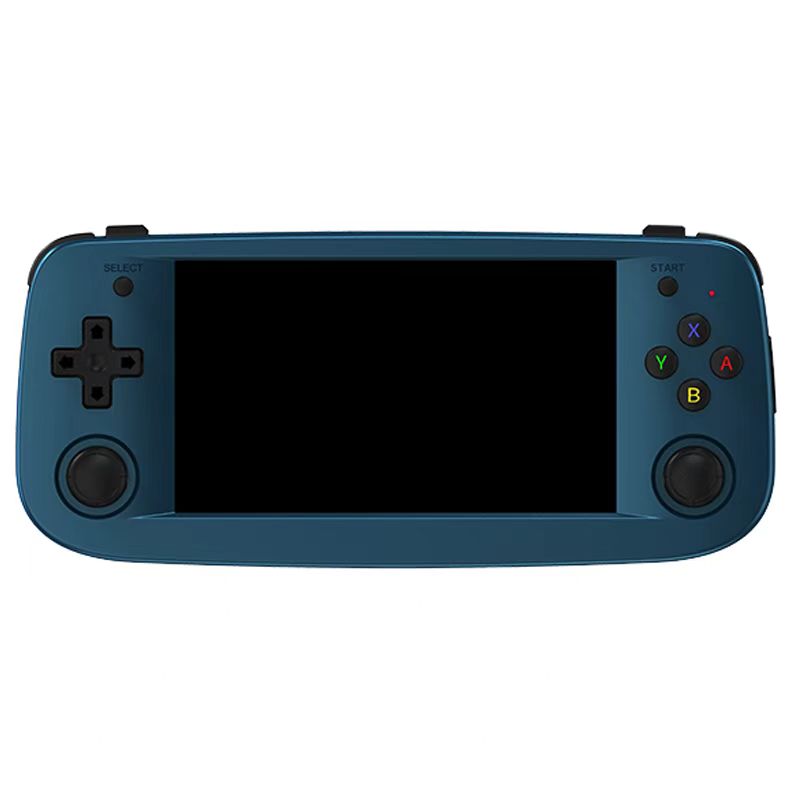
The Anbernic RG-503 arrived in April 2022 as Anbernic’s first handheld built around a Samsung OLED panel, and that screen is the entire reason the device exists. Everything else is a competent but unremarkable RK3566 handheld from the same generation as the RG353 family. Anbernic priced it at $149.99, aiming it at buyers who wanted vibrant blacks and saturated colour on a wide Linux slab rather than another LCD. Anbernic churns out variants at a relentless pace, and the RG-503 is easy to mistake for its LCD cousins at a glance; the panel is the whole differentiator. Two years of hindsight make the trade clear: you are paying an OLED premium on top of a mid-tier chip, and whether that is worth it depends entirely on how much you value the display over raw horsepower.
Emulation performance, generation by generation
The RG-503 runs a Rockchip RK3566: four Cortex-A55 cores at up to 1.8 GHz paired with a Mali-G52 GPU and, critically, just 1 GB of LPDDR4 RAM. That RAM ceiling is the single biggest constraint on what this thing can do. Everything up to and including the 16-bit and 32-bit era is effortless. NES, SNES, Genesis, Game Boy Advance, PC Engine and the arcade libraries (CPS1/2/3, most Neo Geo) run at full speed with room to spare, and PlayStation 1 through DuckStation or the PCSX ReARMed core is rock solid, upscaled and smooth. This is where the RG-503 lives comfortably.
Climb past that and the cracks show. Dreamcast via Flycast is playable rather than perfect: Sonic Adventure, Crazy Taxi and Sonic Adventure 2 hover around 40 fps, and Marvel vs. Capcom 2 runs but not at full speed. PSP through PPSSPP is a per-game lottery, where Tekken: Dark Resurrection is fine but Tekken 6 chugs, and you will spend real time in the settings menu trimming resolution and toggling frameskip. N64 is the usual mess of glitches and crashes that plagues the whole RK3566 tier. Nintendo DS through DraStic handles lighter titles but strains the cores in 3D-heavy games, and squeezing two screens onto one display is always a compromise. Saturn is hit-or-miss. Treat the ceiling as confident through PS1 and negotiable above it. This is not a Windows machine, and there is no PS2 or GameCube here.
Screen, build and controls
The 4.95-inch OLED runs at 960 x 544, the same panel resolution as the original PS Vita, and it is genuinely lovely, with deep blacks and punchy colour no LCD Anbernic can match. The catch is that 544 vertical pixels do not divide cleanly into most retro resolutions, so integer scaling is imperfect and you will lean on shaders or accept slight blur. The body weighs 235 g and measures roughly 190 x 84 x 21 mm, a wide horizontal slab with dual clickable analog sticks, a d-pad, four face buttons, and L1/L2/R1/R2 up top. The sticks are conventional potentiometer units, not Hall effect, so long-term drift is a realistic concern. In the hand it sits somewhere between a Vita and a widescreen brick, fine for shorter sessions but a stretch for larger palms. The plastic shell feels a touch cheap but does not creak under a squeeze. The worst design decision is a Reset button on the bottom edge that is far too easy to hit mid-game.
Software and setup
Out of the box the RG-503 ships with a Linux front end that is serviceable but not where most owners end up. The RK3566 has strong community support, and the honest recommendation is to reflash. JELOS was the go-to firmware for this chip and has since been succeeded by ROCKNIX, both offering clean setups, per-core configuration and RetroArch out of the box. ArkOS and Batocera also run on the RG-503 if you prefer their layouts. Setup is the usual routine: image a microSD, drop ROMs onto a second card, scrape artwork. Wi-Fi (2.4/5 GHz 802.11ac) and Bluetooth 4.2 are on board, alongside mini-HDMI output and Moonlight streaming for pushing to a TV or pulling games from a PC. None of it is plug-and-play polished, but the ecosystem is mature and well documented.
Price, value and who it is for
At $149.99 the RG-503 was never the value pick in its own lineup, since the LCD RG353 siblings gave you the same silicon, more RAM options and Android for less. What you buy here is the OLED, full stop. If you mostly play 8-, 16- and 32-bit games and want them to look their best on a portable, the panel earns its keep and PS1 will be a highlight. If your goal is squeezing out Dreamcast, PSP and N64, the 1 GB of RAM and modest A55 cores will frustrate you, and a Snapdragon Android handheld or an RK3588-class device is the smarter spend. Buy the RG-503 for the screen and the sub-PS2 library, go in knowing the ceiling, and flash ROCKNIX on day one.
📐 Size & Pocketability
⚖️ Weight vs Other Handhelds
🔋 Real-World Battery Estimator
⭐ Emulation Performance
📊 View How This Score is Calculated
The Hardware Power Score is an absolute metric. Perfect emulation of difficult, modern consoles awards significantly more points than standard retro consoles.
- 15× Multiplier: Modern PC
- 12× Multiplier: Switch, PS3, Xbox 360
- 10× Multiplier: Wii U
- 8× Multiplier: PS2, GameCube, Wii, Xbox
- 5× Multiplier: Saturn, Dreamcast, PSP
- 3× Multiplier: N64, PS1
- 1× Multiplier: SNES, GBA
Generation 6
Generation 5
Handhelds & Retro
⚡ Performance Benchmarks
Where Anbernic RG-503 ARM Mali-G52 MP2 (2EE) lands against the handhelds everyone knows. Every bar shares one scale, so longer genuinely means faster — add up to two rivals to compare.
CPU = Geekbench 6 multi-core · GPU = 3DMark Wild Life. Median real-world scores; every bar shares one scale — add up to two rivals to compare.
📋 Full Specifications
📺 Display
⚙️ Platform
💾 Memory
🕹️ Controls
📏 Body
🔋 Battery
⚖️ Verdict
✅ The Good
- Samsung OLED panel at 960 x 544 (the original PS Vita's screen) with blacks and colour no Anbernic LCD can match
- Runs everything through PlayStation 1 at full speed, including upscaled DuckStation and the 16-bit and arcade libraries
- Excellent community firmware support on a well-documented RK3566 chip: JELOS/ROCKNIX, ArkOS and Batocera all run on it
- Useful extras for the price, including mini-HDMI output, Moonlight streaming, 802.11ac Wi-Fi and dual clickable analog sticks
❌ The Bad
- Only 1 GB of RAM caps Dreamcast, PSP, N64 and Saturn at inconsistent, per-game performance
- Non-Hall-effect sticks risk long-term drift, and the bottom-edge Reset button is far too easy to press mid-game
- The OLED's 544 vertical pixels do not scale cleanly to most retro resolutions, forcing shaders or accepting slight blur
📰 Latest News & Guides
The Ultimate Guide to ARMSX3: Android’s New PS3 Emulator, Competitor Comparisons, and Setup Tutorial
18/08/2026Pokémon Gold, Silver, and Crystal (Gen 2) Recomp Lands on Android
17/08/2026How to Play the Pokémon Red, Blue, or Yellow Recomp on Your Android, Windows, and Linux Devices
16/08/2026🔍 Similar Handhelds
Other handhelds that emulate up to PSP.