
🛒 Where to Buy
⚠️ Golden Rule of Retro Handhelds: Throw away the cheap MicroSD card that comes in the box — it will fail. And never use a high-wattage PD “Fast Charger” on these devices; it can damage the battery. Use a standard 5V/1.5A brick.
Device Overview: Anbernic RG35XX
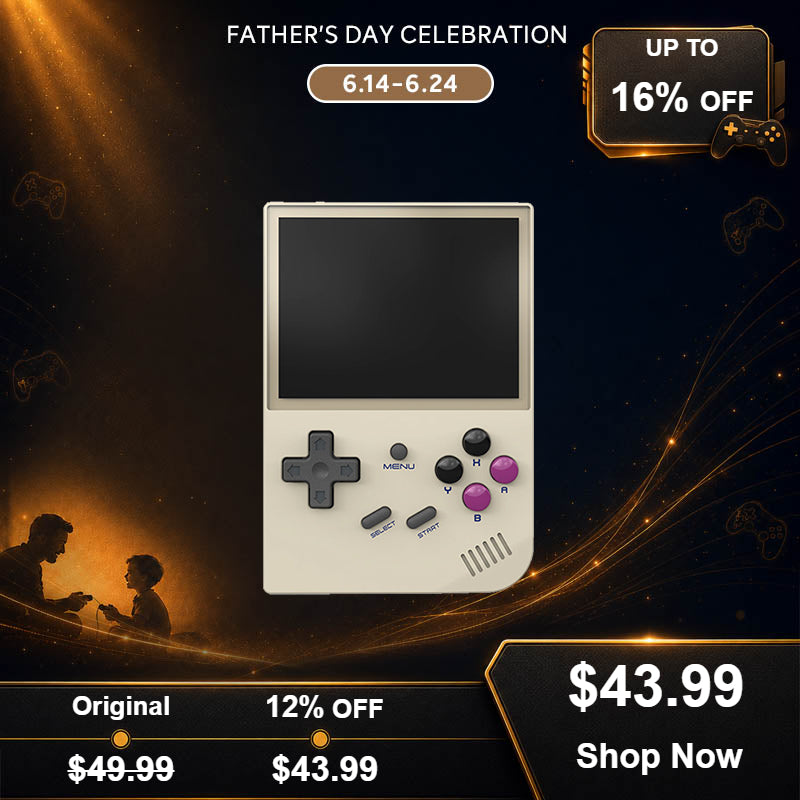
The Anbernic RG35XX is the cheapest sensible entry into the company’s 35-series, and the variant worth describing is the mainstream RG35XX 2024 refresh built on the Allwinner H700, not the original 2023 model that shipped with the slower dual-system Actions ATM7039. If you have read about an RG35XX running Linux, muOS, and Knulli, this is the chip you are dealing with: a quad-core ARM Cortex-A53 clocked at 1.5GHz with a Mali-G31 MP2 GPU and 1GB of LPDDR4. That puts the RG35XX squarely in the same weight class as the Miyoo Mini Plus, and a rung below its own siblings, the horizontal RG35XX H, the redesigned RG35XX Plus, and the clamshell RG35XX SP, all of which share the H700 but add WiFi and Bluetooth. The base 2024 vertical unit does not. That single omission defines the device: no over-the-air anything, no RetroAchievements, no online scraping unless you do it on a PC.
What you actually get for fifty dollars is a tidy, slab-shaped Game Boy-style brick with a 3.5-inch IPS panel at 640×480, OCA full lamination, a 2600mAh battery rated around seven hours, and a vibration motor, all weighing 186 grams. It is the screen that makes the pitch. At 4:3 and 640×480, it is a genuinely good window for everything up to and including the 32-bit era, sharp and well-laminated.
Emulation performance, generation by generation
Generation by generation, the H700 has a hard and predictable ceiling. Everything 8-bit and 16-bit is flawless and always will be: NES, SNES, Genesis, Master System, PC Engine, Neo Geo, and the entire Game Boy line run at full speed with frame-skip headroom to spare. Game Boy Advance is perfect through mGBA or gpSP. PlayStation 1 is the real headline and it delivers, running the vast majority of the PS1 library at full speed under DuckStation or the PCSX ReARMed core in RetroArch, including the heavier 3D titles, though a handful of the most demanding games want a frame or two of skip. From there it gets selective. Nintendo 64 is a coin toss handled by Mupen64Plus: Mario 64, Zelda, and the lighter platformers play well, while Conker and anything leaning hard on the RDP fall apart. Dreamcast through Flycast is similar, the 2D fighters and lighter 3D titles are fine while Crazy Taxi and the showcase games chug. PSP via PPSSPP is the most variable of all, 2D and isometric games such as the Tactics titles run, but 3D-heavy action like God of War drops into single-digit framerates. Sega Saturn is mostly a no. And to be unambiguous: this is not a PS2 or GameCube machine, full stop. Anyone telling you otherwise is selling you something.
Screen, build and controls
The build is honest for the money. The shell is plastic but assembled without creak, the d-pad is a clean cross with good pivot, and the face buttons are tactile. The shoulder buttons are the weak point, mushier than the Plus, and the base 2024 unit has no analog sticks at all, only a d-pad. Newer firmware lets you tap the power button mid-game to map the d-pad as a left-stick input, which is a genuine help for N64 and PS1 games that demand analog, but it is a workaround, not a replacement, and it is awkward for anything needing simultaneous stick and pad. If your library leans on dual analog, look at the H instead.
Software and setup
Software is where the RG35XX earns its reputation. Stock firmware is a competent, no-frills Linux launcher that boots fast and just plays games, and it is perfectly fine if you never want to tinker. But the device exists inside a vibrant SD-card custom-firmware culture, and swapping it is the whole point of buying one. The standouts are muOS, which gives you the fastest boot and the strongest per-core emulation tuning at the cost of more setup, and Knulli, a Batocera-derived build with a polished EmulationStation interface, theme downloader, and scraping. Batocera, GarlicOS, ROCKNIX, and minUI all run on it too. Because everything lives on a microSD and the unit has dual slots, you can keep stock on the internal card and CFW on a second card and switch by swapping, which makes experimenting risk-free.
Price, value and who it’s for
At roughly fifty to sixty-five dollars, the RG35XX is a value pick, but it is no longer the obvious one within its own family. The honest recommendation: buy the base 2024 vertical only if you want the cheapest pocketable 4:3 brick, you primarily play 8-bit through PS1, and you do not care about WiFi. If you want analog sticks, get the H. If you want WiFi, RetroAchievements, and a bigger battery for the same money, the Plus is the smarter buy, and the clamshell SP is worth the premium if you value the form factor. It is a great first handheld and a great gift, but a poor choice if your heart is set on N64, Dreamcast, or PSP as a primary use case.
📐 Size & Pocketability
⚖️ Weight vs Other Handhelds
🔋 Real-World Battery Estimator
⭐ Emulation Performance
📊 View How This Score is Calculated
The Hardware Power Score is an absolute metric. Perfect emulation of difficult, modern consoles awards significantly more points than standard retro consoles.
- 15× Multiplier: Modern PC
- 12× Multiplier: Switch, PS3, Xbox 360
- 10× Multiplier: Wii U
- 8× Multiplier: PS2, GameCube, Wii, Xbox
- 5× Multiplier: Saturn, Dreamcast, PSP
- 3× Multiplier: N64, PS1
- 1× Multiplier: SNES, GBA
Generation 6
Generation 5
Handhelds & Retro
⚡ Performance Benchmarks
Where Anbernic RG-35XX ARM Mali-G31 MP2 lands against the handhelds everyone knows. Every bar shares one scale, so longer genuinely means faster — add up to two rivals to compare.
CPU = Geekbench 6 multi-core · GPU = 3DMark Wild Life. Median real-world scores; every bar shares one scale — add up to two rivals to compare.
📋 Full Specifications
📺 Display
⚙️ Platform
💾 Memory
🕹️ Controls
📏 Body
🔋 Battery
⚖️ Verdict
✅ The Good
- Excellent 640×480 OCA-laminated 3.5" IPS panel that flatters everything up to the PS1 era
- Flawless 8/16-bit and GBA emulation, plus genuinely strong full-speed PS1 performance
- Deep custom-firmware support (muOS, Knulli, Batocera, GarlicOS, ROCKNIX, minUI) with dual microSD slots for risk-free swapping
- Very cheap (~$50) and pocketable at 186g, making it an ideal first handheld or gift
❌ The Bad
- No analog sticks on the base model (d-pad only), with only a clumsy power-button stick-emulation workaround
- No WiFi or Bluetooth, so no RetroAchievements or on-device scraping (the H and Plus add them for similar money)
- Mushy shoulder buttons and a smaller 2600mAh battery than the same-priced RG35XX Plus
📰 Latest News & Guides
The Ultimate Guide to ARMSX3: Android’s New PS3 Emulator, Competitor Comparisons, and Setup Tutorial
18/08/2026Pokémon Gold, Silver, and Crystal (Gen 2) Recomp Lands on Android
17/08/2026How to Play the Pokémon Red, Blue, or Yellow Recomp on Your Android, Windows, and Linux Devices
16/08/2026🔍 Similar Handhelds
Other handhelds that emulate up to Dreamcast.