
🛒 Where to Buy
⚠️ Golden Rule of Retro Handhelds: Throw away the cheap MicroSD card that comes in the box — it will fail. And never use a high-wattage PD “Fast Charger” on these devices; it can damage the battery. Use a standard 5V/1.5A brick.
Device Overview: Anbernic RG-35XX Plus
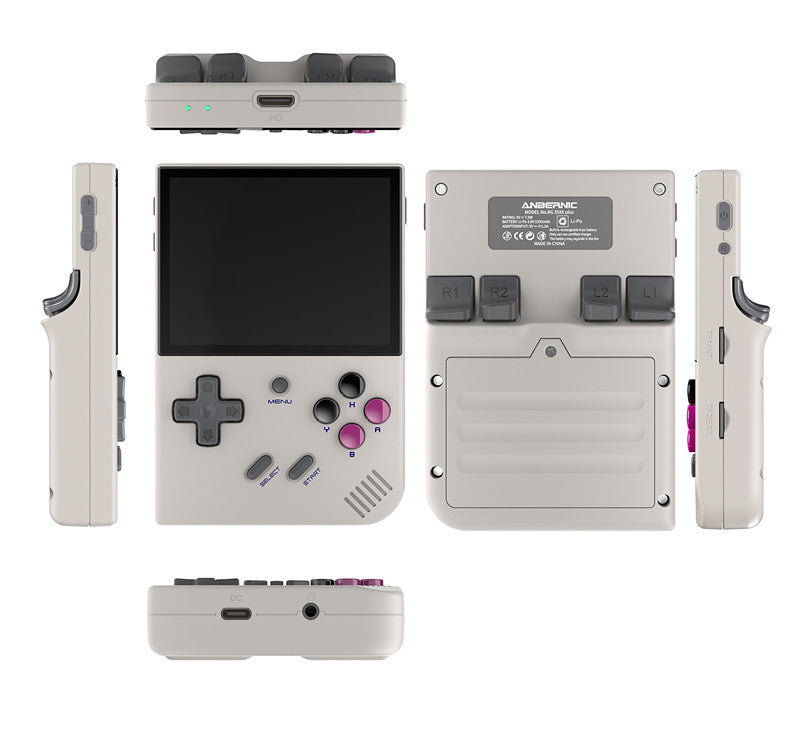
The Anbernic RG-35XX Plus is the chip transplant that turned a likeable budget curio into one of the most-recommended entry handhelds of its generation. It keeps the vertical, Game Boy-shaped shell of the original 2023 RG35XX but swaps in an Allwinner H700 SoC, bolts on 5GHz Wi-Fi and Bluetooth 4.2, and — the reason enthusiasts actually care — opened the door to a deep custom-firmware scene the older model never had. At 186 grams and 117 x 81 x 22 mm it genuinely disappears into a jacket pocket, and at a US$57.99 launch price for the 64GB version it undercut almost everything with a screen this good. This is not a Windows mini-PC or a Steam Deck rival; it is a low-power ARM emulation machine with a very specific job.
Emulation performance, generation by generation
The H700 pairs four ARM Cortex-A53 cores at 1.5GHz with a modest Mali-G31 MP2 GPU and 1GB of LPDDR4. That silhouette tells you the story before you launch a single ROM. Everything 8-bit and 16-bit — NES, SNES, Genesis, Game Boy, GBA, PC Engine, Neo Geo — runs at full speed inside RetroArch with headroom to spare, and PlayStation 1 is fully playable across the library with DuckStation/PCSX cores. This is where the device earns its keep. Climb higher and the ceiling arrives fast. Nintendo 64 through mupen64plus is a title-by-title gamble; lighter games like Super Mario 64 hold framerate, but the absence of analog sticks makes many N64 games awkward even when they run. Dreamcast on Flycast is selective — Crazy Taxi is fine, Shenmue and Sonic Adventure 2 lean on frameskip. Saturn is a coin-flip. PSP via PPSSPP handles 2D and lighter 3D titles but stumbles on demanding games with slowdown and audio crackle, so treat it as a bonus rather than a feature. Nintendo DS through DraStic works but the single 4:3 screen forces clumsy layout choices for dual-screen games, and there is no touchscreen, so titles built around the stylus become a chore. Arcade coverage through FBNeo and MAME is strong up to mid-1990s boards but tapers off once games demand serious 3D. Realistically, buy this as a “flawless up to PS1, hopeful beyond” machine and you will never be disappointed.
Screen, build and controls
The 3.5-inch IPS panel runs 640×480 at a native 4:3 aspect, OCA-laminated so the image sits right under the glass. That 4:3 shape and resolution is a deliberate retro choice: it integer-scales 8- and 16-bit systems cleanly and looks sharper on those than the widescreen panels rivals use. Colours are strong and viewing angles are wide. The shell is unremarkable plastic but assembled solidly for the money. Controls are the honest weak point: you get a d-pad, ABXY face buttons and stacked L1/L2/R1/R2 shoulder buttons, but no analog sticks at all, and nothing here is Hall effect. For the systems this device does best that is a non-issue, but it structurally rules out comfortable N64, PSP and PS1 3D play. The vertical layout is comfortable for short sessions and cramps less-forgiving hands over long ones.
Software and setup
Out of the box it runs Anbernic’s own 64-bit Linux stock OS, which is rougher than the alternatives but perfectly usable if you never want to tinker. The real appeal is that the H700 is exceptionally well supported by community firmware. Knulli, a Batocera fork maintained by acmeplus, is the popular EmulationStation-based pick; muOS offers a cleaner, faster minimalist front-end; MinUI strips everything back to a boxart-free launcher; GarlicOS 2, Koriki/Batocera and ROCKNIX round out the menu. Installation is refreshingly low-risk — most firmwares boot from a second microSD card in the device’s secondary slot, so you leave stock untouched and simply swap cards. Dual microSD slots (expandable to 512GB), a mini-HDMI TV output and Bluetooth for pads and audio round out the setup. Budget an evening to pick a firmware and scrape box art; the payoff is a far better interface than stock.
Price, value and who it is for
At around US$58 the RG-35XX Plus is a lot of confirmed hardware for the outlay: a laminated 4:3 IPS screen, a capable-enough SoC, 3300mAh giving roughly eight hours, wireless, HDMI out and one of the widest firmware ecosystems in its class. It is the right buy for someone who wants a pocketable machine that nails everything from the Game Boy era through PlayStation 1, and who enjoys — or at least tolerates — flashing custom firmware to get the best out of it. Skip it if analog sticks are non-negotiable, if PSP or N64 are your main targets, or if you want a horizontal layout — for those, Anbernic’s own RG35XX H or a stick-equipped sibling is the smarter spend. The main thing that has changed since launch is competition: newer chips like the H700’s successors and Anbernic’s own horizontal models have appeared, but none have undercut this exact combination of price, screen and firmware support. As a first handheld or a cheap retro second, it remains an easy recommendation, and the vibrant custom-firmware community means it will stay useful long after Anbernic stops updating the stock software.
📐 Size & Pocketability
⚖️ Weight vs Other Handhelds
🔋 Real-World Battery Estimator
⭐ Emulation Performance
📊 View How This Score is Calculated
The Hardware Power Score is an absolute metric. Perfect emulation of difficult, modern consoles awards significantly more points than standard retro consoles.
- 15× Multiplier: Modern PC
- 12× Multiplier: Switch, PS3, Xbox 360
- 10× Multiplier: Wii U
- 8× Multiplier: PS2, GameCube, Wii, Xbox
- 5× Multiplier: Saturn, Dreamcast, PSP
- 3× Multiplier: N64, PS1
- 1× Multiplier: SNES, GBA
Generation 6
Generation 5
Handhelds & Retro
⚡ Performance Benchmarks
Where Anbernic RG-35XX Plus ARM Mali-G31 MP2 lands against the handhelds everyone knows. Every bar shares one scale, so longer genuinely means faster — add up to two rivals to compare.
CPU = Geekbench 6 multi-core · GPU = 3DMark Wild Life. Median real-world scores; every bar shares one scale — add up to two rivals to compare.
📋 Full Specifications
📺 Display
⚙️ Platform
💾 Memory
🕹️ Controls
📏 Body
🔋 Battery
⚖️ Verdict
✅ The Good
- Excellent value: laminated 4:3 IPS screen, wireless and HDMI out for around US$58
- Flawless emulation of everything from 8-bit through PlayStation 1
- One of the widest custom-firmware ecosystems in its class (Knulli, muOS, MinUI, GarlicOS 2, ROCKNIX, Batocera/Koriki)
- Genuinely pocketable at 186g with roughly eight hours from the 3300mAh battery, and low-risk CFW via a second microSD slot
❌ The Bad
- No analog sticks at all (and no Hall effect), which rules out comfortable N64, PSP and 3D PS1 play
- PSP, Saturn and heavier Dreamcast titles are beyond the H700's reach
- Stock Anbernic OS is rough, so getting the best experience effectively requires flashing custom firmware
📰 Latest News & Guides
The Ultimate Guide to ARMSX3: Android’s New PS3 Emulator, Competitor Comparisons, and Setup Tutorial
18/08/2026Pokémon Gold, Silver, and Crystal (Gen 2) Recomp Lands on Android
17/08/2026How to Play the Pokémon Red, Blue, or Yellow Recomp on Your Android, Windows, and Linux Devices
16/08/2026🔍 Similar Handhelds
Other handhelds that emulate up to Dreamcast.