
🛒 Where to Buy
⚠️ Golden Rule of Retro Handhelds: Throw away the cheap MicroSD card that comes in the box — it will fail. And never use a high-wattage PD “Fast Charger” on these devices; it can damage the battery. Use a standard 5V/1.5A brick.
Device Overview: Game Console R50S
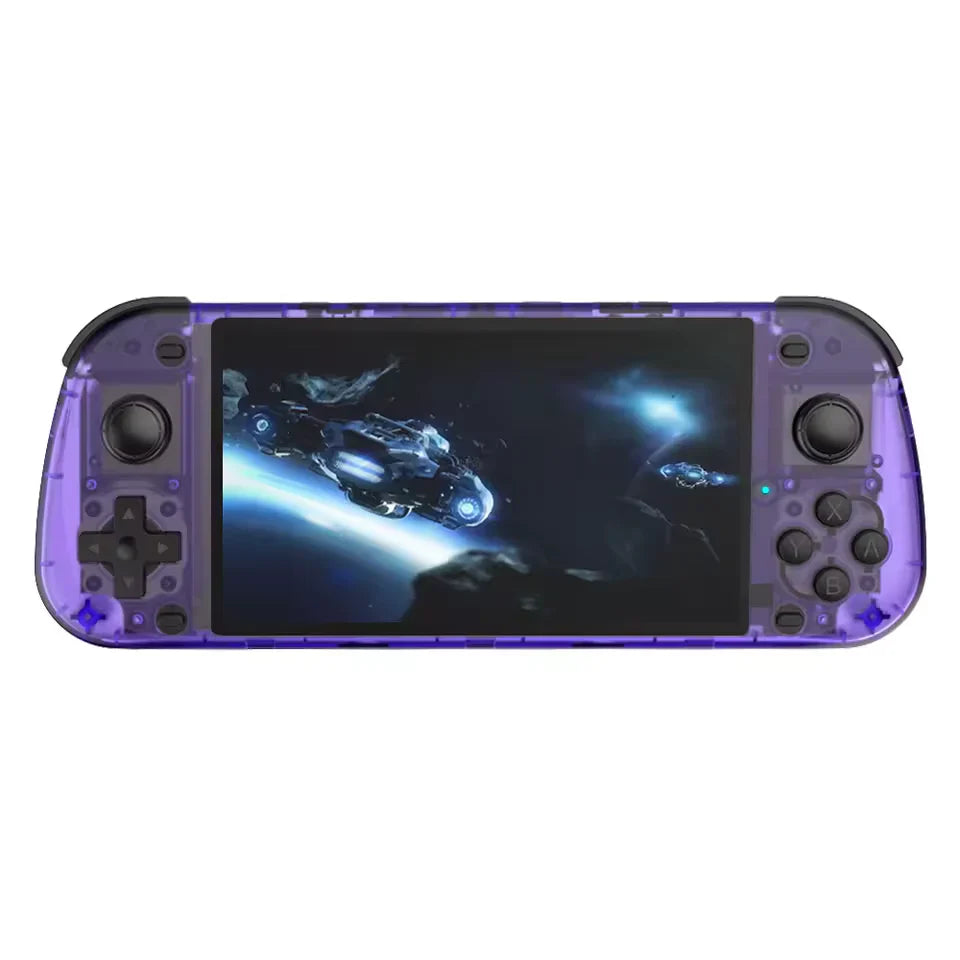
The Game Console R50S is a widescreen budget emulation handheld built on the Rockchip RK3326, the same 2019-vintage silicon that powered Anbernic’s RG351 line and the enormously popular R36S whose name and firmware ecosystem it borrows. Picture the R36S stretched onto a 5.1-inch panel: a horizontal plastic slab aimed at people who want a physically large screen for 8-bit through PlayStation-era libraries and will accept 2019-class performance to get it under $75. It is not a new design so much as a familiar recipe in a bigger shell, and how you feel about it depends almost entirely on whether you buy a genuine unit and reflash it.
Emulation performance, generation by generation
The RK3326 is a quad-core Cortex-A35 running around 1.3 to 1.5 GHz, paired with a Mali-G31 MP2 GPU and 1 GB of DDR3. That is a modest, power-efficient ARM chip, not a pocket PC, so treat any “20,000 games” box claim as a ROM count rather than a promise they all run. Everything through the 32-bit era is comfortable: NES, SNES, Genesis, Master System, PC Engine, Game Boy through GBA, Neo Geo, and the CPS1/CPS2/CPS3 arcade sets all run full speed under RetroArch. PlayStation 1 is the ceiling this chip clears cleanly, and PCSX-ReARMed or DuckStation handle the bulk of the PS1 catalog at full frame rate. Above that, drop your expectations. Nintendo 64 is a coin toss, with roughly 60 percent of the library playable; Super Mario 64 and Ocarina hold up while heavier titles stutter. PSP through PPSSPP manages simpler 2D and lighter 3D games but chokes on anything demanding, so count on maybe three-quarters of your library being tolerable and half of that needing frameskip. Dreamcast is partial, Saturn is mostly a no, and Nintendo DS is workable if you accept the second screen scaled onto a 16:9 display. This is a PS1-and-below machine that occasionally reaches higher; buying it primarily for N64 or PSP will disappoint you.
Screen, build and controls
The headline feature is the 5.09-inch IPS display at 854×480, a 16:9 widescreen running at 60 Hz. At roughly 192 PPI it is sharp enough, and the extra size flatters PS1 3D and MAME fighters, but the 16:9 shape fights the 4:3 systems that make up most retro libraries: you either accept wide pillarboxes or stretch the picture. The native resolution is also low enough that DS and PSP lose fine detail when scaled. The body is a 210 x 90 x 22 mm plastic unit weighing about 300 g, so it is a two-handed device you sit and hold, not something for a jeans pocket. Controls include dual symmetrical analog sticks, but they are conventional potentiometer sticks rather than Hall-effect units, so drift over time is a realistic worry. The shoulders stack L1/R1 over L2/R2, and the D-pad sits low in the traditional R36S position, which some players find cramped. Connectivity is bare: USB-C for charge and data, dual microSD slots (one for the OS, one for ROMs), and no Wi-Fi, no Bluetooth, and no video output whatsoever.
Software and setup
Out of the box the R50S ships with a preloaded microSD and a rough stock Linux frontend stuffed with thousands of ROMs of dubious provenance. Nobody who cares about the device keeps it. Because the chip is RK3326, it inherits a mature custom-firmware scene: ArkOS is the standard recommendation and the most polished option, while ROCKNIX (the AmberELEC and 351ELEC lineage) is the main alternative, and both turn scraping, save states, and per-core settings from the stock mess into something usable. Note what does not apply here: muOS and Knulli target Allwinner H700 devices like the RG35XX line, and OnionOS is Miyoo Mini only, so ignore any guide that points you at them for this chip. The real caveat is authenticity. The R36S/R50S family is flooded with counterfeit boards, some carrying a weaker RK3128 or an unidentified SoC that the standard firmware images will not boot. Confirm your seller ships a genuine RK3326 board before buying, and plan to reflash on day one.
Price, value and who it is for
At roughly $50 to $75 depending on storage and seller, the R50S competes on screen size per dollar rather than raw capability. If you specifically want a large five-inch display for PS1 and 16-bit games on a strict budget, and you are comfortable flashing ArkOS and sourcing your own ROMs, it delivers exactly that for the price of a couple of new Switch games. If you want Hall sticks, Wi-Fi, a pocketable size, or dependable N64 and PSP, put your money toward an Allwinner H700 handheld or a Retroid device instead. This is a narrow tool for a specific buyer, and the biggest risk is not the hardware’s age but the counterfeit lottery wrapped around it.
📐 Size & Pocketability
⚖️ Weight vs Other Handhelds
🔋 Real-World Battery Estimator
⭐ Emulation Performance
📊 View How This Score is Calculated
The Hardware Power Score is an absolute metric. Perfect emulation of difficult, modern consoles awards significantly more points than standard retro consoles.
- 15× Multiplier: Modern PC
- 12× Multiplier: Switch, PS3, Xbox 360
- 10× Multiplier: Wii U
- 8× Multiplier: PS2, GameCube, Wii, Xbox
- 5× Multiplier: Saturn, Dreamcast, PSP
- 3× Multiplier: N64, PS1
- 1× Multiplier: SNES, GBA
Generation 6
Generation 5
Handhelds & Retro
⚡ Performance Benchmarks
Where Game Console R50S Mali-G31 MP2 lands against the handhelds everyone knows. Every bar shares one scale, so longer genuinely means faster — add up to two rivals to compare.
CPU = Geekbench 6 multi-core · GPU = 3DMark Wild Life. Median real-world scores; every bar shares one scale — add up to two rivals to compare.
📋 Full Specifications
📺 Display
⚙️ Platform
💾 Memory
🕹️ Controls
📏 Body
🔋 Battery
⚖️ Verdict
✅ The Good
- Unusually large 5.09-inch 854×480 IPS screen for a sub-$75 handheld, flattering PS1 3D and arcade fighters
- Built on the well-supported RK3326, so mature custom firmware (ArkOS, ROCKNIX) is a straightforward day-one upgrade
- Roomy 4200 mAh battery good for around 8 hours, plus dual microSD slots that keep the OS and ROM library separate
- Runs everything through PlayStation 1 at full speed, covering the majority of what most retro players actually want
❌ The Bad
- The 2019-class RK3326 hits a hard ceiling: N64 is inconsistent (~60%), PSP is spotty, and Dreamcast/Saturn are largely out of reach
- Potentiometer analog sticks rather than Hall-effect, plus no Wi-Fi, no Bluetooth, and no video output at all
- The R36S/R50S line is heavily counterfeited, and some units ship weaker RK3128 or unidentified chips that custom firmware will not boot, making authenticity a genuine gamble
📰 Latest News & Guides
The Ultimate Guide to ARMSX3: Android’s New PS3 Emulator, Competitor Comparisons, and Setup Tutorial
18/08/2026Pokémon Gold, Silver, and Crystal (Gen 2) Recomp Lands on Android
17/08/2026How to Play the Pokémon Red, Blue, or Yellow Recomp on Your Android, Windows, and Linux Devices
16/08/2026🔍 Similar Handhelds
Other handhelds that emulate up to DS.