
🛒 Where to Buy
⚠️ Golden Rule of Retro Handhelds: Throw away the cheap MicroSD card that comes in the box — it will fail. And never use a high-wattage PD “Fast Charger” on these devices; it can damage the battery. Use a standard 5V/1.5A brick.
Device Overview: Anbernic RG-35XX SP
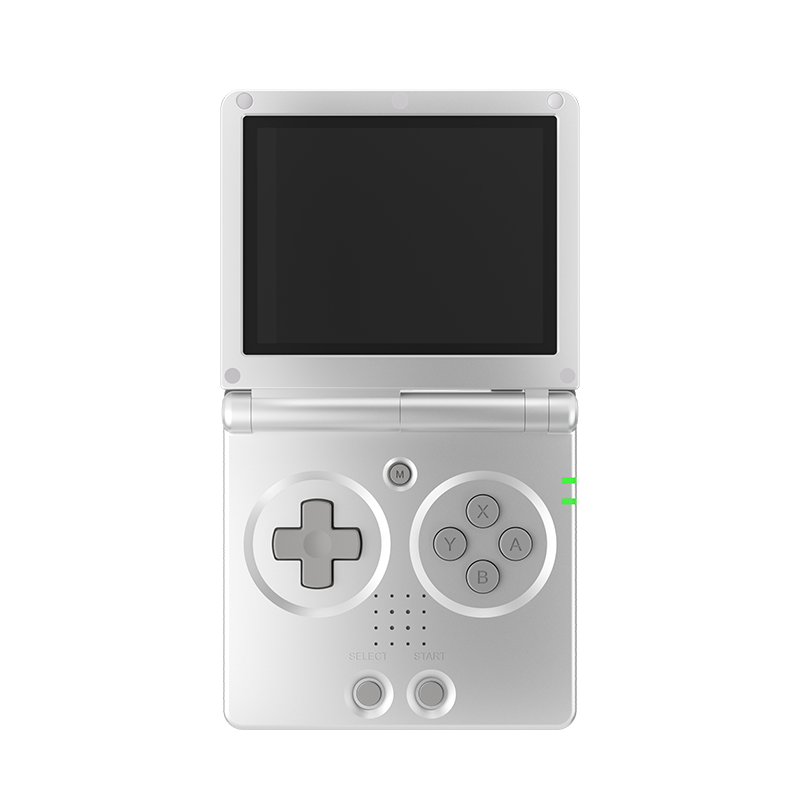
The Anbernic RG-35XX SP is a clamshell retro handheld built as an open homage to the Game Boy Advance SP, right down to the fold-flat hinge and the magnets that hold the lid shut in your pocket. Under the shell it is not exotic hardware: it runs the same Allwinner H700 as the rest of Anbernic’s 2024 RG35XX family, so the SP is really that proven platform folded into a pocketable clamshell body. It launched at $64.99 (and regularly sells nearer $58), which puts it in direct competition with Anbernic’s own RG35XX H and RG35XX Plus. The pitch is narrow and honest: a laminated screen, a hinge that protects it, and enough silicon to run everything up to and including the PlayStation 1.
Emulation performance, generation by generation
The H700 pairs a quad-core ARM Cortex-A53 at 1.5GHz with a dual-core Mali-G31 MP2 and 1GB of LPDDR4. This is a low-power ARM SoC, not a pocket PC, and it behaves accordingly. Everything through the 16-bit era is trivial: NES, SNES, Master System, Genesis, Game Boy through GBA, PC Engine and Neo Geo all run full speed under RetroArch cores like mGBA, Snes9x and Genesis Plus GX. The standout is PlayStation 1, where PCSX ReARMed holds full speed across the vast majority of the library; this is the device’s real ceiling and the reason to buy it. Above that, expectations have to come down. Nintendo 64 through Mupen64Plus is a coin flip that leans toward disappointment: lighter titles are playable, but many games stutter and, crucially, the SP has no analog sticks, so N64 control is a compromise before you even count frames. Dreamcast via Flycast handles 2D fighters and lighter 3D but is inconsistent at full speed. PSP through PPSSPP manages simpler 2D and lighter 3D games at reduced resolution while demanding titles drop frames, and again the missing sticks hurt. Saturn is poor, and the widely-shared GameCube demos are a technical novelty rather than something you would actually play. Nintendo DS runs well under DraStic, though the single 4:3 screen makes dual-screen layouts a chore.
Screen, build and controls
The 3.5-inch IPS panel runs at 640×480 with OCA full lamination, and it is the best part of the device. The 4:3 shape integer-scales GBA and SNES cleanly, colours are punchy, and the bonded glass kills the air gap that makes cheaper handhelds look murky. The clamshell body measures 8.9 x 8.5 x 2.7cm closed and weighs 192g, so it genuinely disappears into a jacket pocket, and the fold-flat design means the screen is never exposed when it is knocked around. Controls are a D-pad, ABXY, Start/Select/Function and four shoulder buttons (L1/R1/L2/R2) along the hinge line. The glaring omission is analog sticks: there is simply no room for them in this form factor, which is fine for retro up to PS1 and a real limitation for anything newer. The plastic build is decent rather than premium, and Anbernic sells it in silver, grey and transparent black and blue finishes.
Software and setup
Out of the box it runs Anbernic’s own 64-bit Linux firmware from a bundled microSD card, and there are two card slots so you can keep the OS and your ROM library separate and swap either freely. Stock firmware is usable but plain, and the SP’s real strength is that it inherits the H700’s mature custom-firmware scene. muOS officially lists the RG-35XX SP among its supported devices and is the easiest upgrade, adding a cleaner interface and PortMaster for a handful of PC ports and native games. Knulli, a Batocera fork built on EmulationStation, has a dedicated build for the device and is the pick if you want one consistent OS across several handhelds. ROCKNIX, the successor to JELOS, also supports it. Setup is the familiar routine: flash an image to a card with a tool like Balena Etcher, drop it in the second slot, and add your own legally-owned ROMs. There is no OnionOS here (that is a Miyoo Mini project) and no need for EmuDeck, which targets PCs.
Price, value and who it is for
At around $58 to $65 with a 64GB card in the box, the RG-35XX SP is a lot of hardware for the money, and the screen quality alone justifies the price against flat-panel rivals. But you are paying partly for the clamshell novelty, and that novelty costs you analog sticks. Buy this if you want a GBA-SP-shaped device for 8-bit, 16-bit and PS1 gaming, value pocketability and a protected screen, and treat N64, Dreamcast and PSP as occasional bonuses rather than the main event. If those later systems or twin-stick control matter to you, the sibling RG35XX H (same chip, but with sticks and a landscape body) or a larger device is the smarter buy. As a focused retro machine that shuts like a book, though, the SP knows exactly what it is.
📐 Size & Pocketability
⚖️ Weight vs Other Handhelds
🔋 Real-World Battery Estimator
⭐ Emulation Performance
📊 View How This Score is Calculated
The Hardware Power Score is an absolute metric. Perfect emulation of difficult, modern consoles awards significantly more points than standard retro consoles.
- 15× Multiplier: Modern PC
- 12× Multiplier: Switch, PS3, Xbox 360
- 10× Multiplier: Wii U
- 8× Multiplier: PS2, GameCube, Wii, Xbox
- 5× Multiplier: Saturn, Dreamcast, PSP
- 3× Multiplier: N64, PS1
- 1× Multiplier: SNES, GBA
Generation 6
Generation 5
Handhelds & Retro
⚡ Performance Benchmarks
Where Anbernic RG-35XX SP ARM Mali-G31 MP2 lands against the handhelds everyone knows. Every bar shares one scale, so longer genuinely means faster — add up to two rivals to compare.
CPU = Geekbench 6 multi-core · GPU = 3DMark Wild Life. Median real-world scores; every bar shares one scale — add up to two rivals to compare.
📋 Full Specifications
📺 Display
⚙️ Platform
💾 Memory
🕹️ Controls
📏 Body
🔋 Battery
⚖️ Verdict
✅ The Good
- Excellent 3.5-inch 640×480 laminated IPS screen that integer-scales retro systems cleanly
- Clamshell design protects the display and makes it genuinely pocketable at 192g
- Full-speed PS1 emulation and flawless 8-bit/16-bit performance from the proven H700
- Strong custom-firmware support: officially on muOS, plus dedicated Knulli and ROCKNIX builds
❌ The Bad
- No analog sticks, which hampers N64, PSP and Dreamcast control and ergonomics
- H700 hits a wall above PS1: N64, Dreamcast and PSP are inconsistent at best
- Only 1GB RAM, Bluetooth 4.2 and plastic build reflect the budget price point
📰 Latest News & Guides
The Ultimate Guide to ARMSX3: Android’s New PS3 Emulator, Competitor Comparisons, and Setup Tutorial
18/08/2026Pokémon Gold, Silver, and Crystal (Gen 2) Recomp Lands on Android
17/08/2026How to Play the Pokémon Red, Blue, or Yellow Recomp on Your Android, Windows, and Linux Devices
16/08/2026🔍 Similar Handhelds
Other handhelds that emulate up to Dreamcast.