
🛒 Where to Buy
⚠️ Golden Rule of Retro Handhelds: Throw away the cheap MicroSD card that comes in the box — it will fail. And never use a high-wattage PD “Fast Charger” on these devices; it can damage the battery. Use a standard 5V/1.5A brick.
Device Overview: Miyoo A30
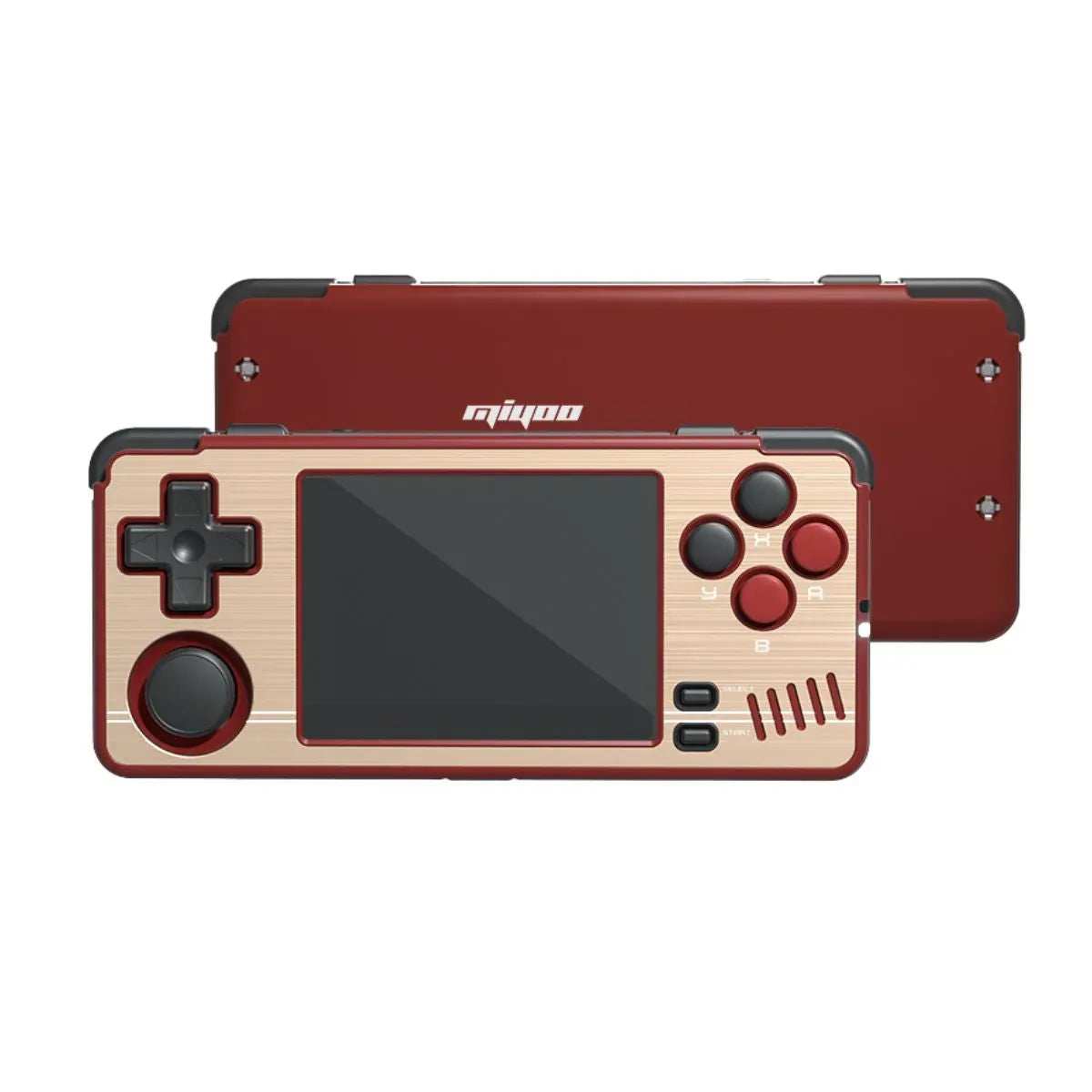
The Miyoo A30 is Miyoo’s attempt to answer one question: what does the beloved Miyoo Mini feel like if you rotate it into a landscape shell and bolt on a thumbstick? Released in mid-2024 at roughly $45 to $50, it is a pocket-sized horizontal handheld that draws obvious comparisons to Nintendo’s Game Boy Micro. Under the hood it is deliberately modest, built around an Allwinner A33 running four ARM Cortex-A7 cores at up to 1.2 GHz, a Mali-400 MP2 GPU and just 512 MB of RAM. That is early-2010s tablet silicon, and it sets hard limits on what this thing can and cannot do. Buy it understanding that it is a 16-bit-and-below machine that occasionally reaches higher, not a do-everything emulator.
Emulation performance, generation by generation
Everything through the 16-bit era runs the way you want it to. NES (FCEUmm), Game Boy and Game Boy Color (Gambatte), Master System and Genesis/Mega Drive (Genesis Plus GX, PicoDrive), and the PC Engine all play at full speed with room to spare. SNES is where the first cracks show: lighter cores such as snes9x2005 are fine, but the accurate snes9x build can stutter in Super FX and other heavy titles, so you sometimes drop to a faster core. Game Boy Advance through gpSP or a tuned mGBA is genuinely good, which for many buyers is the whole point of a device this size. PlayStation 1 via PCSX ReARMed is the realistic ceiling: a large share of the library is playable, though CD-heavy 3D games will show slowdown and you may need to lean on frameskip. Nintendo 64 and Dreamcast are where the marketing outruns the hardware. mupen64plus will boot some N64 titles, but expect compromised frame rates and a short list of games that actually hold up, while Dreamcast, PSP and Saturn are effectively off the table. Arcade emulation through FinalBurn Neo and MAME is a mixed bag that depends entirely on the specific board. Treat the A30 as a machine that nails retro up to PS1 and quietly stops there.
Screen, build and controls
The 2.8-inch IPS panel runs at 640 x 480 in a 4:3 ratio, which is the correct shape for the systems this device targets and gives 8- and 16-bit games clean scaling. The catch is brightness: even maxed out the screen looks dull, and it is not a display you will enjoy outdoors. The chassis is plastic with a metal front plate, small enough to vanish into a jacket pocket at 125 x 57 x 15 mm and around 115 g. Controls are uneven. The NES-style D-pad is usable but mushier than the Mini Plus’s and prone to registering stray vertical inputs, which hurts fighting games and precision platformers. There is a single Switch-style analog stick, which is not Hall effect and is mounted uncomfortably low, so your thumb has to reach down for it, alongside four face buttons and four shoulder buttons (L1/L2/R1/R2). A vibration motor is included, a nice touch at this price. The 2600 mAh battery is good for roughly five hours depending on system and brightness.
Software and setup
Out of the box the A30 runs Miyoo’s stock Linux OS, which is functional but cluttered and, notoriously, ships with default filter and scaling settings that make some emulators feel slower than the hardware actually is. That is the single biggest reason to look at custom firmware immediately. The A30’s community centres on spruceOS, a polished overhaul that strips the bloat, corrects those performance-sapping defaults and adds a cleaner interface; for most owners it is close to mandatory. If you prefer a minimalist, near-instant-boot experience with no menus getting in the way, MinUI supports the A30 and is the fastest-booting option available for it. Both install to the microSD card, so you are not risking the internal storage, and both are far better starting points than fighting the stock firmware. Connectivity is limited to 2.4 GHz Wi-Fi, which is mainly useful for network features and file transfers rather than anything demanding.
Price, value and who it is for
At around $45 to $50 the A30 is cheap, and its appeal is specific rather than broad. It exists for people who want a genuinely tiny landscape handheld for NES, Game Boy, Genesis, SNES and GBA, and who like the idea of a Game Boy Micro that also plays a decent chunk of the PS1 catalog. If that is you, and you flash spruceOS or MinUI on day one, it delivers. It is a poor pick if you care about N64 or anything newer, if you need a bright screen for outdoor play, or if you want a precise D-pad and a comfortably placed stick, since the vertical Miyoo Mini Plus arguably still does the core job better. The A30 is a likeable, flawed little machine: right-sized, honestly priced and best judged by the modest hardware inside it rather than the spec-sheet claims that reach beyond it.
📐 Size & Pocketability
⚖️ Weight vs Other Handhelds
🔋 Real-World Battery Estimator
⭐ Emulation Performance
📊 View How This Score is Calculated
The Hardware Power Score is an absolute metric. Perfect emulation of difficult, modern consoles awards significantly more points than standard retro consoles.
- 15× Multiplier: Modern PC
- 12× Multiplier: Switch, PS3, Xbox 360
- 10× Multiplier: Wii U
- 8× Multiplier: PS2, GameCube, Wii, Xbox
- 5× Multiplier: Saturn, Dreamcast, PSP
- 3× Multiplier: N64, PS1
- 1× Multiplier: SNES, GBA
Generation 6
Generation 5
Handhelds & Retro
📋 Full Specifications
📺 Display
⚙️ Platform
💾 Memory
🕹️ Controls
📏 Body
🔋 Battery
⚖️ Verdict
✅ The Good
- Genuinely pocketable landscape shell at roughly 115 g with a correct 4:3, 640 x 480 IPS panel for retro systems
- Runs everything up to 16-bit flawlessly and handles GBA plus a large share of the PS1 library well
- Active, high-quality custom-firmware support (spruceOS and MinUI) that transforms the stock experience
- Very cheap at about $45 to $50, and still includes a vibration motor and Wi-Fi
❌ The Bad
- Dim screen that is hard to read even at maximum brightness and unusable in sunlight
- Mushy NES-style D-pad prone to stray inputs, plus a non-Hall analog stick mounted awkwardly low
- The Allwinner A33 hits a wall at PS1: N64 is unreliable and Dreamcast, PSP and Saturn are out of reach
📰 Latest News & Guides
The Ultimate Guide to ARMSX3: Android’s New PS3 Emulator, Competitor Comparisons, and Setup Tutorial
18/08/2026Pokémon Gold, Silver, and Crystal (Gen 2) Recomp Lands on Android
17/08/2026How to Play the Pokémon Red, Blue, or Yellow Recomp on Your Android, Windows, and Linux Devices
16/08/2026🔍 Similar Handhelds
Other handhelds that emulate up to DS.