
🛒 Where to Buy
⚠️ Golden Rule of Retro Handhelds: Throw away the cheap MicroSD card that comes in the box — it will fail. And never use a high-wattage PD “Fast Charger” on these devices; it can damage the battery. Use a standard 5V/1.5A brick.
Device Overview: BOYHOM R40S
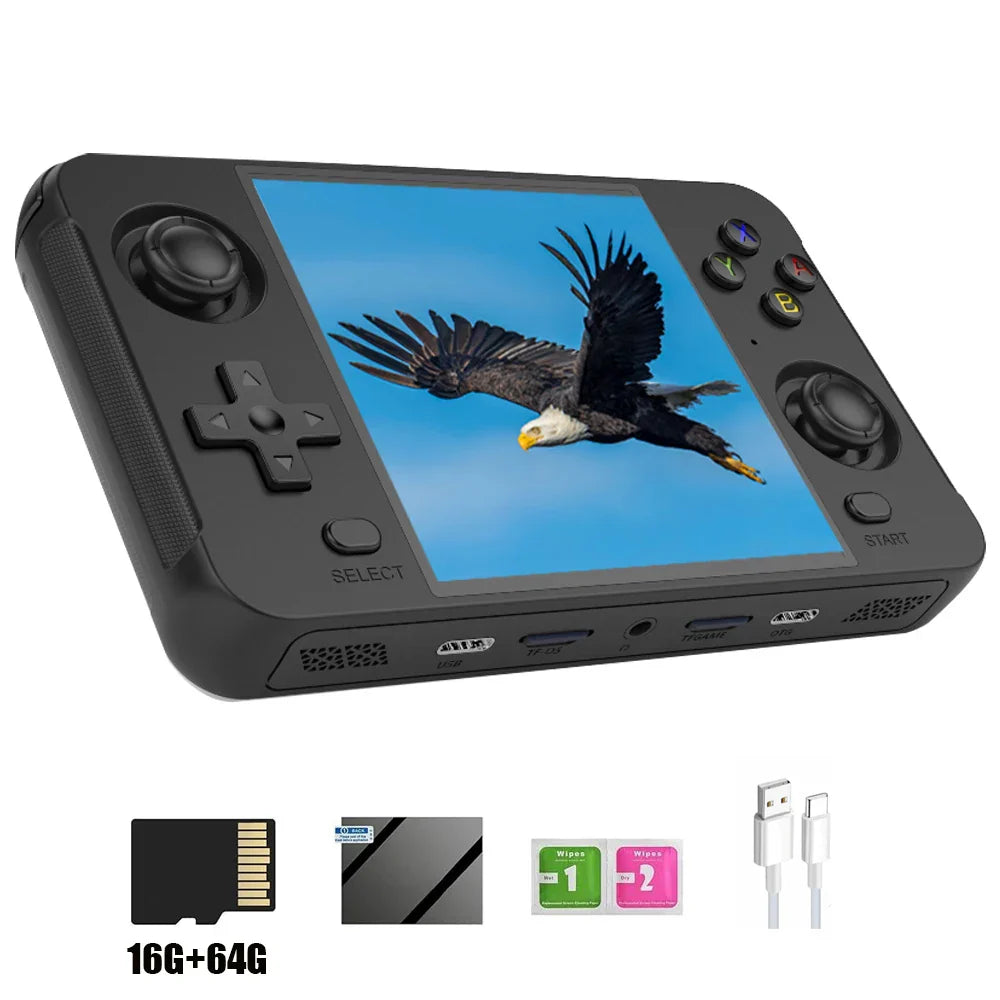
The BOYHOM R40S is a square-screen emulation handheld that copies the format PowKiddy popularized with the RGB30: a 4-inch, 720×720, 1:1 IPS panel wrapped around a Rockchip RK3566. It launched in mid-2024 at roughly $50 to $75 depending on the seller, and it lands in a crowded pool of near-identical RK3566 devices. The entire pitch is the aspect ratio. A 1:1 screen wastes no glass on systems that were themselves close to square, and it turns vertical arcade boards into full-height images instead of a thin strip between black bars. Everything else about the R40S is ordinary, and a few things about it are worse than ordinary. Connectivity runs to Wi-Fi, Bluetooth, a USB-C port, a 3.5mm jack and stereo speakers, which is enough for scraping box art and pairing a controller but nothing you would lean on for serious netplay.
Emulation performance, generation by generation
The RK3566 is a quad-core Cortex-A55 clocked to 1.8GHz with a Mali-G52 2EE GPU. This is a low-power ARM SoC, not a pocket PC, so treat any “plays PSP” marketing as a ceiling reached only occasionally. Through the 16-bit era it is effortless: NES, SNES, Genesis, Game Boy through GBA, PC Engine, Master System and arcade boards on FBNeo or MAME run at full speed with Snes9x, Genesis Plus GX and the rest of the standard RetroArch cores. PlayStation is comfortable on PCSX ReARMed, and GBA and the earlier Game Boy handhelds are indistinguishable from the originals while slotting naturally into the tall screen. The step up is where honesty matters. Nintendo 64 via Mupen64Plus is a per-game lottery, with Mario 64 fine and the RDP-heavy titles stuttering. Dreamcast on Flycast and PSP on PPSSPP are playable in lighter games at reduced resolution but drop frames the moment a title leans on the hardware. Nintendo DS through DraStic is the R40S’s happiest surprise, because the stacked DS screens map cleanly onto a square panel. Do not expect GameCube, Wii, PS2 or Saturn; the chip and the single gigabyte of RAM rule them out.
Screen, build and controls
The panel is the reason to look at this device and it is genuinely sharp: 720×720 at about 254 ppi, bright enough indoors, with the 1:1 shape paying off for Game Boy, WonderSwan, Neo Geo Pocket, PICO-8 and vertical shmups. The cost is that every 4:3 system (SNES, Genesis, PS1) sits letterboxed with bars above and below, and 16:9 PSP output is squeezed into a narrow band. The body measures 145 x 86.5 x 10mm and weighs 211g of plain plastic with molded grips. Controls are the weak link. The sticks are conventional potentiometer units, not Hall effect, and they barely clear their recesses; the D-pad on review units produced false diagonals and mushy travel; the ABXY buttons showed crosstalk; and the L2/R2 triggers sit where you must shift your grip to reach them. One reviewer’s unit also shipped with a battery that only held a charge while plugged in, a QC failure rather than a design trait, but a fair signal of the manufacturing standard here.
Software and setup
The R40S ships with ArkOS, the community Linux firmware for RK3566 and RK3326 handhelds, usually a version behind current. Stock ArkOS is fine: an EmulationStation front end, per-core RetroArch settings, and box-art scraping over Wi-Fi. Because it is a standard RK3566 board, it also accepts the wider custom-firmware menu; ROCKNIX and Batocera both boot on this class of hardware and give you a cleaner update path and current cores. Note what does not apply here: muOS and OnionOS target Allwinner and Miyoo chips respectively, so those guides are irrelevant, and Knulli is aimed at other silicon too. Setup is the usual routine of imaging a microSD with your chosen firmware, dropping legally owned ROMs and BIOS files on the second card, and scraping. The dual microSD slots make it easy to keep firmware and games on separate cards.
Price, value and who it is for
At $50 to $75 the R40S is worth it only if the square screen is specifically what you want and you can live with mediocre controls. For that money PowKiddy’s own RGB30 does the same 1:1 job with a better-regarded build, and Anbernic’s RK3566 handhelds give you a more comfortable horizontal shape if you do not need the square panel. The R40S makes sense for a Game Boy, WonderSwan or vertical-arcade collector who values the aspect ratio above all, or for a tinkerer who plans to reflash it on day one and does not mind fiddly buttons. Anyone who wants smooth N64 and PSP, dependable ergonomics, or out-of-the-box polish should spend elsewhere. BOYHOM has since put out the R46S, which reuses the same silicon with reworked ergonomics, so cross-shop that model if the shape here worries you. Buy the R40S for the screen, go in knowing the rest is a budget clone, and confirm the battery actually holds a charge the day it arrives.
📐 Size & Pocketability
⚖️ Weight vs Other Handhelds
🔋 Real-World Battery Estimator
⭐ Emulation Performance
📊 View How This Score is Calculated
The Hardware Power Score is an absolute metric. Perfect emulation of difficult, modern consoles awards significantly more points than standard retro consoles.
- 15× Multiplier: Modern PC
- 12× Multiplier: Switch, PS3, Xbox 360
- 10× Multiplier: Wii U
- 8× Multiplier: PS2, GameCube, Wii, Xbox
- 5× Multiplier: Saturn, Dreamcast, PSP
- 3× Multiplier: N64, PS1
- 1× Multiplier: SNES, GBA
Generation 6
Generation 5
Handhelds & Retro
⚡ Performance Benchmarks
Where BOYHOM R40S ARM Mali-G52 MP2 (2EE) lands against the handhelds everyone knows. Every bar shares one scale, so longer genuinely means faster — add up to two rivals to compare.
CPU = Geekbench 6 multi-core · GPU = 3DMark Wild Life. Median real-world scores; every bar shares one scale — add up to two rivals to compare.
📋 Full Specifications
📺 Display
⚙️ Platform
💾 Memory
🕹️ Controls
📏 Body
🔋 Battery
⚖️ Verdict
✅ The Good
- Genuinely sharp 4-inch 720×720 IPS panel with a true 1:1 aspect ratio that fills the screen for Game Boy, WonderSwan, Neo Geo Pocket and vertical arcade shooters
- Runs the entire 8/16-bit, arcade and PS1 catalog at full speed, and handles Nintendo DS well thanks to the square screen
- Standard RK3566 board that ships with ArkOS and also boots ROCKNIX and Batocera, so you are not locked to the stock firmware
- Dual microSD slots and a 4000mAh battery at a low $50 to $75 street price
❌ The Bad
- Poor controls: non-Hall potentiometer sticks that barely protrude, a D-pad prone to false diagonals, ABXY crosstalk, and awkwardly placed L2/R2 triggers
- Budget-clone quality control, including at least one reviewer unit that only ran while plugged in and shells shipped in the wrong color
- Square screen letterboxes every 4:3 system and badly crops 16:9 PSP output, while N64, PSP and Dreamcast performance stays inconsistent
📰 Latest News & Guides
The Ultimate Guide to ARMSX3: Android’s New PS3 Emulator, Competitor Comparisons, and Setup Tutorial
18/08/2026Pokémon Gold, Silver, and Crystal (Gen 2) Recomp Lands on Android
17/08/2026How to Play the Pokémon Red, Blue, or Yellow Recomp on Your Android, Windows, and Linux Devices
16/08/2026🔍 Similar Handhelds
Other handhelds that emulate up to PSP.