
🛒 Where to Buy
⚠️ Golden Rule of Retro Handhelds: Throw away the cheap MicroSD card that comes in the box — it will fail. And never use a high-wattage PD “Fast Charger” on these devices; it can damage the battery. Use a standard 5V/1.5A brick.
Device Overview: GAMEMT E6
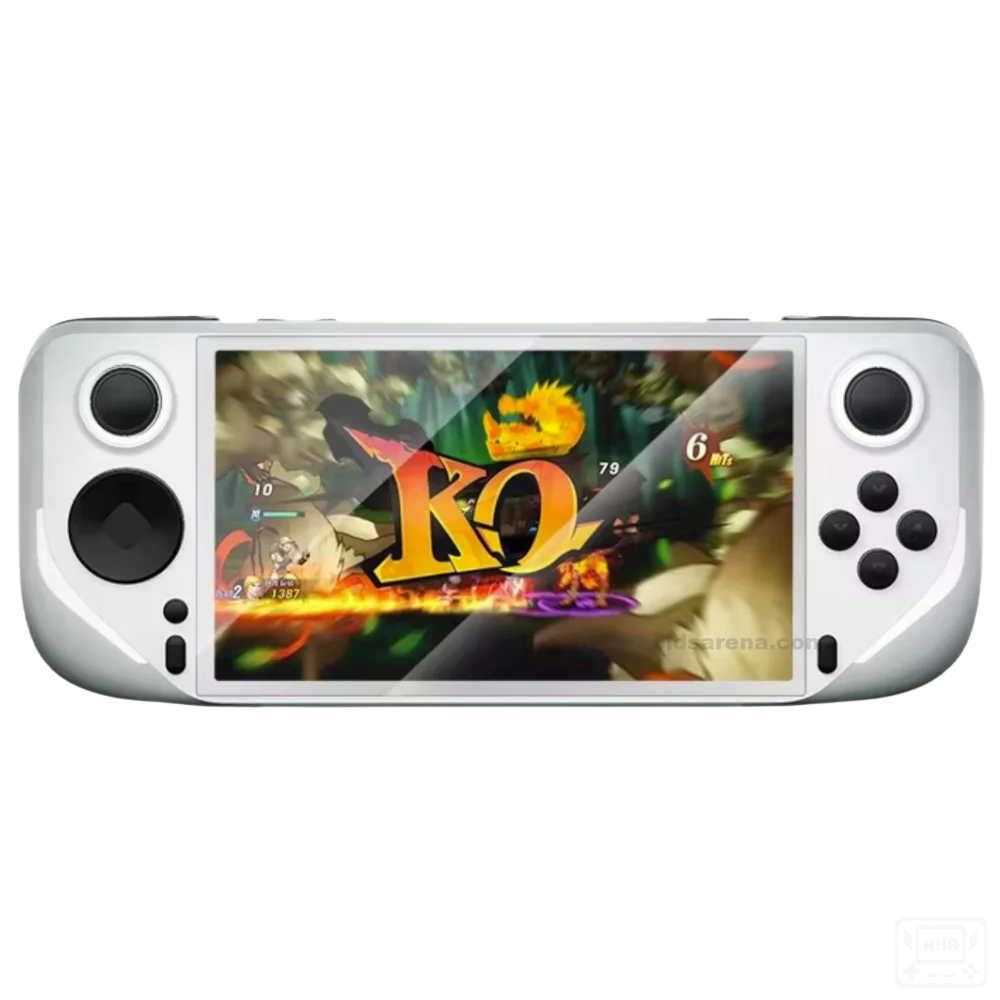
The GAMEMT E6 is a $50-class Android retro handheld built on the Rockchip RK3326, the same aging quad-core system-on-chip that powered the Odroid Go Advance, the Anbernic RG351 line and the wildly cloned R36S. That lineage tells you most of what you need to know: this is a low-power ARM device aimed at 8-bit through PlayStation-era libraries, not a pocket PC. GAMEMT sells it alongside a beefier E6 Plus (RK3566) and E6 Max (Allwinner A527), but the base E6 covered here is the cheapest and slowest of the three, and it should be judged on that footing rather than on its siblings’ spec sheets.
Emulation performance, generation by generation
The RK3326 pairs four ARM Cortex-A35 cores running at 1.3–1.5 GHz with a Mali-G31 MP2 GPU and a single gigabyte of DDR3. Everything through the 16-bit era runs at full speed: NES, SNES, Mega Drive, Master System, PC Engine, Neo Geo and the Game Boy family are effortless, and Game Boy Advance via mGBA or gpSP is flawless. Arcade boards up to CPS1, CPS2 and mid-era MAME sets run cleanly in FBNeo. PlayStation 1 is the comfortable ceiling — PCSX ReARMed or DuckStation clear the large majority of the library at full speed. Above that, honesty is required. Nintendo 64 is a coin toss: Super Mario 64 and Ocarina of Time are playable through Mupen64Plus-Next, but demanding titles stutter. Nintendo DS via DraStic runs a good chunk of the catalogue, though 3D-heavy games dip below full speed and the fixed dual-screen layout is awkward on a single panel. Dreamcast is limited to lighter 2D fare in Flycast and is frequently unstable. PSP is where the marketing outruns the silicon: the RK3326 is not a PSP machine, and only the simplest 2D titles limp along in PPSSPP. Treat “PSP on Android” claims as aspirational. Saturn, GameCube, PS2 and 3DS are all out of reach.
Screen, build and controls
The 5-inch IPS panel runs 854×480 at 60 Hz behind tempered glass, roughly 196 ppi, with no touch layer. That 16:9 shape suits GBA and PSP aspect ratios but leaves black bars around 4:3 systems, and 480p is a modest resolution that caps how much you can upscale sharper 3D emulators. At 203 x 81 x 38 mm and 208 g the E6 is chunky, with a pronounced rear hump for grip. Controls are a mixed bag: dual analog sticks sit in the upper position with the d-pad below, four face buttons, and vertically stacked L1/L2 and R1/R2 shoulders. The sticks are conventional potentiometer units, not Hall-effect, so expect eventual drift, and there are no L3/R3 clicks. The 5000 mAh cell is generous for the chip’s low draw and realistically delivers five to eight hours, charging over USB-C. The speaker fires from the back.
Software and setup
Stock, the E6 boots Android 8.1 — an operating system from 2017. That is old enough to cause friction with modern Play Store builds of RetroArch, DraStic and PPSSPP, and it colours the whole experience. The bigger practical wall is connectivity: the spec sheets list no Wi-Fi, no Bluetooth and no headphone jack, which means ROMs load only by pulling the microSD card and copying files on a computer, with no netplay, no wireless pads and no over-the-air updates. There is no internal storage either, so the bundled card (commonly 64 GB, expandable to 256 GB) is the whole library.
The saving grace of any RK3326 device is its custom-firmware scene. Linux distributions such as ArkOS, AmberELEC, ROCKNIX and Knulli, plus the Android-based GammaOS, turned the R36S and RG351 into far better machines than their stock software allowed, and they generally run leaner and cooler than Android 8.1. The caveat for the E6 specifically is that these images are built and tested against known hardware; GAMEMT is an obscure clone brand, so a clean, fully mapped install is not guaranteed and may demand community tinkering with screen and control configs. Confirm current compatibility for this exact SKU before assuming a one-click flash.
Price, value and who it is for
At roughly $50–55 the E6 is priced as an impulse buy, and against that number it delivers a competent PS1-and-below machine with a large battery. But the value math is unforgiving in 2026. The R36S and its clones use the same chip for similar money with Linux firmware out of the box, and an Anbernic RG34XX or a used RG35XX-class unit often costs little more while adding Wi-Fi and better fit and finish. The E6 makes sense if you find it discounted, you specifically want the larger 5-inch display, and you are comfortable flashing custom firmware. If you want plug-and-play, wireless ROM transfers, or anything past PS1, look elsewhere — and note that public documentation for this exact model is thin, so buy expecting to lean on community help.
📐 Size & Pocketability
⚖️ Weight vs Other Handhelds
🔋 Real-World Battery Estimator
⭐ Emulation Performance
📊 View How This Score is Calculated
The Hardware Power Score is an absolute metric. Perfect emulation of difficult, modern consoles awards significantly more points than standard retro consoles.
- 15× Multiplier: Modern PC
- 12× Multiplier: Switch, PS3, Xbox 360
- 10× Multiplier: Wii U
- 8× Multiplier: PS2, GameCube, Wii, Xbox
- 5× Multiplier: Saturn, Dreamcast, PSP
- 3× Multiplier: N64, PS1
- 1× Multiplier: SNES, GBA
Generation 6
Generation 5
Handhelds & Retro
⚡ Performance Benchmarks
Where GAMEMT E6 Mali-G31 MP2 lands against the handhelds everyone knows. Every bar shares one scale, so longer genuinely means faster — add up to two rivals to compare.
CPU = Geekbench 6 multi-core · GPU = 3DMark Wild Life. Median real-world scores; every bar shares one scale — add up to two rivals to compare.
📋 Full Specifications
📺 Display
⚙️ Platform
💾 Memory
🕹️ Controls
📏 Body
🔋 Battery
⚖️ Verdict
✅ The Good
- Big 5000 mAh battery delivers a genuine 5-8 hours from the frugal RK3326 chip
- Larger 5-inch IPS screen than most sub-$60 rivals, well suited to GBA and PS1
- Runs the entire 8/16-bit and PlayStation 1 library at full speed for around $50
- RK3326 silicon has a mature custom-firmware ecosystem (ArkOS, ROCKNIX, Knulli, GammaOS) to fall back on
❌ The Bad
- No Wi-Fi, Bluetooth or headphone jack, so ROMs load only by physically swapping the microSD card
- Ships on ancient Android 8.1 (2017) with drift-prone potentiometer sticks rather than Hall-effect
- Obscure clone brand with thin documentation and unverified custom-firmware support for this exact model
📰 Latest News & Guides
The Ultimate Guide to ARMSX3: Android’s New PS3 Emulator, Competitor Comparisons, and Setup Tutorial
18/08/2026Pokémon Gold, Silver, and Crystal (Gen 2) Recomp Lands on Android
17/08/2026How to Play the Pokémon Red, Blue, or Yellow Recomp on Your Android, Windows, and Linux Devices
16/08/2026🔍 Similar Handhelds
Other handhelds that emulate up to DS.