
🛒 Where to Buy
⚠️ Golden Rule of Retro Handhelds: Throw away the cheap MicroSD card that comes in the box — it will fail. And never use a high-wattage PD “Fast Charger” on these devices; it can damage the battery. Use a standard 5V/1.5A brick.
Device Overview: Anbernic RG-353VS
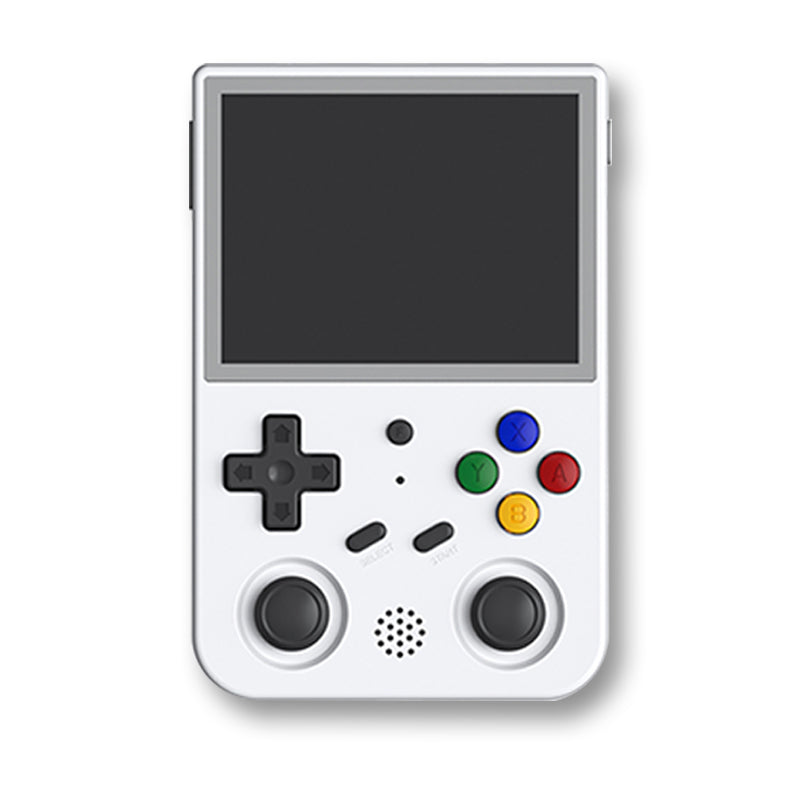
The Anbernic RG-353VS is the stripped-down, Linux-only member of Anbernic’s RG353 family, built around the Rockchip RK3566 and wrapped in a vertical, Game Boy-style shell. It shares its chassis and 3.5-inch screen with the pricier RG353V, but Anbernic cut three things to reach a lower price: it drops the Android dual-boot, halves the RAM to 1GB, and removes the touchscreen. What is left is a focused retro machine that does one job well, running emulators from Linux firmware. The missing extras only matter if you wanted Android apps or touch menus, which is almost nobody’s reason for buying a device like this.
Emulation performance, generation by generation
The RK3566 is a quad-core Cortex-A55 clocked to 1.8GHz with a Mali-G52 GPU. This is a modest, power-efficient ARM chip, not a pocket PC, and the emulation ceiling reflects that. Everything up to the 16-bit era runs at full speed with headroom to spare: NES, SNES, Genesis, Master System, PC Engine, Game Boy through Game Boy Advance, plus Neo Geo and the CPS1 and CPS2 arcade libraries all hold locked frame rates. PlayStation 1 is the sweet spot above that, where PCSX-ReARMed plays the catalog at full speed with few exceptions. Nintendo DS is a genuine highlight thanks to DraStic, which runs the bulk of the library smoothly with configurable dual-screen layouts.
The picture gets uneven once you push into the fifth and sixth generations. Nintendo 64 through Mupen64Plus is hit-or-miss: Super Mario 64 and Ocarina of Time are fine, but demanding titles stutter and some need per-game tweaks. Dreamcast on Flycast handles 2D fighters and lighter 3D well, then drops frames in heavier scenes. PSP through PPSSPP runs 2D and lighter 3D games but chokes on the demanding stuff, and here the 1GB of RAM bites, since the 2GB RG353P and RG353M are noticeably steadier on PSP, N64 and Saturn. Sega Saturn remains awkward, as it is on every ARM handheld. GameCube, Wii, PS2, 3DS and anything newer are simply out of reach; do not buy this expecting them.
Screen, build and controls
The 3.5-inch IPS panel runs at 640×480 in a 4:3 aspect ratio, laminated with OCA so the image sits right against the glass. That resolution is deliberate: 4:3 is the native shape of almost every pre-PlayStation system, so SNES and Genesis fill the screen without the letterboxing you get on 16:9 handhelds. It is a 60Hz panel with no high-refresh trickery, which is all these frame rates need. The vertical shell measures 126 x 83 x 21mm and weighs 180 grams, small enough to pocket and dense enough to feel solid. Below the face buttons and D-pad sit two offset analog sticks. They are conventional potentiometer sticks, not Hall-effect, so expect the usual eventual drift over years of use; for a device whose best games never touched an analog stick, that is a minor gripe. You also get L1/R1/L2/R2 shoulder buttons, which are digital rather than analog triggers.
Software and setup
Out of the box the RG-353VS boots Anbernic’s own Linux build, which works but is not where the device shines. The real reason to own an RK3566 handheld is the custom-firmware scene. ArkOS is the long-standing favorite, being lightweight, reliable and easy to configure. ROCKNIX (the continuation of JELOS) and AmberELEC are the other mature options, and Batocera runs here too if you prefer its front end. All are community-maintained, installed by flashing an image to a microSD card, and they turn the two card slots into a clean split: OS on one, ROMs on the other. Note that muOS, Knulli and OnionOS are not options here, since those target Allwinner H700 and Actions-based handhelds rather than this Rockchip chip, a common point of confusion for first-time buyers. Setup is a weekend project: flash firmware, drop your legally owned ROMs and any required BIOS files onto the second card, and scrape box art. Connectivity is generous for the class, with dual-band Wi-Fi 5, Bluetooth 4.2 for pads and headphones, HDMI out for the TV, and a 3.5mm jack.
Price, value and who it is for
The RG-353VS launched at roughly $80, positioning it as the value pick of the 353 line, and that framing has since been squeezed from both sides. The Allwinner H700 generation, meaning the RG35XX H, RG35XX Plus and their kin, is cheaper, while Anbernic’s own 2GB RK3566 models handle the borderline systems better for not much more money. So the honest audience is narrow: someone who specifically wants a vertical, Game Boy-shaped handheld with dual sticks, who plays mostly 8-bit through PS1 and DS, and who does not need Android or a touchscreen. If that is you, the 3200mAh battery’s roughly six hours, the sharp 4:3 screen and the deep firmware support make it a satisfying little machine. If you want N64, Dreamcast and PSP to run reliably, spend a little more on a 2GB sibling instead.
📐 Size & Pocketability
⚖️ Weight vs Other Handhelds
🔋 Real-World Battery Estimator
⭐ Emulation Performance
📊 View How This Score is Calculated
The Hardware Power Score is an absolute metric. Perfect emulation of difficult, modern consoles awards significantly more points than standard retro consoles.
- 15× Multiplier: Modern PC
- 12× Multiplier: Switch, PS3, Xbox 360
- 10× Multiplier: Wii U
- 8× Multiplier: PS2, GameCube, Wii, Xbox
- 5× Multiplier: Saturn, Dreamcast, PSP
- 3× Multiplier: N64, PS1
- 1× Multiplier: SNES, GBA
Generation 6
Generation 5
Handhelds & Retro
⚡ Performance Benchmarks
Where Anbernic RG-353VS ARM Mali-G52 MP2 (2EE) lands against the handhelds everyone knows. Every bar shares one scale, so longer genuinely means faster — add up to two rivals to compare.
CPU = Geekbench 6 multi-core · GPU = 3DMark Wild Life. Median real-world scores; every bar shares one scale — add up to two rivals to compare.
📋 Full Specifications
📺 Display
⚙️ Platform
💾 Memory
🕹️ Controls
📏 Body
🔋 Battery
⚖️ Verdict
✅ The Good
- Native 4:3 640×480 laminated IPS screen fills the frame for pre-PS1 systems with no letterboxing
- Runs everything up through PlayStation 1 and Nintendo DS (via DraStic) at full speed
- Deep custom-firmware support (ArkOS, ROCKNIX, AmberELEC, Batocera) with dual microSD slots for a clean OS/ROM split
- Genuinely pocketable at 180g in a Game Boy-style vertical shell, with dual-band Wi-Fi 5, Bluetooth 4.2 and HDMI out
❌ The Bad
- Only 1GB of RAM, so the 2GB RG353P/RG353M are noticeably steadier on N64, Dreamcast, Saturn and PSP
- The RK3566 hits a hard wall at Saturn/GameCube/PS2 and beyond, and N64/PSP performance is inconsistent
- Conventional potentiometer sticks (no Hall effect) can develop drift, and stock Anbernic Linux is mediocre until you flash CFW
📰 Latest News & Guides
The Ultimate Guide to ARMSX3: Android’s New PS3 Emulator, Competitor Comparisons, and Setup Tutorial
18/08/2026Pokémon Gold, Silver, and Crystal (Gen 2) Recomp Lands on Android
17/08/2026How to Play the Pokémon Red, Blue, or Yellow Recomp on Your Android, Windows, and Linux Devices
16/08/2026🔍 Similar Handhelds
Other handhelds that emulate up to PSP.