
🛒 Where to Buy
⚠️ Golden Rule of Retro Handhelds: Throw away the cheap MicroSD card that comes in the box — it will fail. And never use a high-wattage PD “Fast Charger” on these devices; it can damage the battery. Use a standard 5V/1.5A brick.
Device Overview: Valve Steam Deck
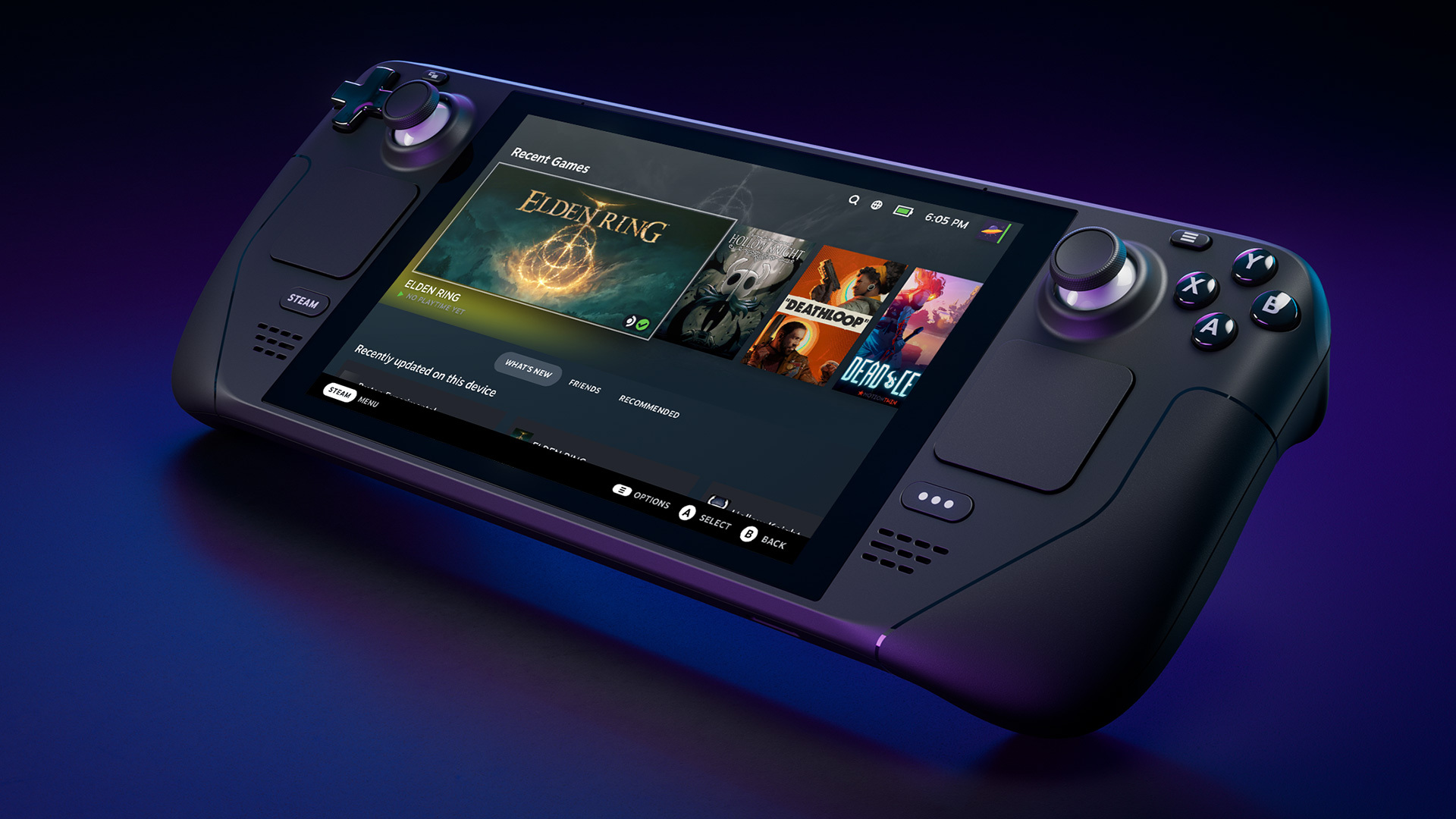
The original Steam Deck is the handheld every other handheld now gets measured against. When Valve shipped it on 25 February 2022 at $399 for the 64GB model, it didn’t just sell a portable PC; it set the reference point for what a $400 device should do. Years later that’s still the frame: the ROG Ally and Legion Go are faster on paper and run Windows, but they’re priced higher, fight a touchscreen-hostile OS, and lack the one input nobody else copied well, the trackpads. The Deck’s pitch is that it’s the cheapest way into the category and, for emulation specifically, the most predictable. It is also the only one of the three designed input-out for couch and handheld use rather than adapted from a Windows tablet.
At its core is the custom AMD “Aerith” APU on a 7nm process: a 4-core/8-thread Zen 2 CPU clocked 2.4-3.5GHz paired with 8 RDNA 2 compute units at up to 1.6GHz, good for 1.6 TFLOPS FP32. It’s backed by 16GB of LPDDR5 running at 5500 MT/s across quad 32-bit channels, shared between system and graphics. That silicon is modest by 2026 standards, but it’s the exact target emulator developers optimized for, which is why behavior here is so consistent.
Emulation performance, generation by generation
This is where the Deck earns its reputation. Everything PS2-era and older is effortless. PCSX2 runs the PS2 library at full speed, usually with a 3x-4x internal resolution bump; Dolphin handles GameCube and Wii at full speed at 2x-3x native, with only the genuine torture tests (Rogue Squadron, F-Zero GX) forcing a drop back to 1x. PSP via PPSSPP runs at native or above with no drama, and everything below the PS2 line, Dreamcast on Flycast, N64, the 16-bit and 8-bit eras, is trivial and runs at full speed on battery. If your library tops out at the PS2 generation, this is a solved problem on the Deck.
The sixth-to-seventh-gen jump is where you start picking your battles. Switch emulation through Ryujinx is realistic but per-game: first-party titles like Mario Odyssey and the 2D Zeldas hold 30fps comfortably, while the heaviest games (Tears of the Kingdom) need tuning and still stutter. Wii U via Cemu is similarly title-dependent but generally kinder than Switch. PS3 on RPCS3 is the genuine coin-flip generation: 2D and lighter 3D titles are playable, but anything demanding pushes the 4-thread CPU past its limit. Xbox 360 is the rough edge, Xenia runs on Linux through compatibility layers at all, but most titles either won’t boot or aren’t playable; Xbox Live Arcade games are the realistic ceiling.
Screen, build and controls
The LCD is the part that aged. It’s a 7-inch optically-bonded IPS panel at 1280×800, locked to 60Hz, rated 400 nits typical. It’s perfectly sharp and color-accurate, but next to the OLED revision its blacks are grey and outdoor visibility is poor. The chassis is large and at roughly 669 grams it’s heavy, you feel it in a long session, though the deep grips distribute that weight better than the flat slabs from Asus and Lenovo. The build itself is solid plastic with no creak, and the fan, while audible under load, is quieter than most Windows rivals because the chip is simply asked to do less.
Controls are the Deck’s quiet advantage. Two full-size sticks, a 6-axis gyro, four assignable rear grip buttons, and the two 32.5mm haptic trackpads that make mouse-driven games and desktop emulator menus genuinely usable on a couch. The caveat worth stating plainly: the LCD model’s sticks are not Hall-effect, so they’re drift-prone over years of use, a real downgrade versus the Hall sticks competitors shipped later.
Software and setup
SteamOS 3, Valve’s Arch-based Linux build, is why this thing is pleasant rather than a project. It boots straight into a controller-native interface, suspends and resumes mid-game reliably, and treats the handheld form factor as the default rather than an afterthought. For emulation the gold-standard path is EmuDeck: one script that installs and configures the whole stack (PCSX2, Dolphin, RPCS3, Ryujinx, PPSSPP and more), sorts BIOS files, and pushes everything into your Steam library as launchable entries with proper artwork. Drop to the KDE Plasma desktop when you need to fine-tune a specific emulator or manage ROMs, then jump back to Game Mode. It’s the most frictionless emulation setup on any handheld.
Price, value and who it’s for
It launched at $399/$529/$649 across the 64GB, 256GB and 512GB tiers, and Valve has since cut LCD pricing aggressively, which makes a used or discounted unit the best-value emulation box you can buy. The 40Wh battery is the honest weak point, Valve’s own “2 to 8 hours” range is accurate, meaning an hour and a half to two hours on demanding 3D emulation. Buy it if you want a no-fuss PS2/GameCube/Wii/PSP machine that also plays your Steam backlog, and you value setup simplicity and trackpads over raw horsepower. Storage matters more than the tier name suggests: the cheapest model used slower eMMC rather than the NVMe SSD in the 256GB and 512GB units, and the microSD slot lets you park a multi-terabyte ROM collection cheaply regardless. If you mainly want Switch and PS3 at high settings, look at the OLED or a beefier Windows handheld instead, but for the PS2-and-back library that defines most emulation use, nothing matches its price-to-result ratio.
📐 Size & Pocketability
⚖️ Weight vs Other Handhelds
🔋 Real-World Battery Estimator
⭐ Emulation Performance
📊 View How This Score is Calculated
The Hardware Power Score is an absolute metric. Perfect emulation of difficult, modern consoles awards significantly more points than standard retro consoles.
- 15× Multiplier: Modern PC
- 12× Multiplier: Switch, PS3, Xbox 360
- 10× Multiplier: Wii U
- 8× Multiplier: PS2, GameCube, Wii, Xbox
- 5× Multiplier: Saturn, Dreamcast, PSP
- 3× Multiplier: N64, PS1
- 1× Multiplier: SNES, GBA
Gen 8 & PC
Generation 7
Generation 6
Generation 5
Handhelds & Retro
⚡ Performance Benchmarks
Where Valve Steam Deck AMD Radeon Steam Deck 8CU (RDNA 2, 8 CUs) lands against the handhelds everyone knows. Every bar shares one scale, so longer genuinely means faster — add up to two rivals to compare.
CPU = Geekbench 6 multi-core · GPU = 3DMark Wild Life. Median real-world scores; every bar shares one scale — add up to two rivals to compare.
📋 Full Specifications
📺 Display
⚙️ Platform
💾 Memory
🕹️ Controls
📏 Body
🔋 Battery
⚖️ Verdict
✅ The Good
- Custom AMD Aerith APU (Zen 2 + 8 RDNA 2 CUs, 16GB LPDDR5) is the exact target emulator devs optimize for, so PS2/GC/Wii/PSP run at full speed predictably
- Dual 32.5mm haptic trackpads plus gyro make mouse-driven games and desktop emulator menus genuinely usable, an input no rival matched
- SteamOS 3 plus EmuDeck is the most frictionless emulation setup on any handheld, with reliable suspend/resume and Game Mode
- Aggressively discounted since launch, making the LCD the best price-to-result emulation box available
❌ The Bad
- 40Wh battery only delivers ~1.5-2 hours on demanding 3D emulation (Valve's honest "2-8 hours")
- 7-inch 1280×800 60Hz 400-nit LCD looks dull next to the OLED revision, with grey blacks and poor outdoor visibility
- Non-Hall-effect analog sticks are drift-prone over time, and at ~669g the unit is heavy in long sessions
📰 Latest News & Guides
The Ultimate Guide to ARMSX3: Android’s New PS3 Emulator, Competitor Comparisons, and Setup Tutorial
18/08/2026Pokémon Gold, Silver, and Crystal (Gen 2) Recomp Lands on Android
17/08/2026How to Play the Pokémon Red, Blue, or Yellow Recomp on Your Android, Windows, and Linux Devices
16/08/2026🔍 Similar Handhelds
Other handhelds that emulate up to CURRENTGEN.