
🛒 Where to Buy
⚠️ Golden Rule of Retro Handhelds: Throw away the cheap MicroSD card that comes in the box — it will fail. And never use a high-wattage PD “Fast Charger” on these devices; it can damage the battery. Use a standard 5V/1.5A brick.
Device Overview: Razer Edge 5G
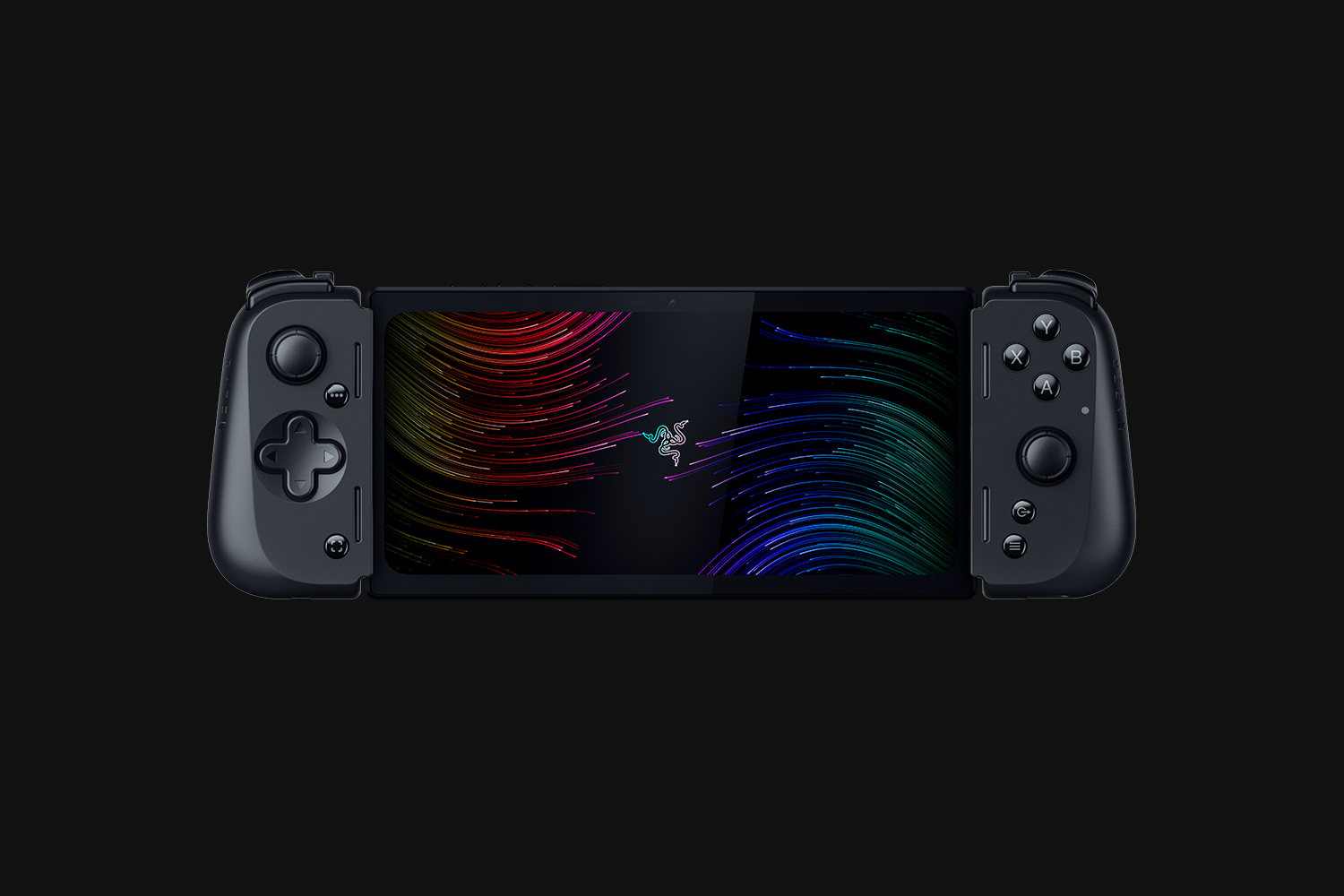
The Razer Edge 5G is the cellular version of Razer’s short-lived Android gaming handheld, sold exclusively through Verizon when it arrived on January 26, 2023. Underneath it is the same machine as the Wi-Fi Razer Edge: a 6.8-inch tablet running Qualcomm’s Snapdragon G3x Gen 1, docked into a detachable Kishi V2 Pro controller. Razer pitched it first as a cloud and native-Android device, running Xbox Cloud Gaming, GeForce NOW, and Steam and Xbox remote streaming through the Razer Nexus launcher, and the “5G” is the actual selling point here, letting you stream those services on Verizon’s network away from Wi-Fi. It shipped in Wi-Fi and 5G trims, with pricier Founders and Pro bundles that added Razer’s Hammerhead earbuds. That framing matters, because Razer never marketed the Edge as an emulation box, yet the silicon inside is one of the strongest chips ever put in a handheld of this shape.
Emulation performance, generation by generation
The G3x Gen 1 is essentially Snapdragon 8 Gen 1-class silicon, a 3 GHz octa-core Kryo CPU paired with an Adreno GPU rated around 1.38 TFLOPS, and it runs with an active fan, which is the part that lets it hold clocks a phone would throttle away. In practice that puts the Edge near the top of the Android emulation ladder. Everything through the sixth generation is trivial: NES, SNES, Genesis, GBA, PS1 (DuckStation), N64 (Mupen64Plus FZ), PSP (PPSSPP) and Dreamcast (Flycast) all run at full speed with heavy internal-resolution upscaling to feed that 1080p panel. Nintendo DS and 3DS, through MelonDS and the Citra/Lime3DS forks, are comfortable. GameCube and Wii on Dolphin are where it starts to earn the price: the large majority of that library holds 60 fps, with only the heaviest titles needing per-game tuning. PS2 is the realistic ceiling, where AetherSX2 and the community NetherSX2 forks that succeeded it after the original developer walked away run much of the catalog at a locked 60 with the occasional dip. The 8 GB of LPDDR5 and quick UFS 3.1 storage keep those emulators fed, and the microSD slot (up to 2 TB) holds a large ROM library without eating into the 128 GB onboard. Switch is the honest frontier: Yuzu and Skyline both showed some titles booting on this class of chip, but both projects were pulled in 2024, so anything running today leans on scattered forks and is not a reason to buy the device.
Screen, build and controls
The 6.8-inch AMOLED (2400 x 1080, 144 Hz) is genuinely good, with deep blacks, high brightness, and a refresh rate the chip can actually exploit in lighter games. The tablet alone weighs 264 g; clip in the Kishi V2 Pro and you sit at 401 g, manageable but a touch front-heavy in long sessions. The controller uses microswitch face buttons and a microswitch d-pad, analog triggers, two programmable back buttons and Razer’s HyperSense haptics, plus a 3.5 mm jack and USB-C passthrough charging. The catch worth stating plainly is that the analog sticks are conventional potentiometer units, not Hall effect, so they carry the usual multi-year drift risk that most 2023 controllers did. Because the controller detaches, the Edge also works as a standalone Android tablet, a flexibility the fused Linux handhelds don’t offer.
Software and setup
This is where expectations need resetting. The Edge ships with Android 12 and Razer Nexus, and it is not a Linux retro handheld, so muOS, Knulli, ArkOS, ROCKNIX, OnionOS and Batocera, which target RK3566 and Allwinner boards, have nothing to run on it. Turning the Edge into an emulation machine means the Android route: sideload RetroArch and standalone apps such as Dolphin, PPSSPP, DuckStation and NetherSX2, then organize them behind a frontend like Daijisho or ES-DE, or run EmuDeck’s Android installer to automate a chunk of it. It works well once configured, but that is a couple of evenings of setup rather than flashing a card, and Razer’s own software support faded fast after launch, so meaningful OS updates never really came.
Price, value and who it is for
The Edge 5G launched at roughly $599 outright on Verizon, against $399.99 for the Wi-Fi model, with the cellular variant tied to Verizon and its data plans. That is a lot for an Android handheld, which is why the Edge sold poorly and now turns up used well below list. Battery is the other honest weakness: the 5000 mAh cell is fine for retro emulation but drains in roughly an hour to ninety minutes of demanding cloud or AAA play. Who should want one in 2026? Someone who finds a cheap used unit and wants a high-ceiling Android emulator that reaches PS2 and GameCube behind a real 144 Hz OLED, not someone paying launch prices, and not anyone who needs the 5G radio, which is dead weight outside a Verizon plan.
📐 Size & Pocketability
⚖️ Weight vs Other Handhelds
🔋 Real-World Battery Estimator
⭐ Emulation Performance
📊 View How This Score is Calculated
The Hardware Power Score is an absolute metric. Perfect emulation of difficult, modern consoles awards significantly more points than standard retro consoles.
- 15× Multiplier: Modern PC
- 12× Multiplier: Switch, PS3, Xbox 360
- 10× Multiplier: Wii U
- 8× Multiplier: PS2, GameCube, Wii, Xbox
- 5× Multiplier: Saturn, Dreamcast, PSP
- 3× Multiplier: N64, PS1
- 1× Multiplier: SNES, GBA
Gen 8 & PC
Generation 7
Generation 6
Generation 5
Handhelds & Retro
⚡ Performance Benchmarks
Where Razer Edge 5G Adreno 730 lands against the handhelds everyone knows. Every bar shares one scale, so longer genuinely means faster — add up to two rivals to compare.
CPU = Geekbench 6 multi-core · GPU = 3DMark Wild Life. Median real-world scores; every bar shares one scale — add up to two rivals to compare.
📋 Full Specifications
📺 Display
⚙️ Platform
💾 Memory
🕹️ Controls
📏 Body
🔋 Battery
⚖️ Verdict
✅ The Good
- Snapdragon G3x Gen 1 with active cooling gives it one of the highest emulation ceilings of any Android handheld, holding PS2 and most GameCube/Wii at full speed
- Excellent 6.8-inch 2400×1080 144Hz AMOLED panel, well ahead of the LCDs on comparable Linux handhelds
- Detachable Kishi V2 Pro controller means it doubles as a standalone Android tablet, with microswitch buttons, analog triggers and HyperSense haptics
- Strong connectivity for the class: Wi-Fi 6E, Bluetooth 5.2, USB-C, 3.5mm jack and microSD expansion up to 2TB
❌ The Bad
- Expensive at launch ($599 for the 5G) and the 5G radio is Verizon-locked dead weight for most buyers
- Android 12 with little ongoing support from Razer, and no Linux custom-firmware scene, so all emulation setup is manual sideloading
- Conventional potentiometer sticks (no Hall effect) and weak battery life under cloud/AAA play, around an hour to ninety minutes
📰 Latest News & Guides
The Ultimate Guide to ARMSX3: Android’s New PS3 Emulator, Competitor Comparisons, and Setup Tutorial
18/08/2026Pokémon Gold, Silver, and Crystal (Gen 2) Recomp Lands on Android
17/08/2026How to Play the Pokémon Red, Blue, or Yellow Recomp on Your Android, Windows, and Linux Devices
16/08/2026🔍 Similar Handhelds
Other handhelds that emulate up to Switch.