
🛒 Where to Buy
⚠️ Golden Rule of Retro Handhelds: Throw away the cheap MicroSD card that comes in the box — it will fail. And never use a high-wattage PD “Fast Charger” on these devices; it can damage the battery. Use a standard 5V/1.5A brick.
Device Overview: Game Kiddy GKD Mini Plus Classic
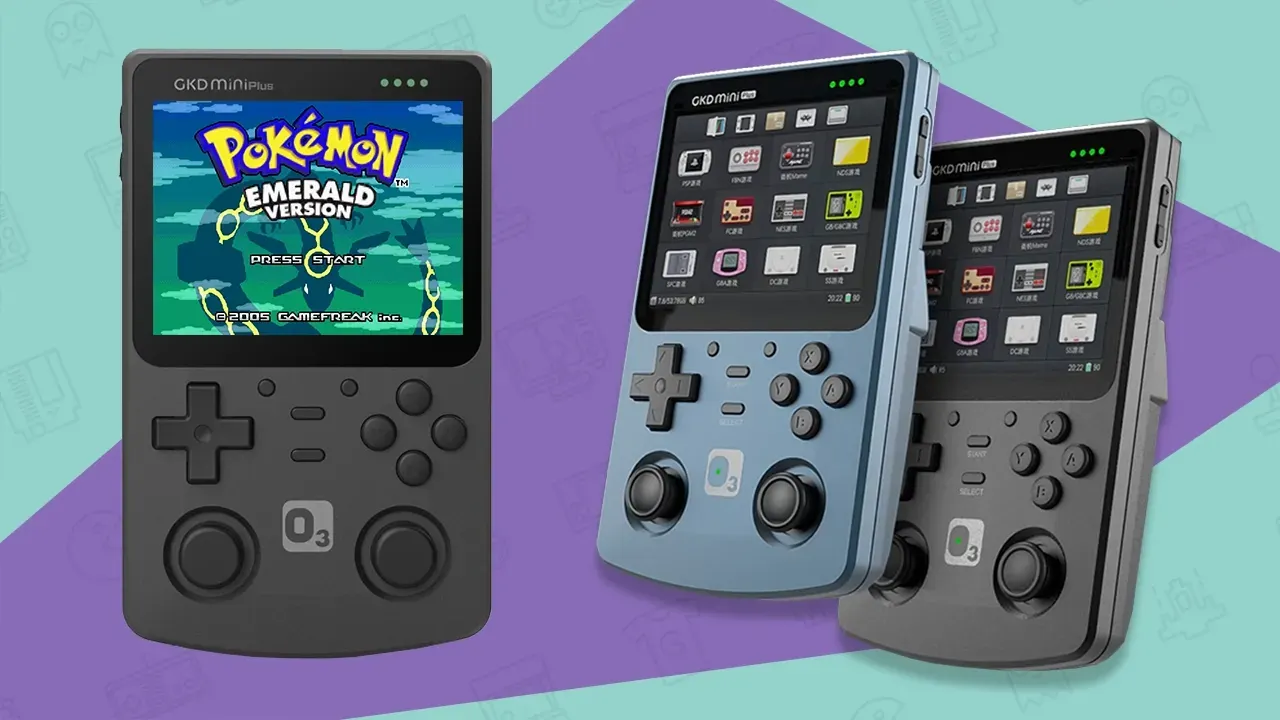
The Game Kiddy GKD Mini Plus Classic is a portrait, metal-bodied emulation handheld built around the Rockchip RK3566, and it wears its Game Boy Color inspiration openly: sharp corners, a tall stance, even a fake cartridge bump moulded into the back. It arrived in January 2023 as the fixed-stick sibling to the standard GKD Mini Plus, trading that model’s detachable USB-C analog module for two sticks bolted permanently to the shell. That single decision defines the device. It is a vertical retro machine trying to bolt twin sticks onto a form factor that was never shaped to hold them. It shipped in a small palette, typically a black or space-grey unit and a blue variant, and it targets collectors who want a tall, cartridge-styled body rather than another wide slab.
Emulation performance, generation by generation
The RK3566 is a known quantity. It is the same quad-core Cortex-A55 (1.8 GHz) and Mali-G52 2EE (850 MHz) chip that powers the Anbernic RG353 line and the Powkiddy RGB30, paired here with 1 GB of LPDDR4, so the ceiling is fixed before you copy a single ROM. Everything through the 16-bit era runs at full speed with headroom to spare: NES, SNES, Genesis, Master System, PC Engine, and the full Game Boy through GBA range, plus the pocket handhelds like Lynx, WonderSwan and Neo Geo Pocket. PlayStation 1 is the comfortable sweet spot, where DuckStation-class cores hold 60 fps with upscaling and texture smoothing switched on. Nintendo 64 and Dreamcast are where you start reading compatibility threads. Flycast runs a lot of Dreamcast at or near full speed, helped by the native 640×480 output, but N64 is per-title: Mupen handles the easy games and stutters on the demanding ones. Saturn is a coin flip, and PSP is not this machine’s job. Only light 2D and simpler 3D titles stay playable, so do not buy it expecting God of War. Arcade sits in between: CPS1, CPS2 and Neo Geo run cleanly through FBNeo, while heavier MAME drivers ask more than the chip wants to give. Nintendo DS is the interesting edge case, because the tall screen suits its stacked dual-display layout better than a horizontal handheld does, though 640×480 still splits into two fairly small panes and the touch input has to be mapped to the stick. Treat PS1 and Dreamcast as the honest headline, with the 8- and 16-bit libraries as the flawless backbone.
Screen, build and controls
The 3.5-inch IPS panel runs 640×480 at a 4:3 ratio, roughly 228 ppi and 60 Hz. It is sharp, correctly proportioned for retro content, and the strongest single reason to consider the device. The aluminium shell feels genuinely solid and adds welcome heft against the plastic competition. The controls are the compromise. Both analog sticks are fixed and sit low on the face, below the action buttons, and that placement cramps your thumbs at the bottom edge on anything that actually leans on them. The sticks are conventional potentiometer units, with no Hall effect claimed, so plan on eventual drift. Shoulder buttons are small and stacked L1/R1, L2/R2, and there is vibration alongside stereo speakers. A 3000 mAh battery is good for roughly four and a half hours of mixed play, charging over USB-C from the bottom edge, and there is a headphone jack plus video out for TV use. For d-pad-driven 8- and 16-bit play the layout is fine; the moment a game wants a stick, the ergonomics fight you.
Software and setup
Stock firmware is a Linux front-end, functional but not why anyone keeps one of these. Because the RK3566 is so widely supported, the real story is custom firmware: JELOS and its successor ROCKNIX both target this chip, as do ArkOS and Batocera, and any of them turns the Classic into a proper RetroArch-plus-standalone-cores box with scraped box art and per-core settings. muOS and Knulli are Allwinner projects and OnionOS is Miyoo territory, so ignore those here. Setup is standard SD-card work: image a card, drop your ROMs and BIOS files onto the second microSD, and boot. The dual microSD slots are a real convenience, letting you keep firmware and library on separate cards.
Price, value and who it is for
It launched near $139 on Kickstarter, with retail listings drifting toward $179, and that is the problem. At that money the RK3566 is dated, and horizontal rivals such as the Anbernic RG353 series or a Retroid Pocket hand you the same or better silicon with far more comfortable ergonomics. What the GKD Mini Plus Classic sells is its shape: a compact, metal, vertical handheld with a genuinely nice 4:3 screen, aimed at people who mostly play NES, SNES, Game Boy and PS1 and love the Game Boy Color silhouette. If that is you, and you can live with low-set sticks you will rarely reach for, it is a characterful little machine. If you want N64, Dreamcast or PSP as daily drivers, or you care about stick ergonomics, put the same cash elsewhere. Coverage of this exact model is also thinner than for the mainstream brands, so confirm the precise SKU and firmware support before you buy.
📐 Size & Pocketability
🔋 Real-World Battery Estimator
⭐ Emulation Performance
📊 View How This Score is Calculated
The Hardware Power Score is an absolute metric. Perfect emulation of difficult, modern consoles awards significantly more points than standard retro consoles.
- 15× Multiplier: Modern PC
- 12× Multiplier: Switch, PS3, Xbox 360
- 10× Multiplier: Wii U
- 8× Multiplier: PS2, GameCube, Wii, Xbox
- 5× Multiplier: Saturn, Dreamcast, PSP
- 3× Multiplier: N64, PS1
- 1× Multiplier: SNES, GBA
Generation 6
Generation 5
Handhelds & Retro
⚡ Performance Benchmarks
Where Game Kiddy GKD Mini Plus Classic ARM Mali-G52 MP2 (2EE) lands against the handhelds everyone knows. Every bar shares one scale, so longer genuinely means faster — add up to two rivals to compare.
CPU = Geekbench 6 multi-core · GPU = 3DMark Wild Life. Median real-world scores; every bar shares one scale — add up to two rivals to compare.
📋 Full Specifications
📺 Display
⚙️ Platform
💾 Memory
🕹️ Controls
📏 Body
🔋 Battery
⚖️ Verdict
✅ The Good
- Rigid aluminium shell in a pocketable portrait format, a clear step up from the usual plastic RK3566 handhelds
- Sharp 3.5-inch 640×480 IPS panel at a correct 4:3 ratio, ideal for 8/16-bit and PS1 content
- Dual microSD slots let you keep custom firmware and your ROM library on separate cards
- Excellent custom-firmware support (JELOS/ROCKNIX/ArkOS/Batocera) thanks to the ubiquitous RK3566
❌ The Bad
- Fixed analog sticks sit awkwardly low below the buttons, and being potentiometer rather than Hall effect they will eventually drift
- The RK3566 caps you at PS1/Dreamcast; N64 is per-game and PSP/Saturn are largely out of reach
- Roughly $139-179 for dated silicon undercuts its value against better-ergonomic RG353/Retroid rivals, and detailed sourcing for this exact model is thin
📰 Latest News & Guides
The Ultimate Guide to ARMSX3: Android’s New PS3 Emulator, Competitor Comparisons, and Setup Tutorial
18/08/2026Pokémon Gold, Silver, and Crystal (Gen 2) Recomp Lands on Android
17/08/2026How to Play the Pokémon Red, Blue, or Yellow Recomp on Your Android, Windows, and Linux Devices
16/08/2026🔍 Similar Handhelds
Other handhelds that emulate up to PSP.