
🛒 Where to Buy
⚠️ Golden Rule of Retro Handhelds: Throw away the cheap MicroSD card that comes in the box — it will fail. And never use a high-wattage PD “Fast Charger” on these devices; it can damage the battery. Use a standard 5V/1.5A brick.
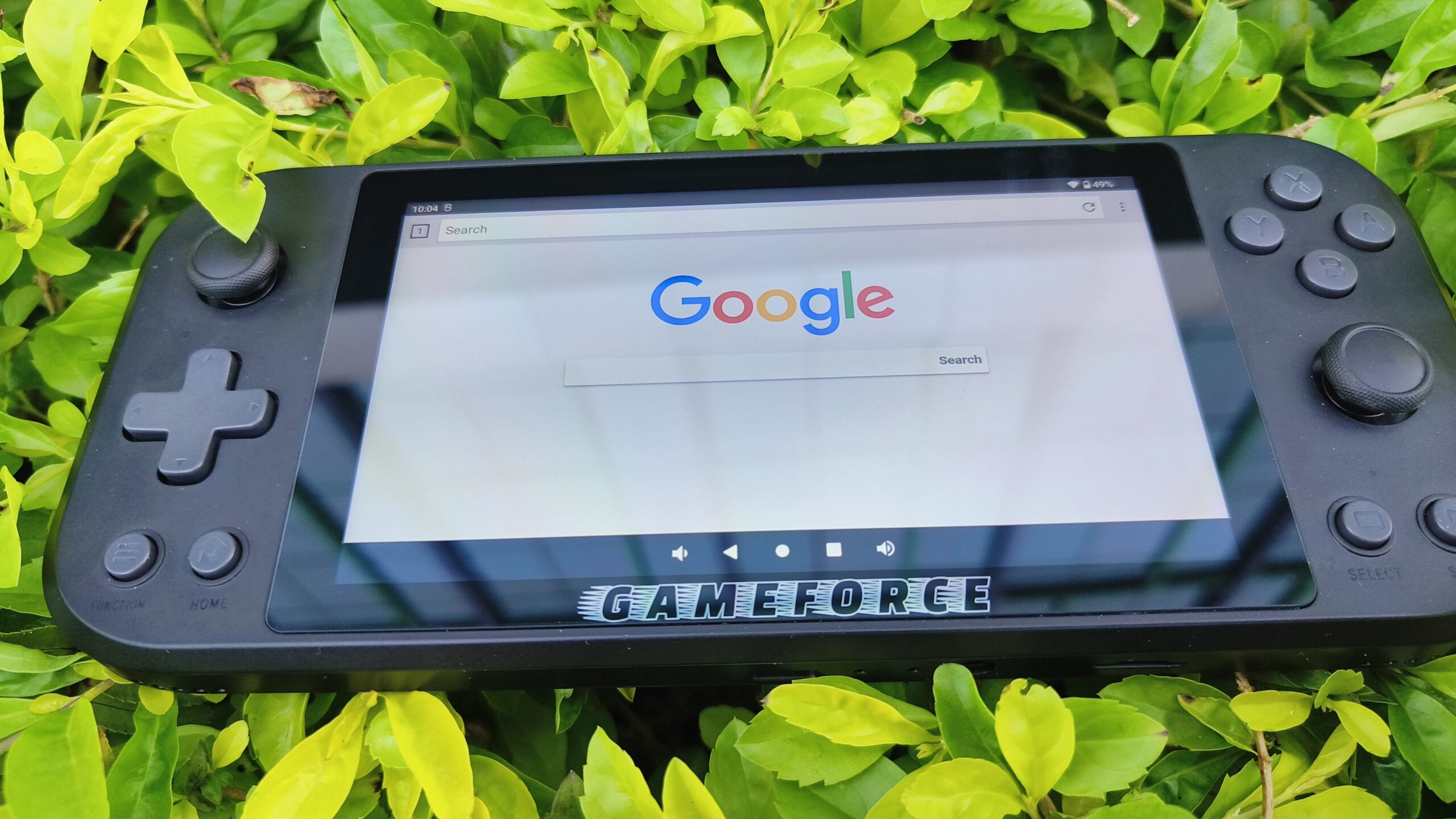
Device Overview: GameForce ACE
The GameForce ACE is a 5.5-inch Android handheld from a small Shenzhen outfit that first made its name selling Game Boy-style clones, and it punches well above that history. At its core sits a Rockchip RK3588S, the same octa-core chip found in single-board computers and TV boxes, pairing four Cortex-A76 cores at up to roughly 2.4 GHz with four low-power A55 cores and a Mali-G610 MP4 GPU. That makes the ACE one of the cheapest routes to RK3588S-class silicon in a controller-shaped body, and the entire pitch rests on exactly what that chip can and cannot emulate.
Emulation performance, generation by generation
Everything through the fifth console generation runs without drama. Game Boy, GBA, NES, SNES, Genesis, PlayStation (via DuckStation), Nintendo 64 (Mupen64Plus), Dreamcast (Flycast) and PSP (PPSSPP) hold full speed, frequently with resolution upscaling on top. Saturn through Yaba Sanshiro is the usual awkward exception but mostly cooperates. Nintendo DS via melonDS is smooth, and 3DS through Citra forks such as Lime3DS is playable if you accept the occasional slowdown. The interesting territory is the sixth generation. GameCube and PS2 are where the RK3588S earns its keep: Dolphin and AetherSX2/NetherSX2 push a large slice of both libraries at full speed, and this is genuinely the class of device people buy specifically for PS2. It is not a clean sweep, though. Heavier GameCube and PS2 titles (think F-Zero GX, Shadow of the Colossus, the busier Gran Turismo tracks) drop frames, and per-game tuning is part of the deal rather than a nicety. Wii is a real maybe: pointer-driven and lighter games run, while anything demanding stutters. Do not buy this for Switch, PS3 or Wii U, because those emulators are x86-bound or effectively dead on ARM Linux and the ACE cannot touch them. It tops out convincingly at PS2 and GameCube; it is not a pocket PC.
Screen, build and controls
The 5.5-inch panel is a 1920×1080 IPS unit running at 60 Hz, OCA-laminated under tempered glass, with capacitive touch. At roughly 400 ppi it is sharp, and 1080p is a sensible native resolution for integer-scaling GBA and DS content, though it is overkill for anything 8- or 16-bit and it costs you battery. The 16:9 shape suits PSP, PS2 widescreen hacks and video, but leaves fat pillarbox bars on 4:3 retro systems. Controls are the strong suit: dual clickable Hall-effect sticks that will not develop drift, vertical analog L2/R2 triggers, and a full face-button and shoulder layout on a 212 mm Switch-style body. The chassis is plastic and the styling openly borrows from a Switch, but the ergonomics are competent. GameForce never published an official weight, and battery figures have shifted between a 5,500 mAh launch spec and a 7,200 mAh production number, so expect real-world runtime to swing hard depending on whether you are sipping SNES or hammering Dolphin, and budget for the higher power draw when you push the harder systems.
Software and setup
Out of the box the ACE runs Android (Android 13 on later units, LineageOS 19 based on Android 12 on early ones). Android gets you Google Play, front-ends like Daijisho or Dig, streaming apps and native Android games, but it also brings the standard Android-handheld chores: sideloading emulators, wrangling per-app settings, and living with a launcher you will probably replace. The more compelling story is Linux. The ACE is a first-class ROCKNIX device, effectively one of that distro’s reference handhelds, so ROCKNIX gives you a tidy EmulationStation front-end, sane per-core defaults and painless updates without touching internal storage. Batocera and UnofficialOS are supported too, and because you can boot Linux from a card, the Android install stays intact. For a retro-focused buyer, flashing ROCKNIX to a microSD is the setup I would actually recommend.
Price, value and who it is for
The ACE launched near $160 and has drifted upward since; current pricing runs roughly $200 for the 8 GB/256 GB model and about $270 for the 12 GB/256 GB version, usually bundled with a case. Storage is a standout. Alongside microSD you get an M.2 2242 NVMe slot, which almost nothing else this size offers, so housing a large PS2 and GameCube library is easy. Connectivity is where the age shows: Wi-Fi 5 and Bluetooth 4.2 are dated, and TV-out runs over Micro HDMI rather than USB-C video. GameForce is a small brand with a thinner support and accessory ecosystem than Anbernic or Retroid, so you lean on the community, the ROCKNIX project and the Retro Handhelds forums, more than on the manufacturer. Buy the ACE if you want serious PS2 and GameCube emulation in a horizontal 5.5-inch body, value drift-proof Hall sticks and NVMe expansion, and are comfortable flashing custom firmware. Skip it if you want plug-and-play polish, current-generation wireless radios, or any expectation of Switch-era games.
📐 Size & Pocketability
🔋 Real-World Battery Estimator
⭐ Emulation Performance
📊 View How This Score is Calculated
The Hardware Power Score is an absolute metric. Perfect emulation of difficult, modern consoles awards significantly more points than standard retro consoles.
- 15× Multiplier: Modern PC
- 12× Multiplier: Switch, PS3, Xbox 360
- 10× Multiplier: Wii U
- 8× Multiplier: PS2, GameCube, Wii, Xbox
- 5× Multiplier: Saturn, Dreamcast, PSP
- 3× Multiplier: N64, PS1
- 1× Multiplier: SNES, GBA
Gen 8 & PC
Generation 7
Generation 6
Generation 5
Handhelds & Retro
⚡ Performance Benchmarks
Where GameForce ACE ARM Mali-G610 MP4 lands against the handhelds everyone knows. Every bar shares one scale, so longer genuinely means faster — add up to two rivals to compare.
CPU = Geekbench 6 multi-core · GPU = 3DMark Wild Life. Median real-world scores; every bar shares one scale — add up to two rivals to compare.
📋 Full Specifications
📺 Display
⚙️ Platform
💾 Memory
🕹️ Controls
📏 Body
🔋 Battery
⚖️ Verdict
✅ The Good
- RK3588S delivers credible PS2 and GameCube emulation (Dolphin, AetherSX2/NetherSX2) that weaker handheld chips cannot match
- Clickable Hall-effect sticks plus vertical analog L2/R2 triggers resist drift and cover modern control needs
- Rare M.2 2242 NVMe slot alongside microSD makes storing a large PS2/GameCube library easy
- First-class ROCKNIX support (plus Batocera and UnofficialOS) with dual-boot Android 13 out of the box
❌ The Bad
- Dated connectivity: Wi-Fi 5, Bluetooth 4.2, and Micro HDMI instead of USB-C video output
- Small brand with thin manufacturer support, and even basic specs like weight and battery are inconsistently published (5,500 vs 7,200 mAh)
- Ceiling is PS2/GameCube; Switch, PS3 and Wii U are out of reach and heavier sixth-gen titles still need per-game tuning
📰 Latest News & Guides
The Ultimate Guide to ARMSX3: Android’s New PS3 Emulator, Competitor Comparisons, and Setup Tutorial
18/08/2026Pokémon Gold, Silver, and Crystal (Gen 2) Recomp Lands on Android
17/08/2026How to Play the Pokémon Red, Blue, or Yellow Recomp on Your Android, Windows, and Linux Devices
16/08/2026🔍 Similar Handhelds
Other handhelds that emulate up to PS2.