
🛒 Where to Buy
⚠️ Golden Rule of Retro Handhelds: Throw away the cheap MicroSD card that comes in the box — it will fail. And never use a high-wattage PD “Fast Charger” on these devices; it can damage the battery. Use a standard 5V/1.5A brick.
Device Overview: Asus ROG Ally X
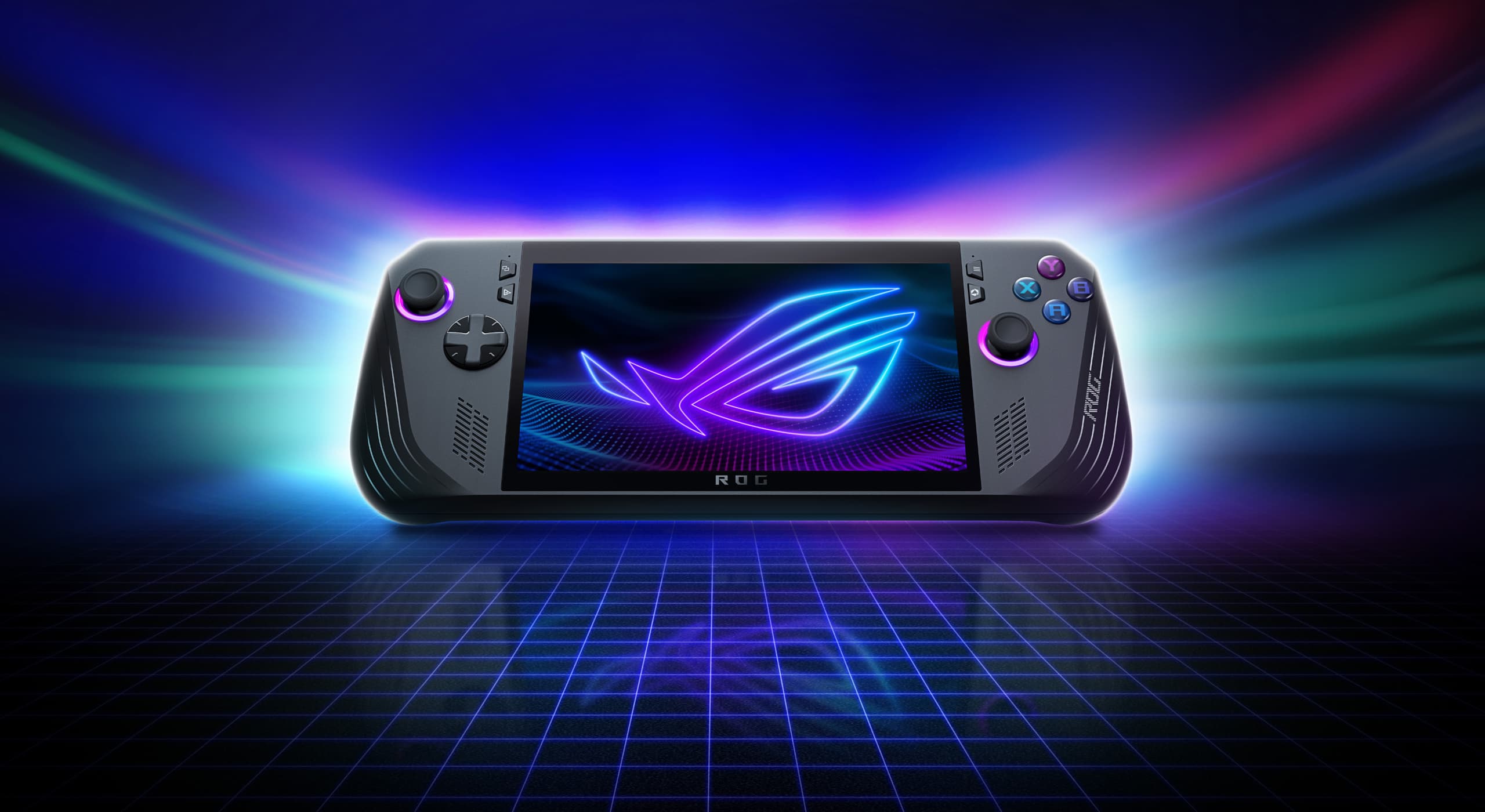
The Asus ROG Ally X is not a new machine so much as a corrected one. Launched on 22 July 2024 at $799.99, it is a mid-generation refresh of the 2023 ROG Ally that keeps the exact same AMD Ryzen Z1 Extreme chip and rebuilds almost everything around it. This is a full Windows 11 x86 handheld, not an ARM emulation box, so its ceiling is set by a real 15-25W laptop APU rather than a phone-class SoC. Asus spent the refresh budget on the three things owners of the original complained about most: battery life, memory, and a microSD reader that literally cooked itself next to the exhaust vent. The result is the most sensible Windows handheld of its generation, sold at a price that assumes you already know what you are getting into.
Emulation performance, generation by generation
Because this runs desktop Windows on a Zen 4 CPU with an RDNA 3 iGPU (12 compute units, up to roughly 8.6 TFLOPs), every emulator that exists for PC runs here, and the interesting question is only how high you can push the demanding ones. Fourth and fifth-generation systems (SNES, Genesis, PS1, N64, Saturn) run at full speed with heavy upscaling and shaders through RetroArch or standalone cores. PSP on PPSSPP, DS, and 3DS on the post-Citra Azahar fork all run at 2-3x internal resolution without drama. Dolphin handles GameCube and Wii beautifully, most titles locked at 1080p or higher. PS2 on PCSX2 and Wii U on Cemu are strong, with Cemu comfortably running Breath of the Wild. The genuinely hard tiers are where the 24GB of RAM earns its keep: RPCS3 makes many PS3 games playable, though not every title holds 60fps and some remain a slideshow. Switch emulation was viable on Ryujinx and Yuzu forks before both projects were shut down in 2024, so expect to hunt for community continuations. Xbox 360 via Xenia and PS Vita via Vita3K work for a subset of games and remain experimental. Treat PS3 and Switch as achievable-but-fiddly, not guaranteed.
Screen, build and controls
The panel is a 7-inch 1920×1080 IPS at 120Hz, 500 nits, with Gorilla Glass Victus, 10-point touch, 100% sRGB and FreeSync Premium variable refresh. It is bright and sharp, but it is still LCD, so anyone spoiled by the Steam Deck OLED’s blacks will notice. The body weighs 678g, up 70g from the original, and the extra mass buys reshaped grips that are noticeably more comfortable over long sessions. Here is the one spec worth flagging honestly: the analog sticks are conventional full-size potentiometer sticks, not Hall effect, so they carry the usual long-term drift risk. The triggers, oddly, are Hall effect. There is a 6-axis gyro for motion aiming. Storage is a standard 1TB PCIe 4.0 M.2 2280 SSD, so upgrades no longer require the cramped 2242 modules the first Ally used, and the UHS-II microSD reader has been moved away from the heat.
Software and setup
It ships with Windows 11 Home and Asus Armoury Crate SE as the controller-friendly front-end, and Windows is exactly as convenient and as annoying as it sounds. The ARM-world custom firmware you see on Anbernic and Miyoo devices, muOS, ArkOS, OnionOS, Knulli and ROCKNIX, does not apply to an x86 machine, so ignore anyone who suggests them here. What is relevant is the PC emulation stack: EmuDeck installs a full emulator suite and EmulationStation front-end on Windows in one pass; Batocera boots from a separate SSD or card and turns the Ally into a dedicated Linux emulation console that runs unusually well on this hardware; and Bazzite gives you a SteamOS-style couch experience if you want to escape Windows entirely. Most owners run Steam plus EmuDeck and never touch a second OS. Connectivity is current, with Wi-Fi 6E and Bluetooth 5.4, and Asus dropped the original’s proprietary XG Mobile connector in favour of that standard USB4 port, so ordinary docks and eGPUs now work without a locked accessory.
Price, value and who it is for
At $799 the Ally X launched well above the Steam Deck OLED ($549) and undercut the flakier MSI Claw and the awkward Lenovo Legion Go. Its trump card is endurance: the 80Wh battery, doubled from the original’s 40Wh, delivers roughly twice the runtime and is the single best reason to pick this over the 2023 model. It is not for someone who wants a plug-and-play retro toy; the Steam Deck’s polish and Linux simplicity make more sense there. The Ally X is for the person who wants raw Windows flexibility, the widest possible emulation range up to PS3 and Wii U, an eGPU-ready USB4 port, and battery life that finally matches a full day of travel, and who accepts that they will occasionally be fighting Windows on a 7-inch screen to get it. On sale below $600, it is one of the easiest handhelds to recommend of its generation.
📐 Size & Pocketability
⚖️ Weight vs Other Handhelds
🔋 Real-World Battery Estimator
⭐ Emulation Performance
📊 View How This Score is Calculated
The Hardware Power Score is an absolute metric. Perfect emulation of difficult, modern consoles awards significantly more points than standard retro consoles.
- 15× Multiplier: Modern PC
- 12× Multiplier: Switch, PS3, Xbox 360
- 10× Multiplier: Wii U
- 8× Multiplier: PS2, GameCube, Wii, Xbox
- 5× Multiplier: Saturn, Dreamcast, PSP
- 3× Multiplier: N64, PS1
- 1× Multiplier: SNES, GBA
Gen 8 & PC
Generation 7
Generation 6
Generation 5
Handhelds & Retro
⚡ Performance Benchmarks
Where Asus ROG Ally X AMD Radeon 780M lands against the handhelds everyone knows. Every bar shares one scale, so longer genuinely means faster — add up to two rivals to compare.
CPU = Geekbench 6 multi-core · GPU = 3DMark Wild Life. Median real-world scores; every bar shares one scale — add up to two rivals to compare.
📋 Full Specifications
📺 Display
⚙️ Platform
💾 Memory
🕹️ Controls
📏 Body
🔋 Battery
⚖️ Verdict
✅ The Good
- Enormous 80Wh battery roughly doubles the runtime of the original Ally
- 24GB of LPDDR5X-7500 lets you allocate generous VRAM for demanding emulators and 1080p games
- Full Windows x86 platform emulates everything up to PS3, Wii U and (with effort) Switch
- USB4/Thunderbolt 4 port plus a fixed, relocated microSD reader correct the original's worst hardware flaws
❌ The Bad
- Analog sticks are conventional potentiometer units, not Hall effect, so drift is a long-term risk
- Same Z1 Extreme silicon as the 2023 model means no gain in peak GPU horsepower
- LCD panel and $799 launch price look steep next to the cheaper Steam Deck OLED
📰 Latest News & Guides
The Ultimate Guide to ARMSX3: Android’s New PS3 Emulator, Competitor Comparisons, and Setup Tutorial
18/08/2026Pokémon Gold, Silver, and Crystal (Gen 2) Recomp Lands on Android
17/08/2026How to Play the Pokémon Red, Blue, or Yellow Recomp on Your Android, Windows, and Linux Devices
16/08/2026🔍 Similar Handhelds
Other handhelds that emulate up to CURRENTGEN.