
🛒 Where to Buy
⚠️ Golden Rule of Retro Handhelds: Throw away the cheap MicroSD card that comes in the box — it will fail. And never use a high-wattage PD “Fast Charger” on these devices; it can damage the battery. Use a standard 5V/1.5A brick.
Device Overview: AYANEO Pocket EVO
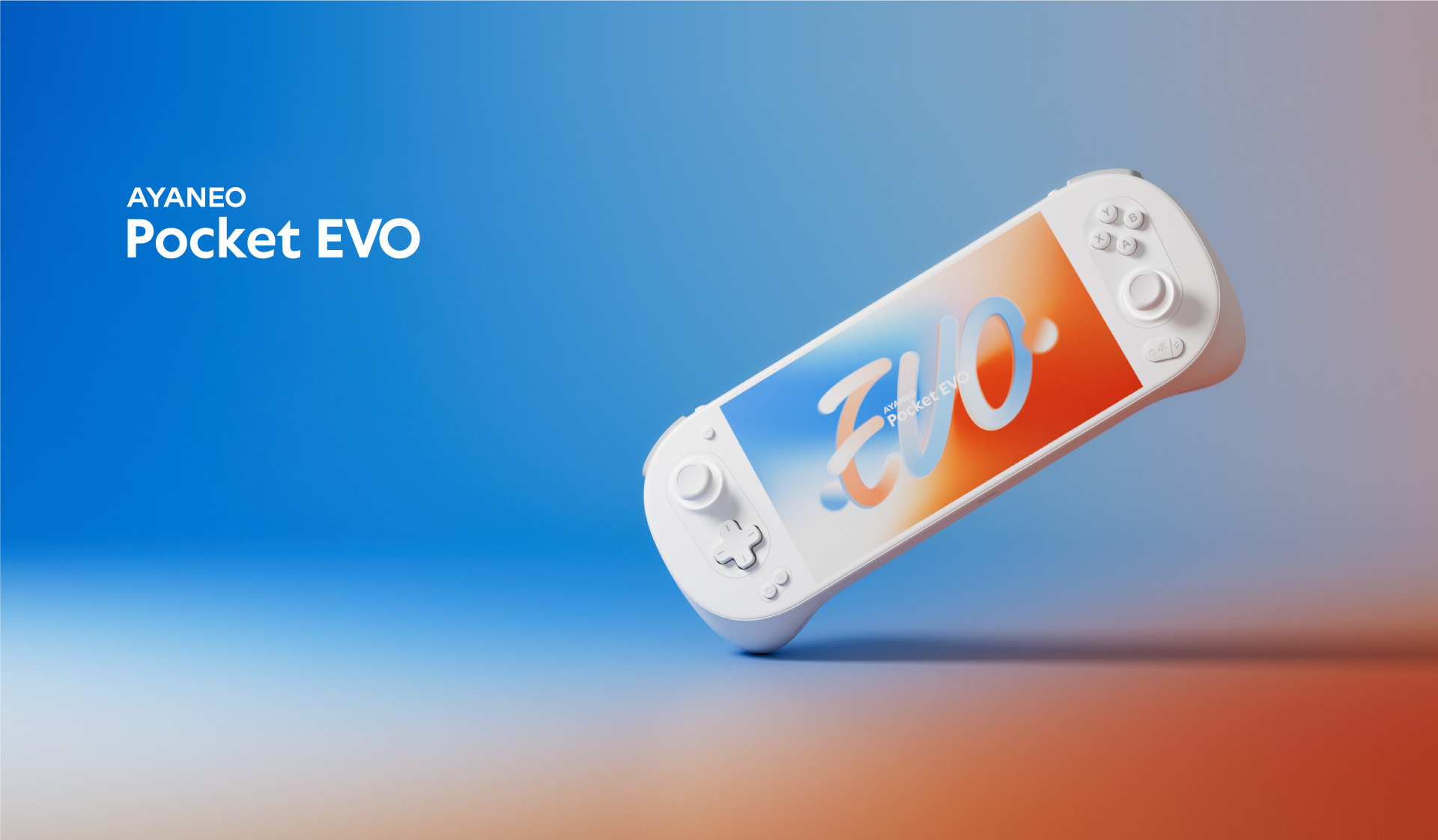
The AYANEO Pocket EVO is a 7-inch Android gaming handheld built around Qualcomm’s Snapdragon G3x Gen 2, the same silicon AYANEO used in the smaller Pocket S. It is a landscape slab that weighs 478g and measures 260.5mm wide, with a 17mm-thin body that swells to a 33.9mm grip, so it sits closer to a Steam Deck footprint than a phone. Crucially, this is an ARM Android device, not one of AYANEO’s x86 Windows machines like the Kun or 2S. That single fact frames everything: you are buying a mobile SoC in a controller shell, tuned for emulation, Android-native games and cloud streaming, not for running native Windows PC titles.
Emulation performance, generation by generation
The G3x Gen 2 pairs an octa-core Kryo CPU on a 4nm process with the Adreno A32 GPU, roughly a Snapdragon 8 Gen 2-class graphics part with a fan and a fatter power budget behind it. In practice, everything up to the sixth generation is trivial. PS1 (DuckStation), N64 (Mupen/simple64 cores), Dreamcast (Flycast) and PSP (PPSSPP) all run at full speed with heavy internal-resolution upscaling. PS2 through AetherSX2 or the NetherSX2 fork clears most of the library at 2x-3x native, with only the genuinely demanding titles — the God of War games, Shadow of the Colossus — asking for per-game tweaks. GameCube and Wii on Dolphin are comfortable, generally 2x resolution at full speed. 3DS via Citra/Lime3DS and PS Vita via Vita3K both work, the latter still patchy game to game. The headline is Switch: forks descended from Yuzu (Eden, Citron, Sudachi) run a real chunk of the catalogue at 30-60fps, though results swing with GPU drivers and the emulator scene’s post-shutdown churn, so treat it as “often great” rather than guaranteed. What this chip cannot do is pretend to be a gaming PC — PS3 is a non-starter, and native Windows x86 games only run through translation layers like Winlator or GameNative (box64 plus Wine), which handle indies and older AA titles but choke on anything modern.
Screen, build and controls
The 7-inch 1080p OLED is the standout. It runs at up to 165Hz with adaptive stepping down through 144, 120, 90 and 60Hz, supports HDR and peaks around 800 nits. OLED contrast flatters retro sprite art and 6th-gen 3D alike, and the high refresh rate genuinely helps high-frame-rate Android games and streaming, less so for capped emulator output. Controls are the other strong suit: Hall-effect joysticks with RGB rings and linear Hall triggers, both quoted at a 250Hz return rate, so stick drift should not be in your future. The face buttons and d-pad are conventional membrane-style AYANEO parts, competent rather than remarkable. Active cooling — a thin blower fan with passive vents — lets the G3x Gen 2 hold its clocks through long PS2 or Switch sessions. The 8600mAh battery with USB-C PD charging is large for the class, though a bright OLED and a hard-pushed Adreno still burn through it in a couple of hours under heavy emulation. Connectivity covers Wi-Fi 6E and Bluetooth.
Software and setup
The Pocket EVO ships on Android 13 with AYANEO’s AYASpace launcher layered on top for performance profiles, RGB and button mapping. Set expectations correctly here: because this is Android on Snapdragon, the Linux custom-firmware ecosystem that defines cheaper Rockchip and Allwinner handhelds — muOS, Knulli, ArkOS, ROCKNIX, Batocera — simply does not apply. You will not be flashing an SD card and rebooting into a new OS. Your “custom setup” instead means staying in Android and building a front end: Daijishou or ES-DE to organise ROMs, standalone emulators for each system, and optionally rooting or swapping AYASpace for a cleaner launcher. It is more fiddly than a plug-and-play OnionOS device but far more flexible, and Google Play plus Xbox and GeForce cloud streaming and native Android games all come along for free.
Price, value and who it is for
Pricing starts at $389 for 8GB/128GB and climbs to $639 for the 24GB/1TB configuration, with LPDDR5X memory and UFS 3.1 storage throughout. That base price is the sticking point: the near-identical G3x Gen 2 sits inside the AYN Odin 2 and the smaller AYANEO Pocket S for less money, and the Retroid Pocket 5 undercuts it too. What the EVO adds is the biggest, best screen in that group plus AYANEO’s build quality. Buy it if you specifically want a 7-inch 165Hz OLED for Android and up-to-PS2/GameCube/Switch emulation and you are comfortable assembling your own software stack. Skip it if you want native Windows gaming (get an x86 handheld), a bargain (get the Odin 2 or Pocket S), or a device that boots straight into a curated retro OS.
📐 Size & Pocketability
⚖️ Weight vs Other Handhelds
🔋 Real-World Battery Estimator
⭐ Emulation Performance
📊 View How This Score is Calculated
The Hardware Power Score is an absolute metric. Perfect emulation of difficult, modern consoles awards significantly more points than standard retro consoles.
- 15× Multiplier: Modern PC
- 12× Multiplier: Switch, PS3, Xbox 360
- 10× Multiplier: Wii U
- 8× Multiplier: PS2, GameCube, Wii, Xbox
- 5× Multiplier: Saturn, Dreamcast, PSP
- 3× Multiplier: N64, PS1
- 1× Multiplier: SNES, GBA
Gen 8 & PC
Generation 7
Generation 6
Generation 5
Handhelds & Retro
⚡ Performance Benchmarks
Where AYANEO Pocket EVO Adreno A32 lands against the handhelds everyone knows. Every bar shares one scale, so longer genuinely means faster — add up to two rivals to compare.
CPU = Geekbench 6 multi-core · GPU = 3DMark Wild Life. Median real-world scores; every bar shares one scale — add up to two rivals to compare.
📋 Full Specifications
📺 Display
⚙️ Platform
💾 Memory
🕹️ Controls
📏 Body
🔋 Battery
⚖️ Verdict
✅ The Good
- Best-in-class 7-inch 1080p OLED at up to 165Hz with HDR and roughly 800 nits, sharper and brighter than any rival Snapdragon handheld
- Hall-effect joysticks and linear Hall triggers rule out stick drift, and the active blower fan holds clocks through long PS2 and Switch sessions
- Snapdragon G3x Gen 2 with the Adreno A32 clears PS1 through PS2, GameCube/Wii and a large slice of the Switch library
- Big 8600mAh battery with USB-C PD charging, and configurations scale up to 24GB LPDDR5X RAM and 1TB of UFS storage
❌ The Bad
- At $389 and up it is expensive for the chip: the same G3x Gen 2 costs less in the AYN Odin 2 and AYANEO's own Pocket S
- Being Android on ARM means no native Windows x86 gaming and none of the muOS/Knulli/ArkOS Linux custom-firmware scene, only Android launchers and translation layers
- Switch and PS Vita emulation stay driver- and game-dependent rather than guaranteed, and heavy OLED use drains the battery in about two hours
📰 Latest News & Guides
The Ultimate Guide to ARMSX3: Android’s New PS3 Emulator, Competitor Comparisons, and Setup Tutorial
18/08/2026Pokémon Gold, Silver, and Crystal (Gen 2) Recomp Lands on Android
17/08/2026How to Play the Pokémon Red, Blue, or Yellow Recomp on Your Android, Windows, and Linux Devices
16/08/2026🔍 Similar Handhelds
Other handhelds that emulate up to CURRENTGEN.