
🛒 Where to Buy
⚠️ Golden Rule of Retro Handhelds: Throw away the cheap MicroSD card that comes in the box — it will fail. And never use a high-wattage PD “Fast Charger” on these devices; it can damage the battery. Use a standard 5V/1.5A brick.
Device Overview: MagicX Mini Zero 28
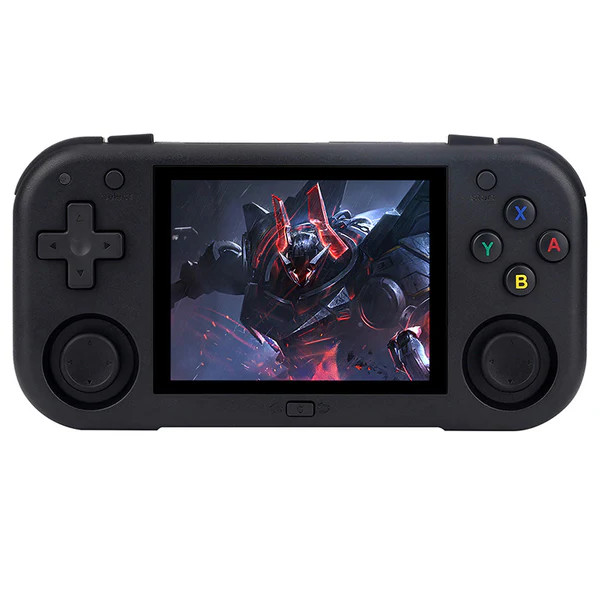
The MagicX Mini Zero 28 is a horizontal, pocket-sized emulation handheld built around the Allwinner A133P — the same quad-core Cortex-A53 chip that powers the TrimUI Brick. It pairs that SoC with 2GB of DDR4 RAM, a 2.8-inch 640×480 IPS panel, and an Android 10 software stack, all in a 129g shell that measures 130×64×19mm. MagicX (sold in some regions under the AMPOWN label) positions it well under $60, and it competes directly with the flood of sub-$60 Anbernic and TrimUI devices rather than with anything running a desktop-class chip. This is a budget retro machine, and reading it against that bar is the only honest way to judge it.
Emulation performance, generation by generation
The A133P is a 1.8GHz A53 cluster with an IMG PowerVR GE8300 GPU, so it is a low-power ARM part, not a miniature PC. Everything through the 16-bit era runs at full speed without drama: NES, SNES, Master System, Genesis, PC Engine, and Game Boy/Color/Advance all sit at 60fps in RetroArch (or the bundled My Boy! for GBA). PlayStation 1 is the comfortable ceiling — Beetle PSX and DuckStation handle the bulk of the library at full speed, and this is where the device spends most of its time. Above that, expect compromises. Nintendo DS via the preinstalled DraStic is largely playable, though the 4:3 screen forces awkward choices about how to stack the two DS displays. N64 is genuinely a mixed bag under Mupen64Plus: Wipeout 64 holds roughly 30fps while Wave Race 64 sags toward 20fps, so treat N64 as a per-game experiment rather than a supported tier. PSP through PPSSPP is similar — lighter titles like God of War: Chains of Olympus are playable with occasional frame drops, but demanding 3D games stutter. Dreamcast on Flycast runs 2D fighters and lighter titles and struggles with the rest. Saturn and GameCube are out of reach. If you specifically want N64 or heavy PSP, this is not the machine to buy.
Screen, build and controls
The 2.8-inch IPS panel uses OCA full lamination, so the glass sits flush against the display with no visible air gap, and 640×480 is a clean integer-friendly resolution for 4:3 systems. It is small and sharp rather than large and detailed — text-heavy games ask you to squint. The chassis is plastic but assembled well, offered in purple, black, and glacier blue, with bottom-firing speakers and a 2.4GHz Wi-Fi radio (no Bluetooth on the base spec). Controls are the notable step up over the earlier XU Mini M: rounded ABXY buttons replace the old flat ones, and the d-pad is sloped for cleaner directional rolls. There are two analog sticks — useful for the PS1 and N64 titles that need them — but they are conventional potentiometer sticks, not Hall effect, so drift over the long term is a possibility. Shoulder buttons cover L1/L2 and R1/R2, and a long-press of R3 toggles an on-screen virtual mouse, a handy trick for navigating Android. There is a 3.5mm headphone jack and a USB-C port; there is no touchscreen and no reset button.
Software and setup
Out of the box it runs a 64-bit build of Android 10 fronted by MagicX’s “Dawn Launcher,” a fork of the Daijisho frontend, with RetroArch, My Boy!, and DraStic preinstalled and a microSD card of games included on most SKUs. There is no Google Play Store, so sideloading through F-Droid or the Aurora Store is how you add anything else. The Android base is a double-edged thing: you get streaming apps, standalone emulators, and a familiar OS, but also Android’s overhead and a launcher that is not as polished as a purpose-built retro frontend. Because the A133P is shared with the TrimUI Brick, this device sits close to an active Linux custom-firmware scene — community ports of muOS, KNULLI, and MinUI have been the expected path for people who want a leaner, faster-booting experience than stock Android. Treat CFW as a community project rather than a guaranteed one-click flash: check current forum threads for your exact hardware revision (there is a V2) before wiping the internal storage.
Price, value and who it is for
MagicX launched the Mini Zero 28 in the mid-to-upper $50s, with pre-orders quoted from around $59, and it is frequently discounted to roughly $38–$55 depending on the SKU and storage tier. At that price it is a competent PS1-and-below machine in an unusually small horizontal body, and the 2900mAh battery’s claimed 7–9 hours is realistic for 8- and 16-bit play. It makes the most sense for someone who wants a genuinely tiny device for retro handhelds and arcade games, values dual sticks and a laminated screen at this price, and is comfortable tinkering with sideloading or custom firmware. Anyone chasing smooth N64, PSP, or Dreamcast should spend more on an H700-plus or Snapdragon device. As a cheap, portable 8-bit-through-PS1 companion, the Mini Zero 28 earns its keep.
📐 Size & Pocketability
⚖️ Weight vs Other Handhelds
🔋 Real-World Battery Estimator
⭐ Emulation Performance
📊 View How This Score is Calculated
The Hardware Power Score is an absolute metric. Perfect emulation of difficult, modern consoles awards significantly more points than standard retro consoles.
- 15× Multiplier: Modern PC
- 12× Multiplier: Switch, PS3, Xbox 360
- 10× Multiplier: Wii U
- 8× Multiplier: PS2, GameCube, Wii, Xbox
- 5× Multiplier: Saturn, Dreamcast, PSP
- 3× Multiplier: N64, PS1
- 1× Multiplier: SNES, GBA
Generation 6
Generation 5
Handhelds & Retro
⚡ Performance Benchmarks
Where MagicX Mini Zero 28 Imagination PowerVR GE8300 lands against the handhelds everyone knows. Every bar shares one scale, so longer genuinely means faster — add up to two rivals to compare.
CPU = Geekbench 6 multi-core · GPU = 3DMark Wild Life. Median real-world scores; every bar shares one scale — add up to two rivals to compare.
📋 Full Specifications
📺 Display
⚙️ Platform
💾 Memory
🕹️ Controls
📏 Body
🔋 Battery
⚖️ Verdict
✅ The Good
- Genuinely pocketable at 129g with a flush, fully-laminated 2.8-inch 640×480 IPS screen
- Handles everything through PlayStation 1 at full speed, plus playable DS via DraStic
- Dual analog sticks, improved rounded ABXY buttons, and a sloped d-pad at a sub-$60 price
- Android 10 base allows sideloaded emulators and streaming apps, and it shares the TrimUI Brick's A133P chip with an active community CFW scene
❌ The Bad
- N64, PSP, and Dreamcast are inconsistent to unplayable – this is a PS1-ceiling device, not a 3D powerhouse
- Analog sticks are potentiometer units, not Hall effect, so long-term drift is a risk
- Stock software is clunky – Android 10 with no Play Store, a rough Daijisho-fork launcher, and no Bluetooth on the base spec
📰 Latest News & Guides
The Ultimate Guide to ARMSX3: Android’s New PS3 Emulator, Competitor Comparisons, and Setup Tutorial
18/08/2026Pokémon Gold, Silver, and Crystal (Gen 2) Recomp Lands on Android
17/08/2026How to Play the Pokémon Red, Blue, or Yellow Recomp on Your Android, Windows, and Linux Devices
16/08/2026🔍 Similar Handhelds
Other handhelds that emulate up to PSP.