
🛒 Where to Buy
⚠️ Golden Rule of Retro Handhelds: Throw away the cheap MicroSD card that comes in the box — it will fail. And never use a high-wattage PD “Fast Charger” on these devices; it can damage the battery. Use a standard 5V/1.5A brick.
Device Overview: AYN Odin 2 Portal
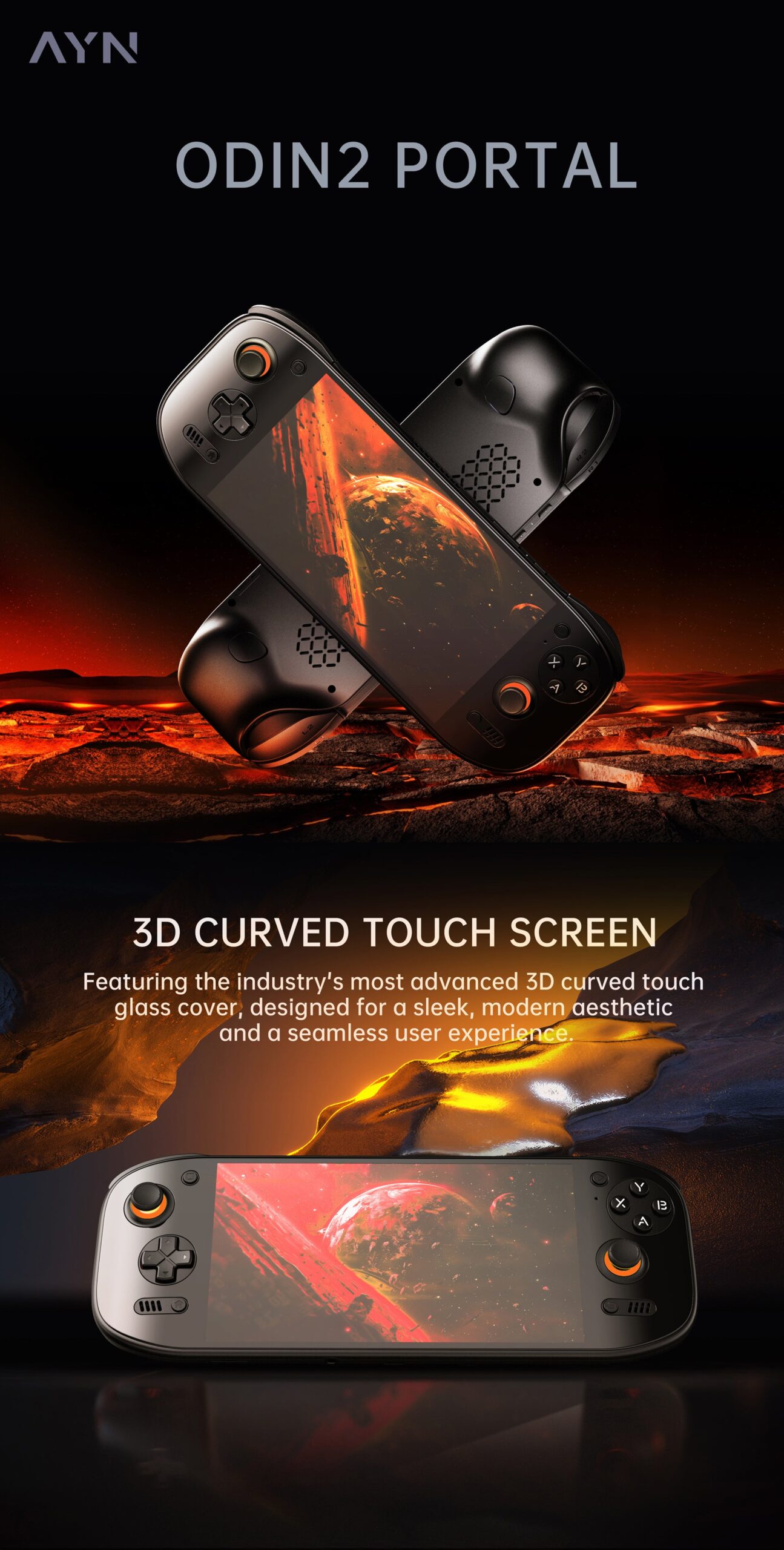
The Odin 2 Portal is what happens when AYN takes the silicon from the Odin 2, throws away the 6-inch LCD chassis, and rebuilds the whole device around a 7-inch 1080p AMOLED panel. That panel is the entire reason this model exists. Everything else, the Snapdragon 8 Gen 2, the Adreno 740, the 8000mAh cell, carries straight over from the standard Odin 2. So if you already understand how a Snapdragon 8 Gen 2 handheld performs, you understand exactly how the Portal performs. What you are paying the premium for is the screen and the larger 430g body that holds it.
A word on the “variant” question, because the marketing muddies it. There is one screen design: a flat AMOLED panel under a single sheet of 3D curved cover glass that bends to meet the side contours of the shell. There is no separate flat-glass model. The “variants” you will see on AYN’s store are storage tiers, Base (8GB/128GB), Pro (12GB/512GB), and Max (16GB/1TB), not different displays. Against the base Odin 2, the Portal trades a sharper, more pocketable LCD body for a bigger, far better-looking emissive screen. Against a Retroid Pocket 5, which also runs an OLED, the Portal brings noticeably more GPU headroom and a larger panel, at a higher price and in a heavier shell.
Emulation performance, generation by generation
Because the chip is identical to the Odin 2, the emulation ceiling is identical too. PS2 through AetherSX2 is trivial: 3x internal resolution for native-1080p output is a baseline expectation here, not a stretch goal, with only the usual stubborn titles needing per-game fiddling. GameCube and Wii on Dolphin run clean and smooth, and they look genuinely striking on the OLED, with deep blacks the Odin 2’s LCD never produced. PSP via PPSSPP, Dreamcast, Saturn, N64 and everything below them are effortless and sip battery, GBA can push past 14 hours on a charge.
Switch is the headline modern target, and it is the one with caveats. With the right build and custom per-game drivers, on emulators in the Yuzu lineage (now carried forward by forks like Sudachi and Eden), a large library is playable and the Portal gives you the best handheld seat for it that this chip can offer. But compatibility is still hit-and-miss per title, exactly as it is on every 8 Gen 2 device, expect tuning, not plug-and-play. 3DS on Citra forks and Vita on Vita3K are viable with the usual rough edges. PS3 (RPCS3) and Wii U (Cemu) on Android remain experimental-to-unsupported on this hardware: a handful of lighter titles can be coaxed along, but neither is a reason to buy this device, and you should not expect a smooth time.
Screen, build and controls
This is the section that justifies the Portal over the base Odin 2. The 7-inch 1920×1080 AMOLED runs at 120Hz, covers 155% sRGB, and hits roughly 800 nits, with no ghosting and the per-pixel black levels only an emissive panel delivers. On a Game Boy Advance library or a Dolphin-rendered GameCube title, the difference from the Odin 2’s LCD is immediate and not subtle. The curved cover glass looks premium and reads as a single continuous surface.
The build is where opinions split. The shell is plastic, and it is both slippery and a relentless fingerprint magnet, plan on a grip case and a microfiber cloth. The curved glass front is gorgeous but it is one more thing that can crack, and on a 430g device you will feel the heft over long sessions. The controls themselves, full-size Hall-effect sticks and triggers, are the same proven AYN kit and are not the compromise here.
Software and setup
The Portal ships on Android 13. Out of the box you get AYN’s own launcher layered over stock Android, which is fine but most owners will install Daijisho or ES-DE to organize ROMs and map per-system emulators. You will be sideloading emulators and, for Switch, hunting down the appropriate forks and per-game driver packs yourself, none of this is curated for you. Wi-Fi 7 and Bluetooth 5.3 keep downloads and controllers responsive. It is an open Android handheld: powerful and flexible, but it expects you to do the configuration work.
Price, value and who it’s for
The Base 8GB/128GB starts around $320-$334 (AYN’s MSRP is $329, and it has sold lower on sale), with the Pro at roughly $399 and the Max near $500. The Pro is the one most people should buy: 512GB holds a serious library without microSD juggling. The honest framing is this, the Portal is a base Odin 2 with a much better, much bigger screen and a heavier body. If a top-tier OLED is what you want and 430g in the hands does not bother you, it is the screen to beat at this performance level. If you prize pocketability or want to save money for identical emulation power, the standard Odin 2 or a Retroid Pocket 5 will get you most of the way there. Buy the Portal for the panel, or don’t buy it at all.
📐 Size & Pocketability
⚖️ Weight vs Other Handhelds
🔋 Real-World Battery Estimator
⭐ Emulation Performance
📊 View How This Score is Calculated
The Hardware Power Score is an absolute metric. Perfect emulation of difficult, modern consoles awards significantly more points than standard retro consoles.
- 15× Multiplier: Modern PC
- 12× Multiplier: Switch, PS3, Xbox 360
- 10× Multiplier: Wii U
- 8× Multiplier: PS2, GameCube, Wii, Xbox
- 5× Multiplier: Saturn, Dreamcast, PSP
- 3× Multiplier: N64, PS1
- 1× Multiplier: SNES, GBA
Gen 8 & PC
Generation 7
Generation 6
Generation 5
Handhelds & Retro
⚡ Performance Benchmarks
Where AYN Odin 2 Portal Adreno 740 lands against the handhelds everyone knows. Every bar shares one scale, so longer genuinely means faster — add up to two rivals to compare.
CPU = Geekbench 6 multi-core · GPU = 3DMark Wild Life. Median real-world scores; every bar shares one scale — add up to two rivals to compare.
📋 Full Specifications
📺 Display
⚙️ Platform
💾 Memory
🕹️ Controls
📏 Body
🔋 Battery
⚖️ Verdict
✅ The Good
- Stunning 7-inch 1080p 120Hz AMOLED (155% sRGB, ~800 nits) that transforms GameCube, GBA and PS2 visuals
- Snapdragon 8 Gen 2 / Adreno 740 handles PS2, GameCube and Wii effortlessly and makes Switch viable per-game
- Large 8000mAh battery with 27W charging delivers long sessions (14+ hours on lighter systems)
- Full-size Hall-effect sticks and triggers plus Wi-Fi 7 / Bluetooth 5.3 connectivity
❌ The Bad
- Heavy at 430g and a slippery, fingerprint-prone plastic shell that nearly demands a grip case
- Switch needs per-game driver tuning, and PS3 / Wii U remain experimental at best on this chip
- Pricey to spec up ($399 Pro, ~$500 Max) versus the cheaper, equally fast base Odin 2 or Retroid Pocket 5
📰 Latest News & Guides
The Ultimate Guide to ARMSX3: Android’s New PS3 Emulator, Competitor Comparisons, and Setup Tutorial
18/08/2026Pokémon Gold, Silver, and Crystal (Gen 2) Recomp Lands on Android
17/08/2026How to Play the Pokémon Red, Blue, or Yellow Recomp on Your Android, Windows, and Linux Devices
16/08/2026🔍 Similar Handhelds
Other handhelds that emulate up to CURRENTGEN.