
🛒 Where to Buy
⚠️ Golden Rule of Retro Handhelds: Throw away the cheap MicroSD card that comes in the box — it will fail. And never use a high-wattage PD “Fast Charger” on these devices; it can damage the battery. Use a standard 5V/1.5A brick.
Device Overview: Retroid Pocket Flip 2 D1100
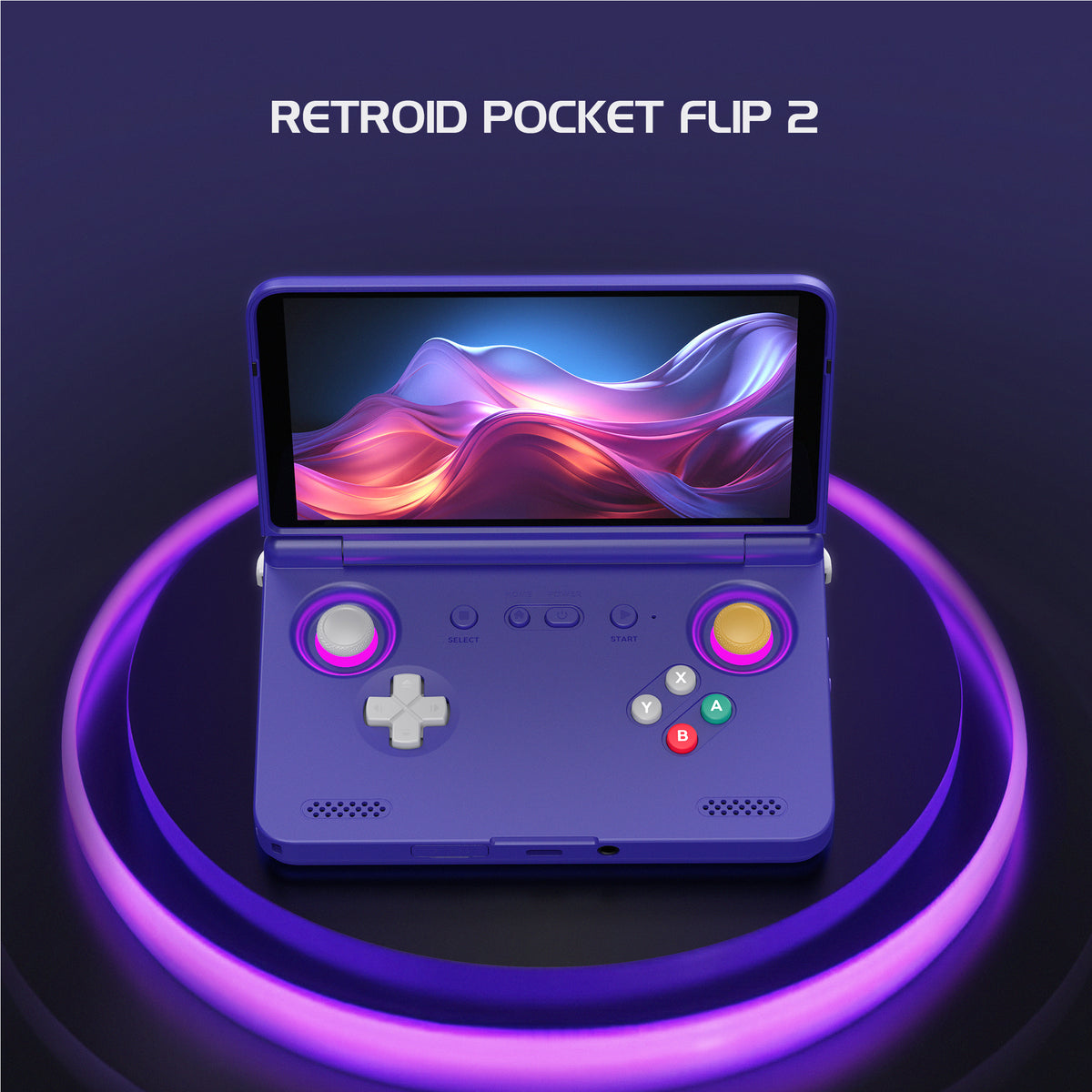
The Retroid Pocket Flip 2 D1100 is the cheaper of two chip options Retroid offers on its second clamshell handheld, and it exists to answer one question: how much emulation do you lose by saving thirty dollars? Instead of the Qualcomm Snapdragon 865 that powers the flagship model, this variant runs a MediaTek Dimensity 1100 — the same SoC found in the Retroid Pocket 4 Pro. Everything else about the shell is identical to its Snapdragon sibling: the folding, DS-style clamshell body, the 5.5-inch 1080p AMOLED, Hall-effect sticks, and active cooling. It launched in April 2025 at roughly $190, and it is best understood as a pocketable Android emulation machine that tops out around the sixth console generation rather than a do-everything powerhouse.
Emulation performance, generation by generation
The Dimensity 1100 pairs four Cortex-A78 cores (up to 2.6 GHz) with a Mali-G77 MC9 GPU, and that combination sets a clear ceiling. Everything through the Game Boy Advance, PS1, N64, and Dreamcast era runs without drama — RetroArch cores and standalone emulators like DuckStation and Flycast handle those effortlessly. PSP is comfortable in PPSSPP, and Saturn is playable if you tolerate the usual quirks. The interesting zone is the sixth generation and beyond. GameCube and Wii in Dolphin run smoothly, and Retro Game Corps found many titles holding up even at 2x internal resolution. PS2 in AetherSX2/NetherSX2 is where the chip starts to sweat: demanding games such as God of War II show frame drops and visual glitches that the Snapdragon model clears up more cleanly. Switch emulation is the same story — Wind Waker HD and similar ports stutter here. The single biggest caveat is that the Dimensity build has no custom GPU driver support, so you cannot swap in the Turnip/Adreno drivers that unlock a lot of Vulkan performance on the Snapdragon variant, and it cannot dual-boot into Linux. Video-decode latency is also higher (roughly 8–10 ms versus 2–4 ms). If your library is retro-through-GameCube, none of that matters; if you were buying specifically for PS2 and Switch, the SD865 is the smarter thirty dollars.
Screen, build and controls
The 5.5-inch AMOLED at 1920×1080 (roughly 400 PPI, 60 Hz, around 500 nits peak) is the headline upgrade over the original Flip, and AMOLED black levels genuinely flatter old 4:3 and pixel-art games. The clamshell hinge folds the screen face-down against the controls, so this is the rare handheld you can drop in a bag without a case. It is a plastic body weighing about 300 g, measuring 140.5 x 89.5 mm and 24.4–31 mm thick when closed. Controls are the strong suit: symmetric Hall-effect analog sticks that resist drift and carry RGB lighting, a d-pad in the lower position, and stacked shoulder buttons with analog L2/R2 triggers. There is a gyro for motion aiming, a touchscreen, and a bottom-mounted USB-C port alongside a microSD slot and a headphone jack. Active cooling keeps the SoC in check — stress testing showed it holding temperature well below 30°C with high stability.
Software and setup
It ships on Android 13, which is the practical choice here: you get the Play Store, standalone emulators, a front-end like Daijisho or ES-DE, and streaming apps out of the box. Retroid’s stock launcher is serviceable but most owners set up their own front-end. Because this is a Dimensity device rather than the Snapdragon one, the custom-firmware and driver landscape is narrower — the GammaOS/GammaOSNext community project targets this hardware, but you will not find the deep Linux/CFW ecosystem (ROCKNIX, Batocera, ArkOS, muOS) that Rockchip-based handhelds enjoy, and the GPU-driver swapping that Snapdragon owners rely on is off the table. Setup is otherwise the standard Android emulation routine: install your emulators, point them at a microSD full of ROMs and BIOS files, and map controls once.
Price, value and who it is for
At about $190 the D1100 is one of the cheapest ways into a 1080p AMOLED clamshell with Hall sticks. It makes sense for someone who mainly plays 8-bit through GameCube, wants the fold-shut portability of a DS-style shell, and does not want to pay the Snapdragon premium for PS2/Switch headroom they will not use. It is the wrong pick if you plan to lean on custom GPU drivers, Linux dual-boot, or heavy PS2 and Switch libraries — spend the extra thirty on the SD865. Viewed honestly, this is a very good retro-to-sixth-gen machine with a genuinely nice screen and a party trick (it folds) that no plain slab offers.
📐 Size & Pocketability
⚖️ Weight vs Other Handhelds
🔋 Real-World Battery Estimator
⭐ Emulation Performance
📊 View How This Score is Calculated
The Hardware Power Score is an absolute metric. Perfect emulation of difficult, modern consoles awards significantly more points than standard retro consoles.
- 15× Multiplier: Modern PC
- 12× Multiplier: Switch, PS3, Xbox 360
- 10× Multiplier: Wii U
- 8× Multiplier: PS2, GameCube, Wii, Xbox
- 5× Multiplier: Saturn, Dreamcast, PSP
- 3× Multiplier: N64, PS1
- 1× Multiplier: SNES, GBA
Gen 8 & PC
Generation 7
Generation 6
Generation 5
Handhelds & Retro
⚡ Performance Benchmarks
Where Retroid Pocket Flip 2 D1100 Mali-G77 MC9 lands against the handhelds everyone knows. Every bar shares one scale, so longer genuinely means faster — add up to two rivals to compare.
CPU = Geekbench 6 multi-core · GPU = 3DMark Wild Life. Median real-world scores; every bar shares one scale — add up to two rivals to compare.
📋 Full Specifications
📺 Display
⚙️ Platform
💾 Memory
🕹️ Controls
📏 Body
🔋 Battery
⚖️ Verdict
✅ The Good
- Bright 5.5-inch 1080p AMOLED that flatters retro and pixel-art games
- Folding clamshell design protects the screen and pockets without a case
- Drift-resistant Hall-effect sticks plus analog L2/R2 triggers and a gyro
- Cheapest way into this shell — around $190, thirty dollars under the Snapdragon model
❌ The Bad
- No custom GPU driver support and no Linux dual-boot, unlike the Snapdragon variant
- PS2 and Switch emulation shows frame drops and glitches the SD865 handles cleanly
- Thinner custom-firmware ecosystem for the Dimensity chip; higher video-decode latency
📰 Latest News & Guides
The Ultimate Guide to ARMSX3: Android’s New PS3 Emulator, Competitor Comparisons, and Setup Tutorial
18/08/2026Pokémon Gold, Silver, and Crystal (Gen 2) Recomp Lands on Android
17/08/2026How to Play the Pokémon Red, Blue, or Yellow Recomp on Your Android, Windows, and Linux Devices
16/08/2026🔍 Similar Handhelds
Other handhelds that emulate up to PS2.