
🛒 Where to Buy
⚠️ Golden Rule of Retro Handhelds: Throw away the cheap MicroSD card that comes in the box — it will fail. And never use a high-wattage PD “Fast Charger” on these devices; it can damage the battery. Use a standard 5V/1.5A brick.
Device Overview: Asus ROG Xbox Ally X
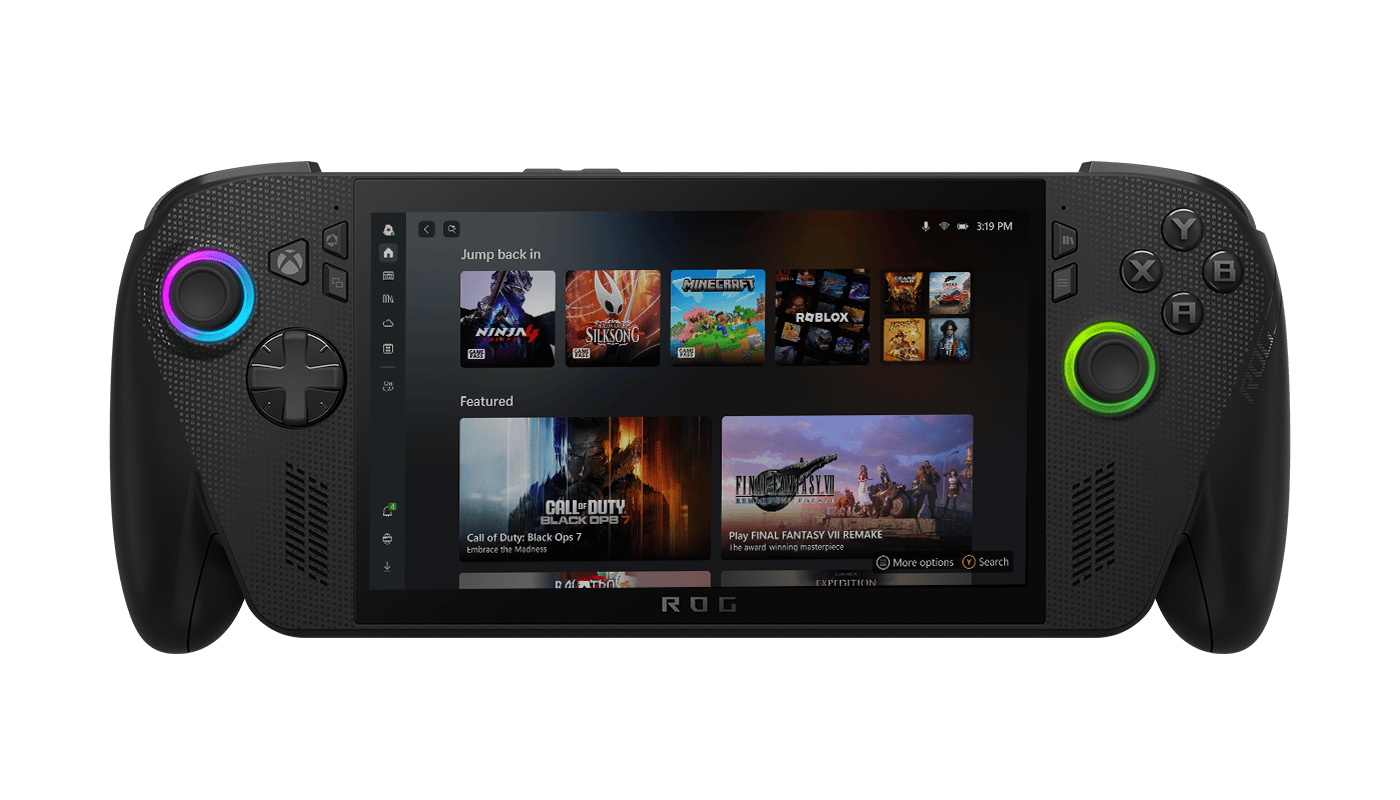
The Asus ROG Xbox Ally X is the first handheld to carry Xbox branding, built by Asus with Microsoft and launched on 16 October 2025 at $999.99. It is not a console and not an emulation box in the single-board-computer sense; it is a full Windows 11 gaming PC folded into a 715-gram slab with contoured grips. What separates it from the earlier ROG Ally X is not the shape but the silicon and the software: an AMD Ryzen AI Z2 Extreme inside, and a new Xbox full-screen experience that boots straight past the Windows desktop into a console-style launcher. At a thousand dollars it sits at the top of the x86 handheld market, above the Steam Deck OLED and well above its own $599.99 sibling, the plain ROG Xbox Ally, which runs a slower quad-core Z2 A.
Emulation performance, generation by generation
Because this is a Zen 5 x86 machine with sixteen RDNA 3.5 graphics cores, not a Rockchip or Allwinner ARM chip, its emulation ceiling is set by watts and thermals rather than by architecture gaps. Everything through the sixth generation is trivial: NES, SNES, Genesis, N64, PS1 and Dreamcast run at full speed, and GameCube and Wii upscale cleanly in Dolphin. PS2 via PCSX2 and PSP via PPSSPP are effortless. DS and 3DS run well on melonDS and Azahar, the maintained Citra fork, and Wii U through Cemu is comfortable. The genuinely demanding targets are where the Z2 Extreme earns its price: RPCS3 for PS3 is playable in a way cheap handhelds cannot touch, and the chip’s AVX-512 support materially helps that emulator. Switch emulation is possible but politically messy, since Yuzu was shut down in 2024 and Ryujinx development halted, so you lean on community forks. Xbox 360 through Xenia and early PS4 work via shadPS4 exist but stay experimental. Expect fan noise and 25W-plus draw when you push RPCS3.
Screen, build and controls
The 7-inch 1080p IPS panel runs at 120Hz with FreeSync Premium, hits 500 nits, covers 100% sRGB and sits behind Gorilla Glass Victus with an anti-reflection coat. It is not OLED, which is the one place the cheaper Steam Deck OLED lands a clean hit; blacks read grey rather than black. The redesigned chassis borrows Xbox controller ergonomics with deep contoured grips that make the 715-gram weight sit better than the flat original Ally. Controls are full-size asymmetric sticks, a proper d-pad, ABXY, bumpers, two assignable back buttons, HD haptics and a 6-axis gyro. The triggers are Hall effect analog. The thumbsticks, notably, are not; they use conventional potentiometer modules, so long-term drift is a real risk, and a small aftermarket already sells Hall-effect stick replacements for this exact device. Connectivity is generous: one USB4 port with Thunderbolt 4 and DisplayPort 2.1, a second USB-C with DisplayPort, Wi-Fi 6E, Bluetooth 5.4, a UHS-II microSD slot and a headphone jack.
Software and setup
The headline change is the Xbox full-screen experience. Press power and you land in an Xbox-style interface that aggregates Game Pass, Steam, Battle.net, the Epic and GOG launchers and your installed titles under one library, with the Windows shell kept dormant to claw back RAM. It is the closest a Windows handheld has come to feeling like a console. Underneath it is still Windows 11 Home, which means the ARM-oriented custom firmwares people associate with retro handhelds, such as muOS, Knulli, ArkOS, ROCKNIX and OnionOS, simply do not apply here; those are built for ARM single-board chips, not this hardware. What is relevant is EmuDeck, which installs and configures the whole emulator stack on Windows in one pass, plus RetroArch or standalone emulators on top. If you dislike Windows overhead, the community answer is Bazzite, a SteamOS-style Linux image tuned for Ally hardware, or Batocera’s x86-64 build for a pure emulation console. The 1TB drive is a standard PCIe 4.0 M.2 2280 SSD and user-replaceable, and the 24GB of LPDDR5X-8000 gives emulators generous headroom.
Price, value and who it is for
At $999.99 the Ally X is a hard sell against a Steam Deck OLED if all you want is retro emulation, since even setting PS3 aside a Deck clears most of the same library for roughly half the money. What the premium buys is Zen 5 headroom for modern AAA games at 1080p, 24GB of RAM, an 80Wh battery that genuinely survives long emulation sessions, USB4/Thunderbolt for an eGPU or dock, and the smoothest console-mode software on any Windows handheld. It suits someone who wants a single device to play current PC games and emulate up to PS3 without owning a desktop, and who values the Xbox library integration. Bargain hunters and pure retro players are better served cheaper; this is a premium enthusiast machine that happens to be an excellent emulator by brute force.
📐 Size & Pocketability
⚖️ Weight vs Other Handhelds
🔋 Real-World Battery Estimator
⭐ Emulation Performance
📊 View How This Score is Calculated
The Hardware Power Score is an absolute metric. Perfect emulation of difficult, modern consoles awards significantly more points than standard retro consoles.
- 15× Multiplier: Modern PC
- 12× Multiplier: Switch, PS3, Xbox 360
- 10× Multiplier: Wii U
- 8× Multiplier: PS2, GameCube, Wii, Xbox
- 5× Multiplier: Saturn, Dreamcast, PSP
- 3× Multiplier: N64, PS1
- 1× Multiplier: SNES, GBA
Gen 8 & PC
Generation 7
Generation 6
Generation 5
Handhelds & Retro
📋 Full Specifications
📺 Display
⚙️ Platform
💾 Memory
🕹️ Controls
📏 Body
🔋 Battery
⚖️ Verdict
✅ The Good
- Zen 5 Ryzen AI Z2 Extreme with AVX-512 makes PS3/RPCS3 genuinely playable, a full tier above ARM handhelds and the base model
- 80Wh battery and 24GB LPDDR5X-8000 give long emulation sessions and real multitasking headroom cheaper handhelds lack
- Xbox full-screen experience is the most console-like software on any Windows handheld, unifying Game Pass, Steam and other launchers
- Strong I/O and serviceability: USB4/Thunderbolt 4, Wi-Fi 6E, UHS-II microSD and a user-replaceable standard M.2 2280 SSD
❌ The Bad
- Thumbsticks use potentiometer modules, not Hall effect, so long-term stick drift is a genuine risk
- $999.99 is steep next to a Steam Deck OLED that covers most of the same emulation for roughly half the price
- IPS panel rather than OLED; 500 nits is bright but blacks look grey beside OLED rivals
📰 Latest News & Guides
The Ultimate Guide to ARMSX3: Android’s New PS3 Emulator, Competitor Comparisons, and Setup Tutorial
18/08/2026Pokémon Gold, Silver, and Crystal (Gen 2) Recomp Lands on Android
17/08/2026How to Play the Pokémon Red, Blue, or Yellow Recomp on Your Android, Windows, and Linux Devices
16/08/2026🔍 Similar Handhelds
Other handhelds that emulate up to CURRENTGEN.