
🛒 Where to Buy
⚠️ Golden Rule of Retro Handhelds: Throw away the cheap MicroSD card that comes in the box — it will fail. And never use a high-wattage PD “Fast Charger” on these devices; it can damage the battery. Use a standard 5V/1.5A brick.
Device Overview: Anbernic RG Vita Pro
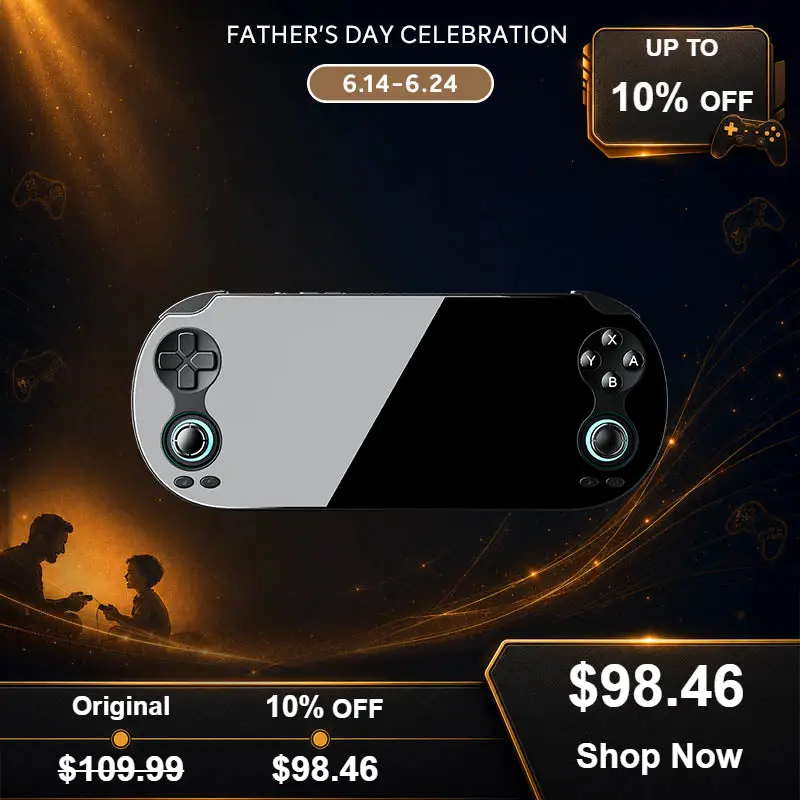
The RG Vita Pro is Anbernic’s tribute act to the PlayStation Vita, and you should read the name as styling, not as a performance promise. It borrows the Vita’s silhouette, the long widescreen slab, dual sticks flanking a central display, but the guts are pure 2026 Anbernic: a Rockchip RK3576 SoC, 4GB of RAM, and a dual-boot Android 14 / 64-bit Linux setup. It sits at the upper end of Anbernic’s Rockchip stack, a clear step above the T618-based base RG Vita that shares its chassis. The “Pro” buys you the better chip and a 1080p panel; it does not buy you actual PS Vita emulation, and Anbernic’s marketing leans hard on a console this hardware cannot reliably run.
What it actually is: a comfortable, large-screen Android emulation handheld for everything up to and including the PSP and sixth-gen, with the usual caveats once you push past GameCube.
Emulation performance, generation by generation
The RK3576 is a mid-tier ARM chip (4x Cortex-A72 + 4x Cortex-A53 at 2.2GHz, Mali-G52 MC3 GPU), and it behaves like one. Everything through the fifth generation is trivial: NES, SNES, Genesis, GBA, PS1, and N64 via standalone RetroArch cores or the Android frontends run full speed with headroom. Dreamcast through Flycast is solid. The genuine highlight is PSP: PPSSPP runs the bulk of the library at 3x internal resolution, with lighter titles pushing 4x, and on a native 1080p panel that looks excellent. GameCube via Dolphin clears roughly 80% of the catalog, Wind Waker, Metroid Prime, Pikmin are fine, while demanding showcases like Rogue Squadron II need resolution drops. PS2 is where the “Pro” branding gets oversold: AetherSX2/NetherSX2 runs a meaningfully larger slice than the base Vita, but the heavy hitters (God of War, Shadow of the Colossus, Kingdom Hearts) demand per-game compromises and still drop frames. Treat it as an easy-PS2 machine, not a reliable one. Switch and PS Vita are off the table in any practical sense, Vita3K is early and crash-prone here, despite the device’s name. Buy it for PSP and GameCube; everything heavier is a bonus, not a guarantee.
Screen, build and controls
The display is a 5.5-inch IPS INCELL touchscreen at 1920×1080, 16:9, around 400 PPI. It is sharp and the resolution genuinely flatters PSP upscaling, but be clear that this is LCD, not OLED or AMOLED, and reviewers consistently call it slightly dim. The widescreen 16:9 shape is the Vita homage and it suits PSP and modern Android content, though it means heavy letterboxing for 4:3 retro systems. The body is a long 206 x 84 x 18.6mm slab weighing 278g, large in the hand and clearly modeled on the original Vita. Controls are the strong point: full dual analog sticks with 3D Hall-effect sensors (no drift), a six-axis gyro, and a vibration motor. The sticks sit slightly inset but track well. Stereo speakers, a 3.5mm jack, and USB-C with 1080p DisplayPort output round it out.
Software and setup
It ships dual-boot: Android 14 as the daily driver and a 64-bit Linux build alongside it. Android is where you’ll live, it’s the more complete environment, with the full slate of standalone emulators (PPSSPP, Dolphin, AetherSX2/NetherSX2, DuckStation, RetroArch) plus Anbernic’s bolted-on AI features (real-time translation, game-guide lookup) that you can ignore. The bundled Linux side looks basic out of the box. As with most RK3576/Rockchip Anbernics, the real upside is custom firmware: a GammaOS build for this device has been promised and improves both polish and per-system performance. Out of the box, expect to spend time loading your own ROMs, configuring frontends like ES-DE, and tuning per-game settings, this is not a plug-and-play retro toy, it’s a tinkerer’s Android handheld. Connectivity is current: Wi-Fi 6 and Bluetooth 5.2. Storage is 64GB eMCP internal plus dual microSD slots taking up to 2TB.
Price, value and who it’s for
Launch pricing was $139.99 early-bird for the first window, settling at $149.99 retail (Anbernic’s own store has since discounted it well below that). At $150 it runs straight into the Retroid Pocket 5, which pairs a stronger Snapdragon with an OLED screen for roughly $50 more and is the better pure-performance buy. So the Vita Pro’s case rests on the form factor and the 1080p PSP experience, not raw power. Buy it if you specifically want the wide Vita-style body, dual Hall sticks, and a sharp PSP/GameCube machine, and you don’t mind doing setup work. Skip it if you’re chasing reliable PS2, anything Switch, or actual Vita games, the name is writing checks the RK3576 can’t cash. The 5000mAh battery (around 8 hours, 18W charging) is genuinely good. It’s a likeable device sold under a misleading badge.
📐 Size & Pocketability
⚖️ Weight vs Other Handhelds
🔋 Real-World Battery Estimator
⭐ Emulation Performance
📊 View How This Score is Calculated
The Hardware Power Score is an absolute metric. Perfect emulation of difficult, modern consoles awards significantly more points than standard retro consoles.
- 15× Multiplier: Modern PC
- 12× Multiplier: Switch, PS3, Xbox 360
- 10× Multiplier: Wii U
- 8× Multiplier: PS2, GameCube, Wii, Xbox
- 5× Multiplier: Saturn, Dreamcast, PSP
- 3× Multiplier: N64, PS1
- 1× Multiplier: SNES, GBA
Generation 7
Generation 6
Generation 5
Handhelds & Retro
⚡ Performance Benchmarks
Where Anbernic RG Vita Pro ARM Mali-G52 MC3 lands against the handhelds everyone knows. Every bar shares one scale, so longer genuinely means faster — add up to two rivals to compare.
CPU = Geekbench 6 multi-core · GPU = 3DMark Wild Life. Median real-world scores; every bar shares one scale — add up to two rivals to compare.
📋 Full Specifications
📺 Display
⚙️ Platform
💾 Memory
🕹️ Controls
📏 Body
🔋 Battery
⚖️ Verdict
✅ The Good
- Sharp 5.5-inch 1080p screen that makes PSP upscaling at 3x-4x look excellent
- Full dual analog sticks with 3D Hall-effect sensors (no stick drift) plus six-axis gyro
- Comfortable large Vita-style body with a strong 5000mAh battery (~8 hrs, 18W USB-C charging)
- Dual-boot Android 14 / Linux with active custom firmware support (GammaOS) on the way
❌ The Bad
- "Vita" branding is misleading: it cannot reliably emulate PS Vita, Switch, or demanding PS2 games
- IPS LCD panel only (not OLED/AMOLED) and reviewers note it runs slightly dim
- At $149.99 it's outclassed on raw power by the OLED Retroid Pocket 5 for about $50 more
📰 Latest News & Guides
The Ultimate Guide to ARMSX3: Android’s New PS3 Emulator, Competitor Comparisons, and Setup Tutorial
18/08/2026Pokémon Gold, Silver, and Crystal (Gen 2) Recomp Lands on Android
17/08/2026How to Play the Pokémon Red, Blue, or Yellow Recomp on Your Android, Windows, and Linux Devices
16/08/2026🔍 Similar Handhelds
Other handhelds that emulate up to Wii.