
🛒 Where to Buy
⚠️ Golden Rule of Retro Handhelds: Throw away the cheap MicroSD card that comes in the box — it will fail. And never use a high-wattage PD “Fast Charger” on these devices; it can damage the battery. Use a standard 5V/1.5A brick.
Device Overview: AYANEO Pocket Micro Classic
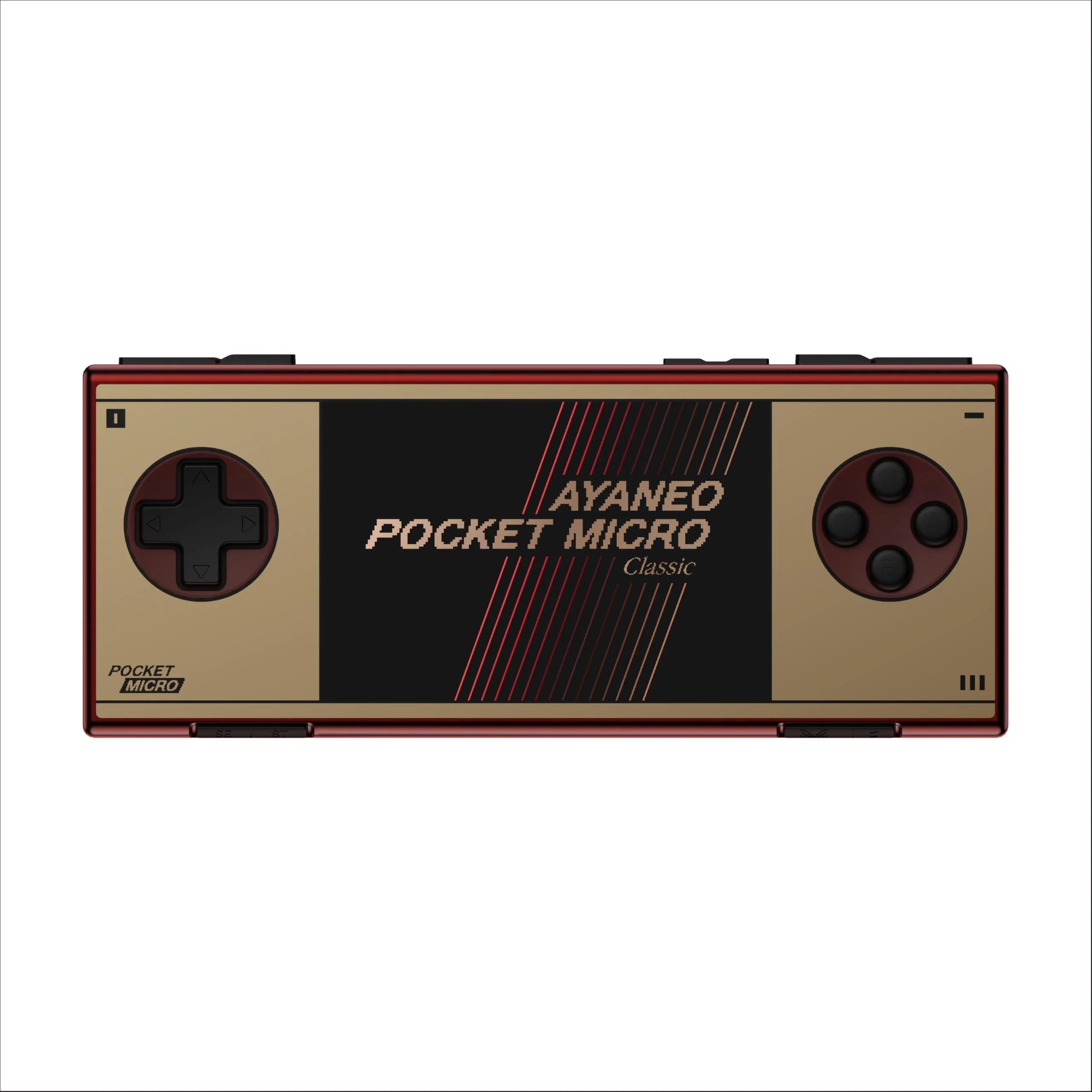
The AYANEO Pocket Micro Classic is the stripped-down, joystick-free version of AYANEO’s Pocket Micro, launched in March 2025 from $179. It is a horizontal, Game Boy Micro-shaped slab of CNC-machined aluminium running Android 13 on a MediaTek Helio G99, and the single decision that defines it is the one AYANEO removed: there are no analogue sticks at all. That reframes the whole device. Where the standard Pocket Micro is pitched as a do-everything pocket emulator, the Classic is honestly a 2D and early-3D machine, built around a d-pad and face buttons rather than twin thumbsticks. If you understand it that way, it is one of the nicest small retro handhelds you can buy. If you don’t, it will frustrate you the first time you load an N64 game.
Emulation performance, generation by generation
The Helio G99 is an octa-core ARM chip (two Cortex-A76 cores near 2.2GHz, six A55 cores, Mali-G57 MC2 graphics). It is genuinely strong for its size, but it is not a Windows x86 handheld and should not be judged like one. Everything through the 16-bit era is trivial: NES, SNES, Genesis, PC Engine, Game Boy and GBA all run at full speed in RetroArch, and GBA in particular looks superb because the native 960×640 3:2 panel maps almost perfectly to its aspect ratio. PS1 through DuckStation, Nintendo 64 via M64Plus FZ, Sega Saturn and Dreamcast via Redream all hit full speed across most of their libraries; Dreamcast titles like Crazy Taxi 2 hold 60fps. PSP through PPSSPP is generally reliable. The ceiling arrives at GameCube and PS2. Dolphin runs lighter GameCube games around 25 to 30fps and demanding ones stutter, while AetherSX2 or NetherSX2 will push a handful of PS2 titles to a playable 20 to 30fps with underclocking and give up on many others. The bigger caveat is the missing sticks: N64, PSP, Dreamcast, GameCube and PS2 all lean on analogue control, and AYANEO’s software “joystick mapping” mode (routing the d-pad or gyro to a virtual stick) is a workaround, not a substitute. The Classic’s real sweet spot is 8-bit, 16-bit, GBA, arcade and 2D PS1 — content where a d-pad is the correct input.
Screen, build and controls
The 3.5-inch borderless IPS panel is the standout: 960×640, 3:2, roughly 330 PPI, 400 nits and around 115% sRGB coverage at a flat 60Hz. It is sharp and colour-rich, and the 3:2 shape wastes far less glass on 4:3 and GBA content than a widescreen handheld would. The aluminium unibody is dense and feels expensive; the whole thing weighs about 227g in a 156 x 63 x 18mm frame, a few grams lighter than the standard Pocket Micro. Controls are a conductive-rubber d-pad and ABXY cluster with quick rebound, plus split L1/L2 and R1/R2 shoulder buttons to reduce misfires. There is a 6-axis gyro, a fingerprint-reader power button, and an X-axis linear haptic motor with sound-synced vibration. Two honest omissions carry over from the standard model: no analogue sticks and no 3.5mm headphone jack, so audio is Bluetooth 5.2 or USB-C only. The 2600mAh battery is modest and returns roughly six hours of light retro play.
Software and setup
This is an Android 13 device, not a Linux retro handheld, and that is the most important setup fact. The Linux custom-firmware scene — muOS, Knulli, ArkOS, ROCKNIX, OnionOS, Batocera — simply does not apply here; you never reflash the Classic, you install apps onto it. Out of the box it runs AYANEO’s AYAHome launcher with AYASpace for performance profiles (power-saving through full-throttle) and button mapping. Because it has full Google Play, the real “setup” is downloading RetroArch alongside standalone emulators (DuckStation, PPSSPP, Dolphin, NetherSX2, Redream, M64Plus FZ) and fronting them with Daijisho or ES-DE for a console-style library. EmuDeck’s Android installer can automate much of that if you want a one-shot configuration. You also get everything else Android offers: Moonlight and GeForce Now streaming, Xbox Cloud, and native store games — though the absent sticks limit how many of those are actually playable.
Price, value and who it is for
Pricing runs $179 for 6GB/128GB (Shadow Black), $209 for 8GB/256GB, and $239 for the limited Retro Gray and Retro Gold finishes, all LPDDR4X with UFS 2.2 storage. The awkward math is that this is only about $10 below the full Pocket Micro, which keeps the Hall-effect sticks for almost the same money. So the Classic is not the value pick — it is the aesthetic and ergonomic pick. Buy it if you want the smallest, best-built pocket handheld for pick-up-and-play 2D libraries and you genuinely do not care about analogue-era 3D. If N64, PSP, Dreamcast, GameCube or PS2 are on your regular rotation, spend the extra ten dollars on the standard Pocket Micro, or step up to the Pocket Micro 2, and keep your thumbsticks.
📐 Size & Pocketability
⚖️ Weight vs Other Handhelds
🔋 Real-World Battery Estimator
⭐ Emulation Performance
📊 View How This Score is Calculated
The Hardware Power Score is an absolute metric. Perfect emulation of difficult, modern consoles awards significantly more points than standard retro consoles.
- 15× Multiplier: Modern PC
- 12× Multiplier: Switch, PS3, Xbox 360
- 10× Multiplier: Wii U
- 8× Multiplier: PS2, GameCube, Wii, Xbox
- 5× Multiplier: Saturn, Dreamcast, PSP
- 3× Multiplier: N64, PS1
- 1× Multiplier: SNES, GBA
Gen 8 & PC
Generation 7
Generation 6
Generation 5
Handhelds & Retro
⚡ Performance Benchmarks
Where AYANEO Pocket Micro Classic Arm Mali-G57 MC2 lands against the handhelds everyone knows. Every bar shares one scale, so longer genuinely means faster — add up to two rivals to compare.
CPU = Geekbench 6 multi-core · GPU = 3DMark Wild Life. Median real-world scores; every bar shares one scale — add up to two rivals to compare.
📋 Full Specifications
📺 Display
⚙️ Platform
💾 Memory
🕹️ Controls
📏 Body
🔋 Battery
⚖️ Verdict
✅ The Good
- Superb pocketable build: dense CNC-aluminium body and a sharp 3:2 960×640 IPS panel that frames GBA and 4:3 systems with almost no wasted screen
- Helio G99 clears everything through Dreamcast, plus most PSP and 2D PS1, at full speed in a device this small
- D-pad-first layout with crisp conductive-rubber buttons and sound-synced haptics is ideal for retro and arcade libraries
- Full Android 13 with Google Play, so RetroArch, standalone emulators, ES-DE/Daijisho frontends and game streaming all install freely
❌ The Bad
- No analogue sticks at all: N64, PSP, Dreamcast, GameCube and PS2 analogue games are compromised, and the software "joystick mapping" is a stopgap
- Only about $10 cheaper than the standard Pocket Micro, which keeps the Hall sticks, so the value gap is thin
- No 3.5mm headphone jack, a small 2600mAh battery, and GameCube/PS2 remain a stutter-prone stretch on this ARM chip
📰 Latest News & Guides
The Ultimate Guide to ARMSX3: Android’s New PS3 Emulator, Competitor Comparisons, and Setup Tutorial
18/08/2026Pokémon Gold, Silver, and Crystal (Gen 2) Recomp Lands on Android
17/08/2026How to Play the Pokémon Red, Blue, or Yellow Recomp on Your Android, Windows, and Linux Devices
16/08/2026🔍 Similar Handhelds
Other handhelds that emulate up to Wii.