
🛒 Where to Buy
⚠️ Golden Rule of Retro Handhelds: Throw away the cheap MicroSD card that comes in the box — it will fail. And never use a high-wattage PD “Fast Charger” on these devices; it can damage the battery. Use a standard 5V/1.5A brick.
Device Overview: KT Pocket KT-R1
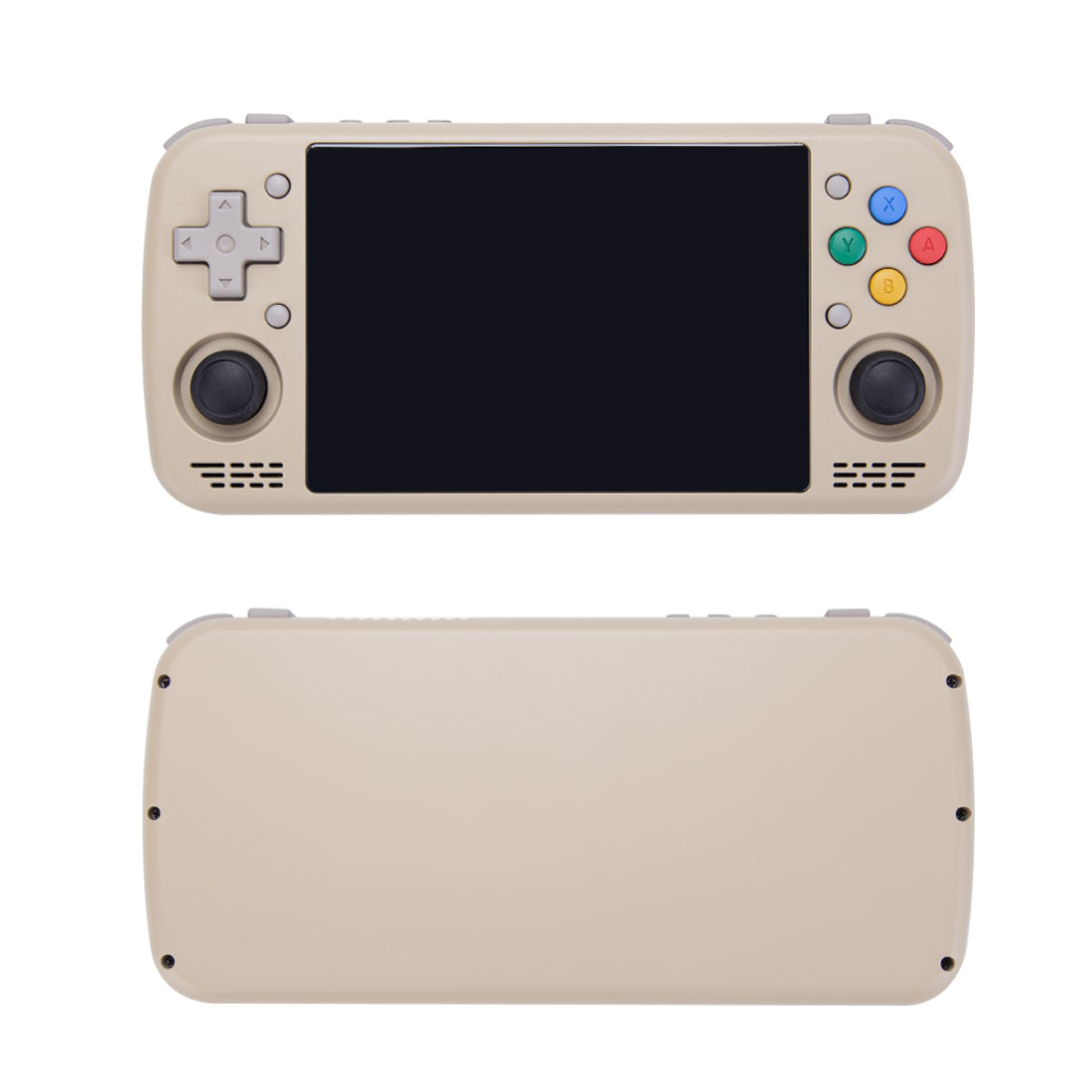
The KT Pocket KT-R1 is an Android gaming handheld from a small, relatively unknown brand that spent an unusually long stretch in “coming soon” limbo before finally reaching buyers. Early prototypes were floated with an Amlogic S922X chip; the production unit that actually shipped runs a MediaTek Helio G99 instead. It is built around a 4.5-inch, 1620 x 1080 IPS touchscreen with a 3:2 aspect ratio, runs Android 12 with the Google Play Store preinstalled, and arrives in multiple configurations: 4GB/64GB, 6GB/128GB, and 8GB/256GB, with plastic or metal shells and optional 4G. The chassis measures roughly 169.8 x 79.5 x 18.3 mm, putting it in the small-but-thick category that favors grip over pocketability.
The honest framing: this is a Helio G99 device, the same mid-range silicon found in dozens of better-distributed handhelds. Nothing about the SoC is exotic. What you are really paying for, and risking, is the KT Pocket brand wrapper around a known chip.
Emulation performance and what to expect
The Helio G99 is an octa-core chip (2x Cortex-A76 at 2.2 GHz, 6x Cortex-A55 at 2.0 GHz) with Mali-G57 MC2 graphics. That class of chip has a well-mapped emulation ceiling, and the KT-R1 lands exactly where the silicon predicts. Everything up to and including PSP and Nintendo 64 runs comfortably, with N64 even upscaling toward 1080p. GBA is a perfect native fit on the 3:2 panel, with no letterboxing. Dreamcast is solid at moderate upscaling. The trouble starts at GameCube, PS2, Saturn, and 3DS: marketing leans on PS2 and 3DS support, but in practice these are hit-or-miss, demand heavy per-game tweaking, turbo/overclock modes, and still surface frame drops and audio stutter. Treat the G99 as a strong PSP-and-below machine that can occasionally stretch into sixth-gen consoles, not a reliable PS2/GameCube box. Anyone buying it specifically for PS2 will likely be disappointed.
Screen, build and controls
The 4.5-inch 1080p panel is sharp and the 3:2 ratio is genuinely well-chosen for retro content. The notable weakness reported by reviewers is brightness: it is dim even at maximum, which hurts outdoor visibility, though it does include a useful “super dim” mode for night play. Build is a mixed bag. The main shell feels solid, and the front-firing stereo speakers are a real plus over handhelds that fire sound downward. But the shoulder triggers are flimsy, lacking a crisp click, the shoulder buttons can rattle, and the thumbsticks are small (functional, but short on travel). One genuinely interesting design choice is a configurable layout option that lets you position the D-pad above or below the left stick. Dual vibration motors and active cooling (fan plus heat sink) are present. Note that the triggers are digital, not analog. Battery is a 5,000 mAh cell rated for roughly six to ten hours depending on workload (some retailer listings claim larger cells and faster charging on higher trims, so capacity figures are inconsistent across sources, verify before buying).
Software and setup
It ships as a standard Android 12 device with Google Play preinstalled, which is the path of least resistance: install RetroArch or standalone emulators (DraStic, AetherSX2, Dolphin, PPSSPP) yourself and configure mapping and frontends to taste. There is no celebrated custom OS or curated software layer here, which means setup is on you, and that is where an obscure brand stings most. Expect minimal first-party documentation, uncertain firmware updates, and thin community know-how compared to Anbernic, Retroid, or AYN devices, where setup guides and forum support are abundant. Budget time for tinkering.
Price, value and who it’s for
Pricing has ranged from about $169 for the base WiFi 4GB/64GB plastic unit up to $279 for the 8GB/256GB trim, with retailer listings seen around $249. That is the core problem. At those prices the KT-R1 competes directly with extremely well-supported G99 and Snapdragon handhelds that do the same emulation, often better, with mature software and real warranty paths. Reviewers bluntly called it overpriced, with one summarizing it as “an overpriced PSP emulator,” and noted that the cheaper RAM variants perform about the same, so paying up buys little. The added risk of an obscure brand is concrete: limited after-sales support, scarce spare parts, uncertain updates, and patchy availability. It makes the most sense only for a buyer who specifically wants the 3:2 screen and the configurable layout, is comfortable self-managing Android emulation, can find it at the low end of its price range, and accepts the brand-risk going in. For everyone else, a mainstream G99 handheld is the safer pick. Caution: because sources on this device are thin and occasionally contradictory (battery size, exact pricing, configuration availability), confirm the current spec sheet directly with the seller before purchase.
📐 Size & Pocketability
⚖️ Weight vs Other Handhelds
🔋 Real-World Battery Estimator
⭐ Emulation Performance
📊 View How This Score is Calculated
The Hardware Power Score is an absolute metric. Perfect emulation of difficult, modern consoles awards significantly more points than standard retro consoles.
- 15× Multiplier: Modern PC
- 12× Multiplier: Switch, PS3, Xbox 360
- 10× Multiplier: Wii U
- 8× Multiplier: PS2, GameCube, Wii, Xbox
- 5× Multiplier: Saturn, Dreamcast, PSP
- 3× Multiplier: N64, PS1
- 1× Multiplier: SNES, GBA
Generation 7
Generation 6
Generation 5
Handhelds & Retro
⚡ Performance Benchmarks
Where KT Pocket KT-R1 Arm Mali-G57 MC2 lands against the handhelds everyone knows. Every bar shares one scale, so longer genuinely means faster — add up to two rivals to compare.
CPU = Geekbench 6 multi-core · GPU = 3DMark Wild Life. Median real-world scores; every bar shares one scale — add up to two rivals to compare.
📋 Full Specifications
📺 Display
⚙️ Platform
💾 Memory
🕹️ Controls
📏 Body
🔋 Battery
⚖️ Verdict
✅ The Good
- Sharp 4.5-inch 1620×1080 IPS panel with a 3:2 aspect ratio that fits GBA and retro content natively
- Strong, reliable performance for everything up to PSP and N64, with N64 upscaling toward 1080p
- Front-firing stereo speakers plus active cooling (fan and heat sink) and dual vibration motors
- Ships as open Android 12 with Google Play preinstalled, plus a configurable D-pad/stick layout
❌ The Bad
- Obscure brand with thin documentation, uncertain firmware updates, scarce parts, and frequent stock shortages
- Overpriced versus far better-supported Helio G99 handhelds that emulate the same systems
- PS2/GameCube/3DS support is unreliable and tweak-heavy; flimsy triggers and a dim screen outdoors
📰 Latest News & Guides
The Ultimate Guide to ARMSX3: Android’s New PS3 Emulator, Competitor Comparisons, and Setup Tutorial
18/08/2026Pokémon Gold, Silver, and Crystal (Gen 2) Recomp Lands on Android
17/08/2026How to Play the Pokémon Red, Blue, or Yellow Recomp on Your Android, Windows, and Linux Devices
16/08/2026🔍 Similar Handhelds
Other handhelds that emulate up to Wii.