
🛒 Where to Buy
⚠️ Golden Rule of Retro Handhelds: Throw away the cheap MicroSD card that comes in the box — it will fail. And never use a high-wattage PD “Fast Charger” on these devices; it can damage the battery. Use a standard 5V/1.5A brick.
Device Overview: Anbernic RG Vita
The Anbernic RG Vita is the cheaper of two Vita-styled handhelds Anbernic launched together, and it is built around the Unisoc Tiger T618 rather than the Rockchip RK3576 inside the RG Vita Pro. That single decision defines the whole device. The T618 is the same octa-core chip (2x Cortex-A75 plus 6x Cortex-A55, Mali-G52 MP2) that has powered Anbernic’s mid-range Android units for years, so the RG Vita is a known quantity wearing a new, wide chassis. It launched at $99.99 for the first 72 hours of pre-orders and settles at $109.99 retail.
The split between the two models is clean. The base RG Vita gets a 5.46-inch 720p screen, 3GB of RAM, Android 12, Wi-Fi 5, and Bluetooth 5.0. The Pro steps up to a 5.5-inch 1080p panel, 4GB of RAM, the faster RK3576, Android 14 with a Linux dual-boot option, Wi-Fi 6, and 18W charging, for roughly fifty dollars more. If you are comparing against the Retroid Pocket 4 Pro, the math is unforgiving: the RP4 Pro’s Dimensity 1100 is a meaningfully stronger chip that handles GameCube and PS2 far more consistently. The RG Vita’s pitch is not raw power. It is the widescreen Vita shape, dual Hall sticks, and a sub-$100 entry price.
Emulation performance, generation by generation
The T618 ceiling here is honest and well-mapped. Everything through the 32-bit era is effortless: NES, SNES, Genesis, Game Boy Advance, and PlayStation 1 run at full speed with no fuss, typically via RetroArch cores or standalones like DuckStation for PS1. PSP is the standout. On PPSSPP, games fill the 16:9 panel edge-to-edge and run cleanly, which is the single best argument for this form factor. Dreamcast (Flycast), Saturn, and Nintendo 64 are mostly solid, with the usual per-title edge cases that have always dogged those platforms on ARM hardware.
Above that line, expectations need managing. GameCube on Dolphin is selective: some titles hold 60fps, many do not, and you will be hunting per-game settings. PS2 on AetherSX2 or its NetherSX2 fork is light and selective at best. God of War 2 boots and is playable, but expect graphical glitches and stutter rather than a clean run. The 3GB of RAM, one gigabyte short of the Pro, is a real factor: it shows up as sluggishness in heavy front-ends like EmulationStation DE and leaves less headroom for the demanding emulators. Nintendo Switch and actual PS Vita emulation are off the table entirely. Treat the GameCube/PS2 tier as a bonus you tinker with, not a reason to buy.
Screen, build and controls
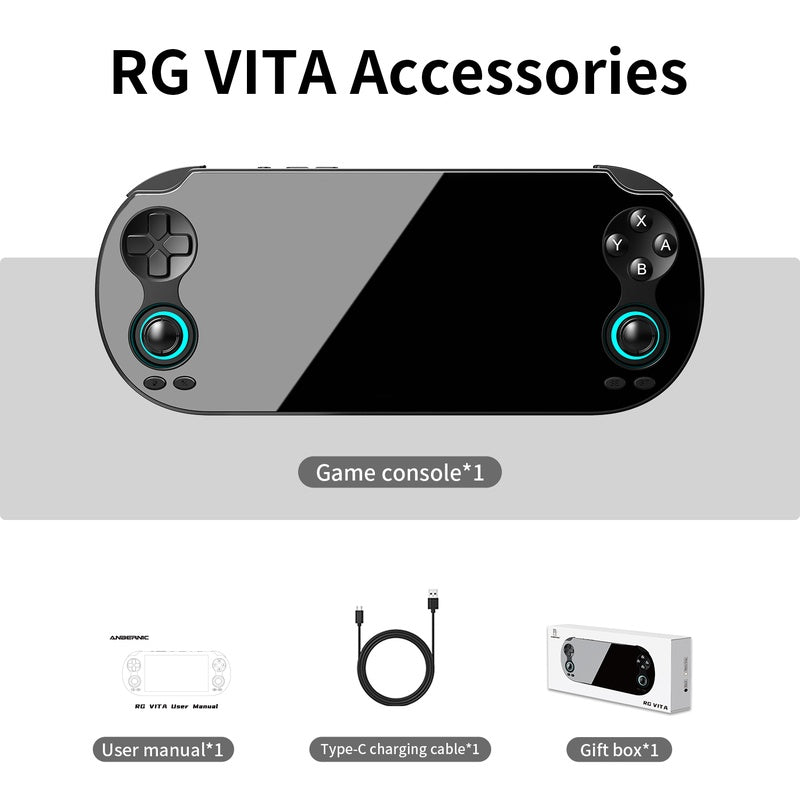
The widescreen 5.46-inch IPS INCELL touchscreen at 1280×720 is the defining feature. It is the wrong shape for 4:3 retro systems, which letterbox with black bars on the sides, but it is exactly right for PSP and for game streaming. The body measures 206 x 84 x 18.6mm and weighs 274 grams, giving it the long, flat Vita silhouette. Controls are the strong point: dual large-angle 3D Hall-effect analog sticks resist the stick drift that plagues potentiometer-based handhelds, with RGB ring lighting around them. There is a six-axis gyroscope for motion aiming, non-linear shoulder triggers, stereo speakers, and a 3.5mm jack. The 5000mAh battery is rated for around eight hours, which holds up for lighter systems and drops under PSP and heavier loads.
Software and setup
The base unit ships with Android 12 only, no Linux dual-boot (that is a Pro feature). You get the Google Play Store and full sideloading, so the standard routine applies: install your emulator front-end of choice, point it at a microSD card (expandable to 2TB), and configure per-system cores. Anbernic’s stock launcher is serviceable but most owners swap in a cleaner front-end. There is an active custom-firmware and tweaking community around the T618 platform, and because this exact chip has been in circulation for years, emulator compatibility profiles and per-game settings are already documented. Streaming via Steam Link and Moonlight works well at 720p/60, which suits the widescreen panel.
Price, value and who it’s for
At $99.99 to $109.99, the RG Vita is for the buyer who wants the Vita form factor specifically and whose library tops out at PSP and Dreamcast. It is a comfortable, drift-resistant PSP and PS1 machine with a screen shaped for the job, and the Hall sticks alone justify a chunk of the price. Be clear-eyed about one thing: the “Vita” name is styling, not capability. This handheld does not emulate the PlayStation Vita, and the T618 will never touch GameCube or PS2 reliably. If those generations matter to you, spend up on the RG Vita Pro or cross-shop the Retroid Pocket 4 Pro. If you want a cheap, well-built widescreen handheld for everything up through PSP, the base RG Vita earns its money.
📐 Size & Pocketability
⚖️ Weight vs Other Handhelds
🔋 Real-World Battery Estimator
⭐ Emulation Performance
📊 View How This Score is Calculated
The Hardware Power Score is an absolute metric. Perfect emulation of difficult, modern consoles awards significantly more points than standard retro consoles.
- 15× Multiplier: Modern PC
- 12× Multiplier: Switch, PS3, Xbox 360
- 10× Multiplier: Wii U
- 8× Multiplier: PS2, GameCube, Wii, Xbox
- 5× Multiplier: Saturn, Dreamcast, PSP
- 3× Multiplier: N64, PS1
- 1× Multiplier: SNES, GBA
Generation 7
Generation 6
Generation 5
Handhelds & Retro
⚡ Performance Benchmarks
Where Anbernic RG Vita Mali-G52 MP2 lands against the handhelds everyone knows. Every bar shares one scale, so longer genuinely means faster — add up to two rivals to compare.
CPU = Geekbench 6 multi-core · GPU = 3DMark Wild Life. Median real-world scores; every bar shares one scale — add up to two rivals to compare.
📋 Full Specifications
📺 Display
⚙️ Platform
💾 Memory
🕹️ Controls
📏 Body
🔋 Battery
⚖️ Verdict
✅ The Good
- Dual 3D Hall-effect analog sticks resist drift, with RGB ring lighting and a six-axis gyro
- Excellent PSP emulation on a 16:9 5.46-inch panel that fills the screen edge-to-edge
- Sub-$100 launch pricing ($99.99 early, $109.99 retail) undercuts most Android rivals
- Android 12 with Google Play and full sideloading, plus solid 720p Moonlight/Steam Link streaming
❌ The Bad
- 3GB of RAM (vs the Pro's 4GB) causes lag in heavy front-ends and limits demanding emulators
- GameCube is selective and PS2 is light-and-glitchy; no Switch or actual PS Vita emulation
- 720p screen and Android-only (no Linux dual-boot) make the Pro the better long-term buy for ~$50 more
📰 Latest News & Guides
The Ultimate Guide to ARMSX3: Android’s New PS3 Emulator, Competitor Comparisons, and Setup Tutorial
18/08/2026Pokémon Gold, Silver, and Crystal (Gen 2) Recomp Lands on Android
17/08/2026How to Play the Pokémon Red, Blue, or Yellow Recomp on Your Android, Windows, and Linux Devices
16/08/2026🔍 Similar Handhelds
Other handhelds that emulate up to Saturn.